
Cooling and air/UAE › Dubai
District cooling in Dubai: how it works and what the bill covers
Where the cold in your flat comes from, what each line on an Empower or Emicool bill means, who fixes the fan coil, and where to take a disputed bill.
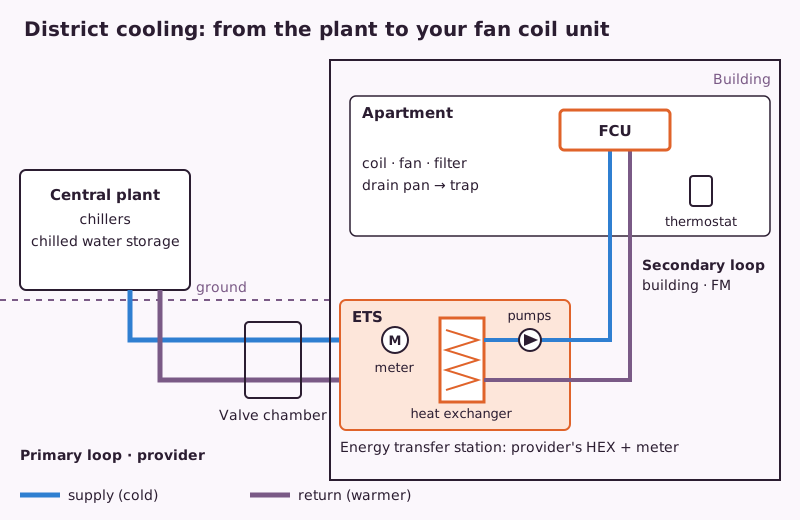
Many Dubai towers are on district cooling: the building does not make its own cold. A central plant chills water and pipes it under the streets to the building's energy transfer station, where it cools the building's own water, which runs up to a fan coil unit in each flat. In daily life you deal with two parties. The building's facilities management (FM) handles anything that goes wrong with cooling inside the flat. The provider, or its billing agent, sends you a bill with a fixed charge for capacity kept ready for your flat and a metered charge for the cooling you use.
#Too warm, or a bill that looks wrong
If the flat is not cooling:
- Check the thermostat. Cooling mode, a set point below the room temperature, the fan not switched off. Shut the balcony door and windows.
- Look at the return-air grille. A filter clogged with dust cuts the airflow. Clean it only if you can reach it and the building allows it; otherwise report it.
- Ask a neighbour or the building chat. If the whole building is warm, the fault is in the building's plant room or at the provider, and FM is already on it.
- Report to FM with the room, the set and actual temperature and a photo of the thermostat. Anything inside the flat is FM's job, and Emicool tells its customers to go to FM first.
If the bill looks wrong:
- Check the meter number on the bill against your flat.
- Separate the fixed lines from the metered ones (see what is on the bill). A large bill for an empty flat is usually the capacity charge, which runs whether or not anyone lives there.
- Write to the provider or billing agent named on the bill. Under Empower's published terms, an amount you dispute in writing within 14 days is not a reason to cut you off.
- Go to the RSB only if the provider does not resolve it.
#How the cold reaches your flat
From the plant to your room:
- Plant. Large chillers cool water. Most Tabreed plants also store chilled water in big tanks, made in advance so the plant uses less energy.
- Network. Insulated pipes under the streets, one taking water to the buildings, one bringing it back.
- Valve chamber. Where the network enters the building's plot, with the valves that can shut the building off.
- Energy transfer station. A plant room in the building. A plate heat exchanger passes the cold from the provider's water to the building's water, and the energy meter sits here too.
- The building's loop. Pumps, risers, valves and balancing valves that carry the building's water to every floor.
- Fan coil unit. The unit in your flat: a coil of chilled water, a fan, a filter, a tray for condensation, a valve and a thermostat. The fan pushes air through the cold coil and cool air comes out in the rooms.
Who owns and looks after each part:
| Part | Who is responsible |
|---|---|
| Plant, network, valve chamber | The provider |
| Heat exchanger in the transfer station | The provider or the building, as the connection agreement says |
| Transfer station room, power, drainage | The building |
| Pumps, risers and valves of the building's loop | Common property, run by the building's management entity through FM |
| Fan coil in the flat | Part of your unit, unless the plot documents say otherwise. In some buildings FM services them anyway, so check your building's rules |
A few things about how it works explain what you see day to day.
Two waters, one heat exchanger. The provider's water and the building's water never mix, which is why the building's loop has to be flushed and its water tested before the provider lets it through the heat exchanger. The valve on your fan coil opens and closes as the thermostat asks, so the flow through the building changes all day.
The temperature difference matters. The provider and the building agree how cold the water arrives and how warm it should go back. If it goes back not warm enough, more water has to be pumped for the same cooling. That problem is called "low Delta T", and the Supreme Council of Energy can approve a surcharge for it.
How the meter counts. It measures how much water passed and how much it warmed up in the building, and turns that into ton-hours. A refrigeration ton is 12,000 Btu per hour, about 3.517 kW of cooling. A ton-hour is about 3.5 kWh of heat taken out of your flat.
Where the fan coil sits. In buildings designed to the 2021 Dubai Building Code, apartment fan coils go in a wet area, the bathroom or kitchen, usually above the false ceiling, so a leak does less damage. Ducts take the air to grilles in the rooms, and it comes back through a filter grille. Condensation from the coil runs into a tray and through a trap into the building's drains. If it drips, see why an air conditioner leaks water.
#Who supplies the cold
The Dubai Building Code names Emaar District Cooling, Tabreed, Empower and Emicool as providers in Dubai, and says the list is not complete. Your provider depends on where the building is and its connection agreement. You do not choose it. Some buildings and communities bill through a separate billing agent, which needs the RSB's authorisation to bill for a provider, and its charges need approval too.
#What is on the bill
Dubai's district cooling rules say tariffs are based on cooling capacity, cooling energy or another basis the RSB approves, and every charge needs the Supreme Council of Energy's approval. The bill must show, in dirhams, your contracted capacity and its rate, your consumption and its rate, and any billing service charges. A provider may not charge anything that has not been approved.
Here is what the lines mean, using Emicool's published definitions. Other providers use a similar structure; the amounts are in your own contract.
| Line | What it is | Changes with use? |
|---|---|---|
| Capacity charge (demand charge) | Yearly AED rate per refrigeration ton × the capacity contracted for your flat, split into 12 monthly payments. The capacity is approved by the building owner's consultant and authorised by Dubai Municipality | No. You pay it even if the flat is empty or the fan coil is off |
| Consumption charge | AED per ton-hour from your meter | Yes |
| Fuel surcharge (DEWA surcharge) | The electricity cost of making chilled water, passed on monthly, based on DEWA's monthly tariff | Yes, it changes month to month |
| Metering charge | A fixed monthly fee for meter upkeep, data and e-billing | No |
| VAT | As shown on the invoice | — |
One-off charges when you move in (Emicool, read 31 October 2026):
- Security deposit. Refundable, equal to 8 months of your flat's capacity charge.
- Activation fee. AED 200, once, when billing starts in your name.
- Connection charge. Once, when the unit is first connected to district cooling.
Emicool sends invoices on the 1st of the month, due within 15 days, with a late fee of AED 100. If a meter fails, it may estimate your use from the same month last year, or the month before, for up to two bills. Empower's published Conditions of Service, the 2009 revision, correct the bill when a tested meter is more than 3 % out either way, allow service to be suspended 30 days after an unpaid bill falls due, and do not cut you off over an amount you dispute in writing within 14 days. Check the terms in your own agreement, because providers revise them.
We do not quote rates per ton or per ton-hour. They differ by provider and project, and we found no official, dated tariff table published by every provider. Your contract and first invoice show the real figures.
#Who does what
| Job | Tenant | Flat owner | Building FM | Provider |
|---|---|---|---|---|
| Set the thermostat, keep doors and windows shut | ✓ | |||
| Clean the return-air filter, or report it dirty | ✓ if you can reach it and it is allowed | often ✓ | ||
| Fan coil service: coil, tray, trap, valve, motor | pays, unless the building contract covers it | ✓ usually does it | ||
| Building pumps, risers, water treatment, balancing | through service charges | ✓ | ||
| Transfer station heat exchanger and everything before it | gives access | ✓ | ||
| Valves on the building's cooling connection | ✓ only | |||
| Meter readings and accuracy | can ask for a test | can ask for a test | ✓ | |
| Account, deposit, bills | ✓ if the account is in the tenant's name | ✓ otherwise | ✓ or billing agent |
Emicool says it directly: for any cooling problem in your flat, go to the building's FM first. Bills go to the provider.
#What people usually ask
- High consumption although we are hardly home. Check that the fan coil is not running with the balcony door open, that the thermostat is not set far below room temperature on high fan, and that the meter number on the bill is yours. Then you can ask the provider in writing to test the meter. Under Empower's terms you pay for the test unless the meter over-reads by at least 3 %, and a meter more than 3 % out either way means the bill is corrected.
- Can the landlord pass the cooling bill to the tenant? That is up to the tenancy contract. "Chiller free" in a listing has no legal definition; read the clause.
- Can I put in a split air conditioner instead? Not without approval from the building and the authorities, because the facade, the structure and condensate drainage are all involved. A separate guide will cover split units in district-cooled flats.
- Moving out. Close the account with the provider so the deposit is refunded against the final bill.
#Summer outages and maintenance
The provider may cut or reduce supply for planned work. Empower's terms promise best efforts to warn affected customers at least 48 hours ahead and to pick the least disruptive time. Ask FM how those notices reach residents in your building. A whole-building loss of cooling can also come from the building's own pumps, controls or power, and that is FM's side, not the provider's.
During an outage, keep doors, windows and blinds shut. Switch the fan coil off or to fan only: a fan over a warm coil moves air but does not cool it. When supply comes back, give the building's loop time to cool down before reporting a fault.
#What goes wrong
- Signing a lease without reading the cooling clause. The capacity charge runs every month, and a vague clause can leave the tenant paying for months nobody lived there.
- Forgetting the deposit when moving out. An account left open keeps collecting capacity charges.
- A renovation that blocks the fan coil. The Dubai code requires HVAC equipment to be reachable for service. A sealed ceiling turns a filter change into a ceiling repair.
- Moving or boxing in a fan coil without a design check. Airflow drops, the water goes back not warm enough, and both your comfort and the building's Delta T suffer.
- Running the fan coil flat out with the doors open. Humid outside air condenses on the coil, the tray overflows and consumption goes up.
- Disputing a bill too late. Under Empower's published terms, protection from disconnection depends on written notice within 14 days.
#How to check
When you move in or after a renovation:
- You know the provider and any billing agent; the account is in the right name; you kept the deposit receipt.
- The meter number on the first bill matches your flat, and you noted the opening reading.
- The tenancy contract says who pays capacity, consumption and surcharges.
- The fan coil access panel opens, you can reach the filter, and you can see the condensate tray.
- The thermostat brings each room to the set temperature in reasonable time.
- No water marks on the ceiling under the fan coil or along the chilled water pipes.
- FM's contact and the provider's customer service number are saved in your phone.
#Who to call
- FM for anything inside the flat: no cooling in one room, noise, smell, leaks, thermostat faults, filter and coil cleaning.
- The provider or billing agent for bills, deposits, meter readings and tests, and account changes.
- An MEP engineer approved by the building before any renovation that moves fan coils, ducts, grilles or ceilings. The management entity and FM will usually want drawings.
- The RSB if the provider does not resolve your complaint. It regulates the providers and tries to settle disputes amicably.
Never open or close valves on the building's district cooling connection. Under Empower's terms only its own staff may touch them, except in an emergency.
If a renovation will touch fan coils, ducts or ceilings, start from a plan of the flat. Librae draws it from a floor plan, a tape or an iPhone scan, and you confirm the dimensions. A contractor can propose moving a grille or a duct but cannot edit the plan, so any change around the AC goes through your approval rather than being decided on site.
#What the codes say
For readers who want the original documents. Exact clauses are in the source list below.
- Dubai Building Code 2021. The list of providers (Ref. G.9); the transfer station, primary and secondary sides, 5–100 % flow, balancing, flushing and water testing before connection (G.10.2–G.10.3); fan coils in wet areas of apartment buildings (H.4.3); access to equipment (H.4.4); isolation valves on chilled water (H.4.13).
- Executive Council Resolution No. 6 of 2021. The RSB regulates the sector and settles disputes (Art. 4); providers handle complaints first (Art. 9); what a bill must show and how tariffs are set (Art. 11); all charges approved by the Supreme Council of Energy, including the low Delta T surcharge, and nothing else may be charged (Art. 12).
- Law No. 6 of 2019 on jointly owned property. The building's cooling system is common property (Art. 7); equipment serving only one flat is part of that flat (Art. 9); owners associations replaced by management entities (Art. 49).
- Empower Conditions of Service, 2009 revision. Who maintains the building side, who may touch the valves, notice of works, meter tests, payment and suspension. Check with Empower whether they still apply to flats in the same form.
This guide explains good practice and cites the documents listed below. It is not a permit, a design approval or an engineering opinion. Work on electrical, gas, fire-safety and structural elements must be carried out by licensed professionals and approved by the relevant authority.
Sources
- Dubai Building Code 2021, Part G, sections G.3.4 and G.10 (district cooling) — Named providers (Ref. G.9, PDF p. 416); ETS with provider heat exchangers, primary and secondary sides, valve chamber, energy metering, variable-flow secondary, flushing and water testing before connection (G.10.2–G.10.3, PDF pp. 505–506).
- Dubai Building Code 2021, Part H, H.4.3, H.4.4 and H.4.13 — FCUs in apartment buildings located in wet areas to limit leak damage (H.4.3, PDF p. 565); HVAC equipment accessible for service (H.4.4, PDF p. 566); chilled water systems with isolation valves (H.4.13, PDF p. 582).
- Executive Council Resolution No. (6) of 2021 Regulating the Provision of District Cooling Services in the Emirate of Dubai — RSB as regulator and amicable settlement of disputes (Art. 4(a)(8)), complaints handled by permit holders (Art. 9(6)), tariff bases and bill contents (Art. 11), charges approved by the Supreme Council of Energy incl. low Delta T surcharge, and the ban on other charges (Art. 12).
- Emicool, Frequently Asked Questions (read 31 October 2026) — Capacity charge, consumption charge per RTh, DEWA fuel surcharge, metering charge, deposit of 8 months' capacity charge, AED 200 activation fee, connection charge, invoice timing and AED 100 late fee, estimated readings, FM first for cooling issues.
- Empower, Conditions of Service (DCS), revision 02-04 effective 1 April 2009 — Building owner maintains building facilities (7.1, 7.3); only Empower operates connection valves except in an emergency (8.3); 48-hour notice for scheduled maintenance (9.2); metering by flow and temperature difference, ±3 % test tolerance and who pays for a requested test (10.1.2, 10.5.2–10.5.3); billing and suspension terms (11–12).
- Law No. (6) of 2019 Concerning Ownership of Jointly Owned Real Property in the Emirate of Dubai, Art. 7, 9, 49 — Building cooling systems and equipment are common parts (Art. 7(a)(4)); equipment serving only the unit is part of the unit (Art. 9(a)(4)); owners associations replaced by management entities (Art. 49).
- Tabreed, Sustainability and ESG — Thermal energy storage (chilled water tanks) used in the majority of Tabreed plants.