
Cooling and air/UAE
AC leaking water from the ceiling: fan coil drain problems in the UAE
Why a fan coil or split AC drips in UAE homes, what to do in the first minutes, what you can check yourself, what FM should fix, and how to save the ceiling.
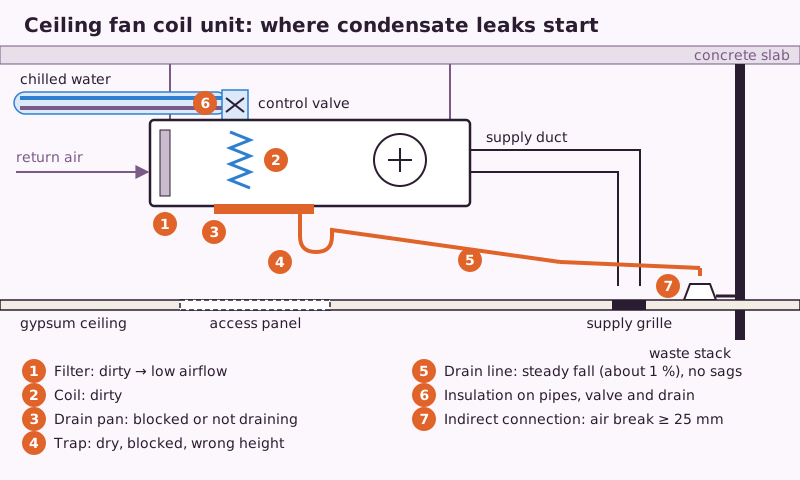
An air conditioner leaks when the water it pulls out of the room air does not reach the drain. In a district-cooled tower the unit is a chilled-water fan coil above the false ceiling; elsewhere it may be a split unit. Either way, the first suspect is a tray, trap or drain pipe clogged with dust and slime. Then come dirty filters, torn insulation on cold pipes and valves, units or drains knocked during a renovation, and humid air getting into the room. Switch the unit off, protect the ceiling, check the few things listed below, and leave the drain, trap and valves to the building's FM or an AC technician.
#The first 10 minutes
- Switch the AC off at the thermostat. If water is running near lights, sockets or the unit's electrics, also switch off the lighting or AC circuit at the distribution board.
- Catch the water. A bucket and towels. Move furniture and electronics out of the way. Open the ceiling hatch only if you can do it without standing in water.
- Watch for about half an hour with the unit off. If the dripping slows and stops, it was condensation. On a chilled-water fan coil, water that keeps coming at the same rate means a leaking pipe, valve or fitting, a control valve stuck open that keeps the coil sweating, or water from the flat above. Call FM straight away. On a split unit, an iced-up coil can keep dripping while the ice melts; that is still a condensation problem.
- Take photos of the leak, the stain and any damage, with the time showing.
- Call FM. In a district-cooled building, go to FM first, not the cooling provider; Emicool says the same. See how district cooling works in Dubai. If you rent, tell the landlord in writing as well. In a villa or a building without FM, call your AC maintenance company.
#What you can check yourself
None of this needs tools or opening the unit.
- The filter. If the return-air grille opens by hand, take the filter out and look. Daikin's fan coil manual says to clean it at least every 2 weeks, more often if needed, with a vacuum or with lukewarm water under 40 °C and a mild detergent, and to let it dry before putting it back. Your building may do this as part of FM service, so ask.
- Doors, windows and the set point. Close the balcony door. If grilles are wet, Daikin advises raising the set temperature and running the fan on high, rather than a low set point on a slow fan.
- Where exactly it drips. Under the unit (tray, pump, level: causes 3, 8, 11 below), along a pipe (insulation, valve), at a supply grille (humid air, grille fit), or at a shaft or riser (the building's drain). Tell FM which.
- Does it stop when the unit is off? See the first-10-minutes rule above.
- Smell or gurgling from the drain or a nearby floor gully points to the trap.
- Recent work. Ceiling, lighting, plumbing or painting work in the last few weeks is a strong clue. Drains get pushed, insulation gets cut, grilles go back loose.
Do not pour chemicals into the tray, cut into insulation or take valve covers off. Do not touch the valves on the chilled water pipes.
#Why it leaks
| # | Cause | Signs | Unit type |
|---|---|---|---|
| 1 | Dirty return-air filter | Weak airflow and cooling; on split units ice on the coil, then a gush of water after switch-off | All |
| 2 | Dirty coil | Weak airflow; on split units the coil can ice up | All |
| 3 | Blocked drain tray | Water drips from the unit casing or the grille under it; slime in the tray | All |
| 4 | Trap blocked, dry or the wrong height | Gurgling, water backing up in the tray, smell from the drain | Ducted fan coils and air handlers |
| 5 | Drain pipe with no fall, sagging or rising after a renovation | The leak started after ceiling or plumbing work; water sits in the pipe | All with gravity drains |
| 6 | Torn or missing insulation on chilled water pipes, valves or the drain | Drips along a pipe away from the unit; stains following the pipe | Chilled-water fan coils |
| 7 | Bad connection to the building drain (no air break, flattened flexible hose, blocked tundish or floor gully) | Leak at the riser or shaft; a gully overflowing | All |
| 8 | Unit not level | Water at the low corner | All |
| 9 | Chilled water still flowing with the fan off (valve stuck open) | Coil and pipes sweat even when the room is not cooling; tray overflows | Chilled-water fan coils |
| 10 | Very humid air coming in (doors and windows open, very low set point) | Water on grilles and diffusers, dripping from the supply grilles | All |
| 11 | Condensate pump failed (cassettes and units with pumps) | Tray full, pump error on the display; Daikin's FWC cassette shows E6 | Units with pumps |
| 12 | Tray cracked or corroded | Still leaks after cleaning | Older units |
What the makers' manuals add:
- Level the unit, not the tray. Daikin Applied's fault table for concealed fan coils lists, under water leaks, a blocked tray, a unit not hung level, chilled water still flowing after the fan stops, hot humid air getting in, a loose valve and leaking unit pipework. The tray is made with a fall to its outlet, so it is the unit that must hang level.
- Fall and trap. Daikin wants the drain to run downhill all the way, with no ups and downs. Daikin Applied suggests at least 1/8 inch per foot, about 1 %, unless local rules say otherwise. The water in the trap stops air being sucked up the drain into the unit: too tall a trap backs water up, too short a trap loses its seal, and a new trap may need filling by hand at start-up.
- Insulation and panels. Daikin requires polyethylene foam thicker than 8 mm on the drain and insulation on every chilled water pipe and joint, because anything colder than the room's dew point collects water. A front panel not fixed tight leaks cold air, which condenses and drips.
- Ice is a split-unit problem. Trane names poor airflow from dirty filters, blocked returns or a dirty coil as the biggest reason a coil freezes, with low refrigerant and thermostat faults also on its list; switch off and do not chip at the ice. Carrier notes that the melting ice can overflow the tray, and that a coil which keeps freezing after the filter is cleaned may have a refrigerant leak. A chilled-water fan coil runs on water above freezing and does not ice up in normal use.
#What FM or the technician should do
Ask for these steps and a short report afterwards:
- Isolate the power to the fan coil and open the access panel.
- Clean the tray and the drain pipe. Flush until clear and get the slime out of the tray outlet.
- Check the trap. Clear it, make sure it holds water, refill it if dry, and check its height suits the unit.
- Pour water into the tray and watch it drain all the way to the building connection. Daikin's installation and test-run procedures include exactly this test. For units with a pump, check the pump starts and the float switch works.
- Check the fall along the whole drain. Re-hang sagging sections and get rid of any rise.
- Check the connection to the building drain. In Dubai, condensation must drain indirectly, into a deep-seal trapped tundish or onto a floor gully, with an air break of at least 25 mm. Flexible polyethylene pipe is not allowed for it.
- Inspect the insulation on chilled water pipes, valves, strainers and the drain. Replace torn or wet sections and seal the joints.
- Check the control valve closes when there is no demand, and that the coil does not sweat with the fan off.
- Check the unit is level and the panels and grilles are fixed tight.
- Clean the coil and filter, and look for cracks or rust in the tray.
#Keeping it from happening again
| Job | How often | Who |
|---|---|---|
| Clean the return-air filter | At least every 2 weeks (Daikin cassette manual); check at least monthly (Daikin Applied) | You or FM, depending on the building |
| Inspect and clean the drain tray, check it drains | Monthly (Daikin Applied) | FM or technician |
| Check the coil, clean when needed | Monthly check (Daikin Applied) | FM or technician |
| Drain test with water | After any ceiling, lighting or plumbing work near the unit | The contractor, with FM watching |
| Keep trays clean, drains flowing, cold pipes insulated | All the time (US EPA) | FM |
| Keep indoor humidity under 60 % | All the time (US EPA) | You: doors shut, AC used sensibly |
#Saving the ceiling
A leaking fan coil usually sits above a plasterboard false ceiling, and the longer the water stays, the more damage it does.
- Dry it within 24–48 hours. The US EPA advises drying wet materials within that time to stop mould. Open the access panel and run fans. Do not close up a wet ceiling.
- Replace failed board, don't paint it. Board that sags, crumbles or stays soft after drying is cut out and replaced. A stain on board that stayed firm and dried quickly can be sealed with a stain-blocking primer and repainted.
- Mouldy board goes. The EPA says porous materials such as ceiling tiles may have to be thrown away once mouldy. It treats about 10 sq ft (roughly 1 m²) as the most you should clean up yourself. For more than that it points to its remediation guidance, and if you hire someone, choose a contractor with mould experience.
- Keep the access panel. The Dubai Building Code requires AC equipment to be reachable for inspection, service and replacement without removing permanent construction. Close the ceiling under the fan coil in a renovation, and the next blocked drain means demolishing the ceiling. The code also puts apartment fan coils in wet areas so leaks do less damage, so keep it that way if you replan rooms.
Once the leak is fixed and the void is dry, price the ceiling repair properly. Mark the damaged area on the flat's plan in Librae and the ceiling area comes from it. Put the hatch under the fan coil on the same plan, so it is in the version issued "For works" and not left to the day of the repair.
#What goes wrong
- Fixing the stain, not the drain. Repaint before the drain is fixed and the stain is back next month.
- Renovating round a working drain. A new ceiling, light fittings or a magnetic track pushed the drain pipe up and the fall is gone. For planning lights around fan coils, see magnetic track lighting.
- Insulation cut for a light fitting. A short bare bit of chilled water pipe or valve drips onto the new ceiling.
- A flexible hose to the drain. It kinks and sags, and the Dubai code bans flexible polyethylene pipe for AC condensation.
- Drain plumbed straight into a waste pipe. No air break, so smells and backflow into the tray.
- Grilles put back loose after painting. Cold air escapes round the edges and condenses.
- AC on with the balcony door open. Humid air overloads the coil and the drain.
#How to check the repair
- Water poured into the tray drains completely and quickly; nothing is left standing.
- The drain pipe falls all the way, with no sag or rise, and is supported along its length.
- The trap holds water; no gurgling.
- The drain meets the building drain indirectly, with a visible air gap or a trapped tundish or gully.
- Chilled water pipes, valves and the drain are fully insulated with sealed joints, and dry on the outside.
- The unit is level; the panel and grilles are tight.
- After a few hours of normal cooling, the ceiling and grilles are dry.
- A wet ceiling was dried within 48 hours; soft or sagging board was replaced.
- The access panel still opens.
#When to call a professional
- FM, straight away: water keeps coming with the unit off; water near electrics or lights; the ceiling is bulging.
- FM or an AC technician: anything inside the unit, including the tray, trap, drain pipe, pump, valve, insulation and coil cleaning.
- A refrigeration technician: a split unit whose coil keeps freezing after the filter is cleaned. Carrier says this may be a refrigerant leak, which a professional has to find, repair and recharge.
- A drywall contractor: replacing water-damaged board once the leak is fixed and the void is dry.
- The building's management, through FM: leaks from risers, shafts, shared drains or the flat above, and before any renovation that moves fan coils, drains or ceilings.
#What the codes say
For readers who want the original clauses.
- Dubai Building Code 2021, Part H: fan coils in apartment buildings installed in wet areas to limit leak damage, H.4.3; equipment reachable for service without removing permanent construction, H.4.4; condensation collected with a properly sized trap and an air break of at least 25 mm, H.5.2.3; indirect discharge into a deep-seal trapped tundish or onto a floor gully, and no flexible polyethylene pipe for condensation, H.6.2.3; 75 mm floor drain seals kept topped up by AC condensation, H.6.2.4.
- Daikin FWC-AT installation manual and Daikin Applied IM 745-3: drain fall and insulation, trap design, drain test, cleaning intervals, fault tables.
- US EPA, A Brief Guide to Mold, Moisture and Your Home: drying within 24–48 hours, humidity under 60 %, the 10 sq ft limit for cleaning up mould yourself.
This guide explains good practice and cites the documents listed below. It is not a permit, a design approval or an engineering opinion. Work on electrical, gas, fire-safety and structural elements must be carried out by licensed professionals and approved by the relevant authority.
Sources
- Dubai Building Code 2021, Part H — H.4.3, H.4.4, H.5.2.3, H.6.2.3, H.6.2.4 — FCUs in residential apartment buildings installed in wet areas to reduce leak damage (PDF p. 565); access for inspection, service and replacement without removing permanent construction (p. 566); condensate collection, trap and 25 mm air break (p. 591); indirect connection via deep-sealed trapped tundish or floor gully, no flexible polyethylene condensate pipe (p. 608); 75 mm floor drain seals kept primed by condensate (pp. 608–609).
- Daikin, FWC-AT fan coil unit installation manual — Drain in downward gradient without up-and-down runs, polyethylene foam drain insulation over 8 mm, insulation of all chilled water piping, drain test, horizontal installation, panel air leakage causing dripping, filter cleaning at least every 2 weeks, E6 pump error, troubleshooting (pp. 4–5, 8).
- Daikin Applied, IM 745-3 Ceiling concealed fan-coil unit, installation and maintenance (October 2018) — Do not level the drain pan; drain slope at least 1/8 in per ft; trap design and priming; monthly pan and filter checks; water-leak troubleshooting (pp. 3–4, 9–10).
- Trane, What to do if the AC evaporator coil is frozen — Restricted airflow (dirty filter, blocked returns, dirty coil) as the main cause; switch off, do not chip ice.
- Carrier, Mini split leaking water — Ice on the coil melting and overflowing the drain pan; dirty filter and low refrigerant as causes of freezing; repeated freezing after a filter clean may mean a refrigerant leak for a professional.
- US EPA, A Brief Guide to Mold, Moisture and Your Home — Dry within 24–48 hours; porous materials such as ceiling tiles may have to be thrown away if mouldy; keep drip pans clean and drains flowing; insulate cold pipes; indoor humidity below 60 %; about 10 sq ft as the limit for doing the cleanup yourself.
- Emicool, Frequently Asked Questions (read 31 October 2026) — For cooling problems in the unit, contact the building's facilities management first.