
Electrical and lighting/Global · UAE
48V magnetic track lighting: track types, drivers and dimming
How a 48 V magnetic track works, which track suits which ceiling, how to size and place the drivers, and what to settle before the ceiling is closed.
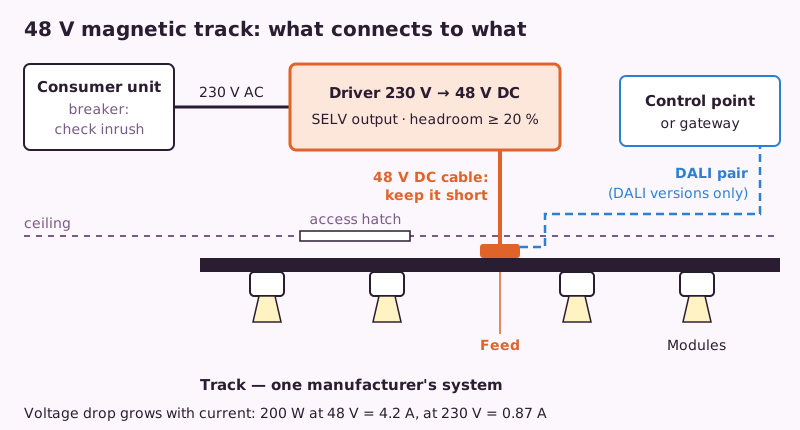
A magnetic track is a slim aluminium profile with 48 V DC conductors inside. The lights cling to it with magnets, take power from those conductors and can be moved by hand. The track powers nothing by itself. It needs a driver that turns 230 V into 48 V, sized with spare capacity, and a short cable from that driver so the voltage does not sag. If you want to dim, the track version and the control system have to be chosen before the ceiling is boarded. And every brand is a closed system: choose the maker and you have chosen every light you will ever hang on it.
#What to settle before the ceiling is boarded
Most of a track system is cheap to change until the plasterboard goes up and expensive afterwards. Agree these with your contractor at the design stage; each point is explained further down.
- One brand for the flat. Tracks, modules and drivers work only within one maker's system.
- Track type for each run. A recessed track has to be fixed to the ceiling frame before boarding; a surface track can go on a finished ceiling later.
- Lights and total wattage per run. Roughly how many spots and linear modules, plus 20 % spare, plus any you may add later.
- A place for every driver: reachable through a hatch, close to the track feed, and no hotter than the driver is rated for.
- Dimming or not. DALI, Casambi or plain on/off decides the track version, the feed and the driver, and whether a control cable runs to the wall.
- What else is in the ceiling. Fan coils, ducts, drains and sprinkler pipes go on the same drawing as the track runs.
- Driver data for the electrician: wattage and switch-on current, so the circuit and breaker can be planned.
Draw the track runs, driver positions and hatches on the ceiling plan. In Librae the ceiling plan and its 3D view come from one project, and once agreed the plan is issued "For works" with a number, so where the profile goes is settled before anyone cuts the ceiling.
#What the system is made of
- Driver. Turns 230 V AC into a steady 48 V DC with a SELV output. Check the wattage, that the output is SELV, the rated ambient temperature, the dimming method and the switch-on current.
- Feed. Connects the driver to the track, and on DALI versions the control pair too. Check where along the run it goes and the maximum load and length per feed.
- Track. The profile with the conductors. Surface, suspended, recessed or low-profile; check whether a DALI version exists.
- Connectors. Straight, corner, T and X joints and end caps. Some carry power, some only hold the pieces together.
- Modules. Spots, zoom spots, linear diffused lights. Only from the same system; count their system wattage.
Why 48 V. Extra-low voltage normally means no more than 50 V AC or 120 V smooth DC, as the Dubai Building Code defines it. Under the British wiring rules, BS 7671, a SELV circuit of no more than 25 V AC or 60 V smooth DC in a normal dry room generally does not need protection against touching live parts. That is what allows open conductors in the track slot. It holds only if the driver really gives a SELV output and the room is dry. The SLV and Maytoni tracks are IP20, not for showers or wet zones. Makers add their own limits: Maytoni says not to fit its track below 2.5 m or where people can touch it by accident, and only indoors at 0–50 °C and no more than 80 % humidity.
#Which track for which ceiling
| Type | How it is fixed | Size and notes | Best for |
|---|---|---|---|
| Surface | Screwed or clipped to a finished ceiling or wall | SLV surface profile 23 mm high, 26 mm wide | Bare concrete ceilings, adding lights without a new ceiling |
| Suspended | Surface track hung on wires or rods with a powered suspension feed | Driver in a ceiling box or in the cable; SLV's 250 W driver comes with 3 m of cable for this | High ceilings, over tables and islands |
| Recessed (plaster-in, trimless) | Fixed into the ceiling frame, boarded up to its edges and filled flush | SLV recessed profile 33 mm deep, 46 mm wide; Maytoni's goes in one or two layers of 12 mm board; Arkoslight's trimless track only in 12.5 mm board | New plasterboard ceilings and bulkheads |
| Deep or low-profile | Deep profiles hide the module adapter; low ones save height | SLV deep profile 47 mm | Deep: cleaner look, room for parts inside; low: low rooms |
A recessed track gives the cleanest result and forgives the least, because the profile becomes part of the ceiling. Maytoni prefers two layers of 12 mm board because the result is more rigid. Arkoslight requires 12.5 mm plasterboard for its trimless track and sells a plaster guard for fitting. The ceiling build itself, frame spacing, board layers, the space needed above the profile and the driver, will be covered in a separate guide on recessing a magnetic track.
#Which lights you can hang
From the LED2 and Arkoslight catalogues:
- Spots with fixed beams (LED2 lists 30°, 36°, 45° and 60°) or zoom optics (15–60°), 6–20 W.
- Low-glare spots marked UGR < 19 in some ranges (LED2).
- Linear diffused modules for general light. Arkoslight's Line 48V uses 10.5 W at the LEDs and 11.64 W as a system, 1,500 lm.
- Indirect up-light in some systems; Arkoslight sells a track with built-in indirect light.
Pick the modules first, then the track. Low-profile and trimless versions often take fewer modules, and some accessories are excluded outright: Arkoslight's Casambi in-track module does not fit its trimless track.
#Sizing the driver
- Add up the system wattage, not the LED wattage. The data sheet's system power includes the module's own electronics (11.64 W against 10.5 W in the Arkoslight example).
- Add 20 %. Maytoni requires a reserve of at least 20 % of the lights' total consumption so the driver does not overheat. In practice, the most you can hang ≈ driver rating ÷ 1.2.
| Driver | Most module load with 20 % spare | 10 W spots |
|---|---|---|
| 100 W | 83 W | 8 |
| 150 W | 125 W | 12 |
| 200 W | 167 W | 16 |
| 250 W | 208 W | 20 |
- Stay within the per-feed limits. Maytoni allows up to 400 W and 20 m of track from one feed; beyond that, a new section with its own feed. Other systems publish their own figures. Use the ones for your system.
- Think about later. Tracks often get extra spots. If you expect to add some, size the driver for them now. Swapping a driver behind a filled ceiling is the expensive part.
- Check the breaker. LED drivers draw a short surge at switch-on. SLV's 250 W in-track driver pulls 80 A for 200 µs, and no more than 12 of them should share a B16 breaker, or 19 a C16. Your electrician needs these numbers to plan the circuit.
#Where the driver goes, and why cable length matters
At 48 V the current is high for the power: 200 W ÷ 48 V = 4.17 A, almost five times the 0.87 A the same load draws at 230 V. The voltage lost in a cable rises with the current, so a long 48 V cable is the usual reason the spots at the far end are dim, uneven or flicker.
Example: 200 W of lights, driver 10 m from the feed, so 20 m of wire there and back. Wire resistance from IEC 60228:
| Cable on the 48 V side | Loop resistance | Voltage lost | % of 48 V |
|---|---|---|---|
| 1.5 mm² copper, solid or stranded (12.1 Ω/km) | 0.242 Ω | 1.0 V | 2.1 % |
| 0.75 mm² flexible (26.0 Ω/km) | 0.52 Ω | 2.2 V | 4.5 % |
| Same 200 W at 230 V on 1.5 mm² | 0.242 Ω | 0.21 V | 0.09 % |
Those resistances are at 20 °C; a warm cable in a hot ceiling does worse. Makers set their own limits. Arkoslight publishes a table linking cable size (0.75 or 1.5 mm²), load and length for remote drivers. Follow your system's table rather than a general rule.
What follows from this:
- Keep the 48 V cable short. Put the driver near the feed and run 230 V to the driver instead; mains cable loses far less.
- For long or heavy runs, split them into sections, each with its own feed and driver, rather than one big driver at one end.
- Feed a long run from the middle if the system allows. Maytoni's feed can go in any section of the track.
Where the driver can live:
| Place | Good | Watch for |
|---|---|---|
| Inside the track | No separate box, short 48 V path | Only some systems offer it; uses up track length; check depth and access |
| Ceiling void above a hatch | The usual answer, easy to replace | Maytoni requires an inspection hatch for the driver |
| Cupboard or bulkhead void (top of a wardrobe, kitchen bulkhead) | Easy to reach, cooler than a roof space | Cable length to the feed; ventilation |
Compare the driver's rated temperature with the space it sits in. SLV's own drivers are rated for 35 °C (200 W Casambi-to-DALI), 40 °C (250 W in-track) and 45 °C (60 W). A ceiling void under a roof or beside sunny glass can be hotter than the room below.
#Dimming and control
Dimming is built into the hardware: the track version, the feed and the driver. You cannot add it later by changing the wall switch.
| Option | How it works on a 48 V track | What to settle before the ceiling closes |
|---|---|---|
| No dimming | On/off driver, ordinary switch | Nothing more. But it is a real fork: Arkoslight sells its feed kits in DIM and NO DIM versions |
| DALI / DALI-2 | The DALI version of track and feed carries the control line to the modules; each module has its own address and can be grouped | DALI track, feed and driver (SLV DALI end feed, LED2 DALI tracks), and a DALI pair from the track to a control point or gateway |
| Casambi (Bluetooth) | A wireless module in the track, or a driver with Casambi-to-DALI built in | Whether wireless works with your track version; control from a phone or wireless switches; limits such as SLV's 8 DALI lights per Casambi driver |
| Zigbee, 0–10 V and others | Some systems offer them | Ask for the official data sheet; we found no maker documents for these on 48 V magnetic tracks |
DALI sends power and data down the same two wires, which can be connected either way round, and every device can be addressed and grouped on its own (DALI Alliance). DALI-2 is the certification for the current version. Look for it on drivers and modules if you plan to connect to a wider DALI system.
#Every brand is a closed system
There is no common standard for magnetic track profiles, contacts or control wires. SLV, Arkoslight, LED2 and Maytoni each list only their own modules, connectors and drivers. So:
- One system per run, and better one per flat.
- Do not assume another brand's module will fit, make contact or dim, even if the profile looks the same.
- Before you buy, ask how long the range has been on sale and whether spare modules and drivers can be ordered on their own. A recessed track outlives its first set of lights.
#What goes wrong
- Driver sized to 100 % of the load. It runs hot, which is exactly what Maytoni's 20 % reserve is there to prevent, and there is no room for one more spot.
- Driver sealed in the ceiling. When it fails, the ceiling gets cut. Maytoni requires a hatch.
- Long 48 V cable. The far spots are dim or flicker, and dimming misbehaves.
- Non-DALI track bought, dimming wanted later. The only fix is new track, feeds and driver.
- Mixed brands. Modules that sit loosely, lose contact or ignore the dimmer.
- Recessed profile not fixed to the frame. The filler cracks along the edge and the modules pull the track out of line.
- Track in a wet zone. An IP20 track over a shower or in a steam room.
- Driver in a hot spot. A driver rated 35–40 °C in a void above a sunny window or under a roof.
- Too many drivers on one breaker. The switch-on surge trips it.
#How to check the work
Before the ceiling is closed:
- A drawing shows the track runs, feeds, drivers and hatches.
- For every driver, total system wattage × 1.2 is no more than the driver rating.
- Load and length per feed are within the maker's limit.
- 48 V cable length and size are checked against the maker's voltage-drop table.
- The track version matches the dimming you want (DALI, Casambi or none); for DALI, the pair is run to the control point.
- The recessed profile is fixed to the ceiling frame and level along its length.
- Drivers are in reachable, ventilated places that stay within their rated temperature.
- The circuit and breaker were chosen with the drivers' switch-on data.
At handover:
- The last module on each run is as bright as the ones near the feed.
- Dimming runs smoothly from lowest to highest without flicker; groups and scenes work as specified.
- Modules snap on firmly and slide along the whole track.
- Driver labels show SELV output and wattage, and the model numbers are written down for spares.
- Every hatch opens and you can get a hand to every driver.
#When to call a professional
Choosing the lights and where they go is design work you can do yourself. The 230 V side, new circuits, breakers and the connections to the drivers, is electrical work for a qualified electrician, and the drivers go in exactly as the maker says. For long runs, DALI with groups and scenes, or a link to a smart-home system, use a lighting designer or the maker's planning service; Arkoslight's track data sheet, for example, links to a product configurator.
#In the UAE
- Rules. The electrical sections of the Dubai Building Code are based on the latest edition of BS 7671. So designers here work to the same British SELV rules described above.
- Approval. In a flat, a new ceiling and new lighting circuits are usually part of the renovation approval (NOC) you get from the building's management or developer; what exactly needs one is the building's call. See renovation permits in Dubai. Add a drawing with the track runs, drivers and hatches to the request.
- What is already in the ceiling. Many flats have fan coil units, ducts and sprinkler pipes in the same void. Put them on the plan before you route the track: a recessed profile cannot pass through a duct, and a driver hatch must not land under a fan coil drain. For why that matters, see what to do when an air conditioner leaks.
- Heat. It matters more here than in a mild climate. Compare the driver's rated temperature with the void it will sit in, especially on top floors and next to west- or south-facing glass.
#What the codes say
For readers who want to know where the numbers come from.
- BS 7671:2018+A4:2026, Section 414, Regulation 414.4.5: in normal dry conditions, a SELV circuit of no more than 25 V AC or 60 V ripple-free DC generally needs no basic protection against touching live parts. This is a paraphrase, not a quote. A4:2026 is the current edition; the previous A2+A3 edition was withdrawn on 15 October 2026.
- Dubai Building Code 2021, Part G. Extra-low voltage is defined as normally no more than 50 V AC or 120 V ripple-free DC. G.4.1: the electrical sections are based on the latest edition of BS 7671 and IET documents.
- Wire resistance in the worked example is the maximum value at 20 °C from IEC 60228:2004.
This guide explains good practice and cites the documents listed below. It is not a permit, a design approval or an engineering opinion. Work on electrical, gas, fire-safety and structural elements must be carried out by licensed professionals and approved by the relevant authority.
Sources
- Maytoni, Magnetical track lighting system 48V, technical description TRX004 / TRA004 — 20 % driver reserve (pp. 2–3, 18); 400 W and 20 m per power entry, inspection hatch for the driver (p. 20); power entry in any section (p. 21); 2.5 m minimum height, IP20, 0–50 °C, RH up to 80 % (pp. 2–3); recessed installation in one or two 12 mm boards, two preferred for rigidity (pp. 7–10).
- SLV 48V TRACK datasheets 1006543, 1006551, 1006560, 1006565, 1006613, 1008383, 1009001 (updated October 2026) — Profile dimensions (surface 23 mm, deep 47 mm, recessed 33 × 46 mm), DALI end feed, driver ratings, inrush current, drivers per B16/C16 breaker, maximum ambient temperatures, 8 DALI luminaires per Casambi-to-DALI driver.
- Arkoslight, Line 48V datasheet A3761020N with Track 48V options — Track versions (surface, trimless, suspended, indirect); trimless track for 12.5 mm plasterboard; remote / aside-box / in-track drivers; DIM and NO DIM feed kits; published voltage-drop table; Casambi module not for trimless track; LED vs system wattage.
- LED2, Magnetic track lighting system catalogue — Surface, suspended and recessed tracks; 100 W and 250 W drivers; module range (spots, zoom, linear) in DALI versions.
- BS 7671:2018+A4:2026 Requirements for Electrical Installations, Section 414 (SELV and PELV) — SELV sources and the 25 V AC / 60 V ripple-free DC threshold below which basic protection is generally unnecessary in normal dry conditions (Reg. 414.4.5); paraphrased. A4:2026 is the current edition; the A2+A3 edition was withdrawn on 15 October 2026.
- Dubai Building Code 2021, Part G — definitions (extra-low voltage) and G.4.1 — Extra-low voltage normally not exceeding 50 V AC / 120 V ripple-free DC (PDF p. 407); electrical design sections G.4–G.7 based on the latest edition of BS 7671 and IET documents (PDF p. 418).
- DALI Alliance, What is DALI — Addressable devices and groups, power and data on one polarity-free pair, DALI-2 certification.
- IEC 60228:2004 Conductors of insulated cables — Maximum conductor resistance at 20 °C used in the voltage-drop example (1.5 mm² plain copper, class 1/2, 12.1 Ω/km; 0.75 mm² plain copper flexible, class 5, 26.0 Ω/km).