
Planning and layout/Global · UAE
Apartment renovation: order of works and how long to wait
The right order of trades in a flat renovation, the drying and curing waits you cannot skip, where contractors break the sequence, and where UAE permits fit in.
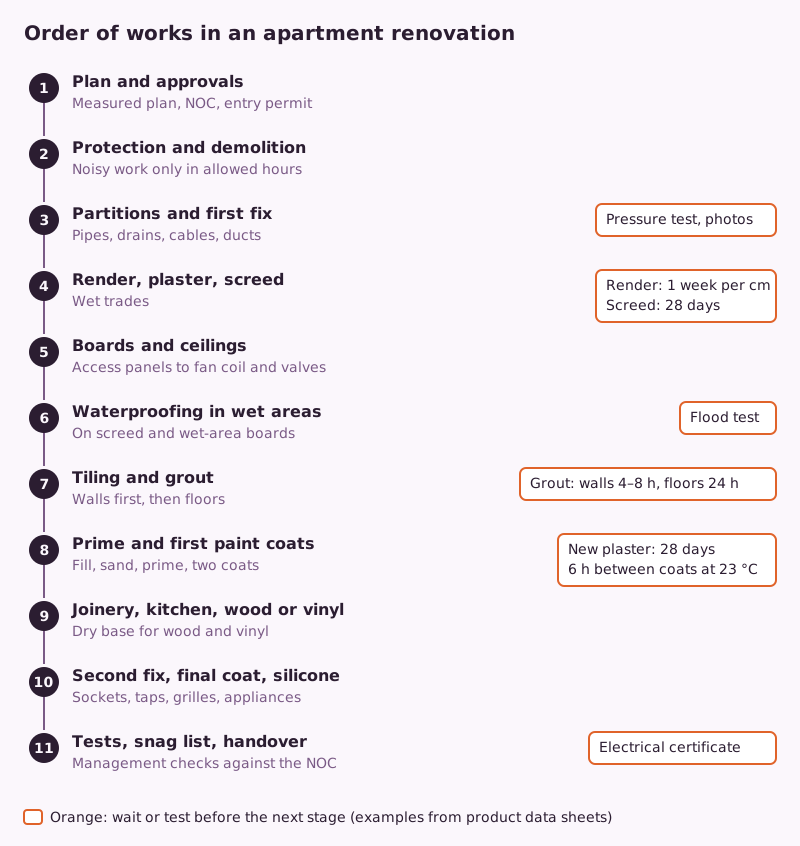
Renovate from dirty to clean and from hidden to visible: approvals, demolition, pipes and cables, partitions, plaster and screed, boards and ceilings, waterproofing, tiles, paint, joinery and floors, then sockets, taps and the final coat of paint. Between some steps you have to wait. A cement screed and fresh plaster must cure before tiles go on, and paint needs a dry wall. Test everything before it disappears behind tiles and boards. In a UAE tower add the building's NOC before anything starts and its completion check at the end.
#The order, step by step
- Measure and plan. A measured plan, the layout, the socket and lighting plan, and the materials list. Order anything with a long delivery time now: kitchen, doors, made-to-measure glass, special tiles. A plan of the flat before and after also goes into the NOC request. Drawn in Librae, it becomes part of the version you agree with the contractor, issued "For works" with a number, so every trade that comes on site works from one document.
- Approvals. In a UAE tower: the building's NOC, any deposit, and the contractor's entry permit. See renovation permits in Dubai. Elsewhere: whatever your building and city require.
- Protection. Floors, lifts and corridors protected. Smoke detectors protected from dust the way the building's rules say.
- Demolition. Only what the NOC allows. Emaar, for one, does not let you remove existing tiles in apartments; new tiles go over them. Debris out the same day.
- Partitions and frames. New drywall frames go up, but stay open on one side (drywall partitions).
- First fix: pipes, drains, cables, ducts. Everything that will be hidden. Boxes for sockets and switches at their final height.
- Tests before closing. Pressure test the new pipes (how to pressure test). Check the cables. Photograph every wall with services in it, with a tape measure in the shot.
- Plaster, render and screed. Wet trades. Then the first long wait (see below).
- Close the walls and ceilings. Boards on partitions, moisture-resistant boards in wet areas, false ceilings with access panels to the fan coil and valves (ceilings and access panels).
- Waterproofing in wet areas, on the screed and on the wet-area boards, then a flood test (waterproofing and flood test).
- Tiling, walls first, then floors, then grout (grout types). Then let the tiled floor set before anyone walks on it.
- Prime and paint, first coats. Fill, sand, prime, two coats. Leave the final coat for later (painting walls).
- Joinery and kitchen. Wardrobes, kitchen units, worktops, internal doors. The kitchen splashback is tiled after the worktop is in.
- Wood, laminate or vinyl floors. Late, on a dry base, once the wet trades are done (vinyl, engineered wood).
- Second fix. Sockets, switches, lights, sanitaryware, taps, AC grilles, appliances.
- Final paint coat and silicone. After the fitters have finished touching the walls.
- Tests, cleaning, snag list. Electrical tests and certificate (electrical testing), clean, then accept the work room by room (snag list).
- Completion with management. In a UAE tower the management checks the work against the NOC before it returns the deposit.
#The waits you cannot skip
The numbers below come from common product sheets. Your products may differ; the data sheet of the product actually used decides.
| Before you | Wait for | Example |
|---|---|---|
| Tile on new render | Render to cure | At least 1 week per cm of thickness (Mapei) |
| Tile on a new cement screed | Screed to cure | At least 28 days, unless it is a rapid screed made for early tiling (Mapei) |
| Tile on gypsum plaster or anhydrite screed | It to dry, then prime | Max 0.5 % residual moisture (Mapei) |
| Grout | Adhesive to set | Walls 4–8 h, floors 24 h (Mapei) |
| Walk on a tiled floor | Adhesive to set | About 24 h; full use after 14 days (Mapei) |
| Prime new cement plaster | Plaster to cure and dry | At least 28 days, surface moisture up to 8 % (Jazeera) |
| Paint | The wall to be warm enough | At least 3 °C above dew point (Jotun) |
| The next coat of paint | The last one to dry | 12 h at 10 °C, 6 h at 23 °C, 2 h at 40 °C (Jotun) |
| Close pipes in | A passed pressure test | See pressure testing |
| Tile over waterproofing | Membrane cure and flood test | See waterproofing |
Two notes on heat:
- Hot surfaces. Mapei asks you to cool a surface heated by direct sun with water before tiling, and its adhesive is for +5 to +35 °C. A sunny balcony or a room without AC can go above that.
- Cold walls and humid air. Jotun's emulsion sheet wants the wall at least 3 °C above dew point. A wall chilled by AC next to humid air from an open balcony door can be colder than that, and the paint will not form properly. Paint with doors shut and AC steady.
For wood and vinyl the base must be drier than for tiles. The flooring maker gives the limit and how to measure it; measure, do not guess (see engineered wood and vinyl floors).
#Where the order gets broken
- Tiling a fresh screed or render to save two weeks. The base shrinks and the tiles crack or come loose.
- Closing walls and ceilings before the pressure test. A leak is then found by the neighbour below.
- Waterproofing with no flood test.
- Painting before the dusty trades end. Then repainting everything.
- Final paint coat before the electrician and the kitchen fitter. Every socket and every cabinet leaves marks.
- Laying wood or vinyl before the wet trades dry. Boards swell, vinyl lifts.
- Splashback tiled before the worktop. The tile line then misses the worktop, and the gap gets filled with silicone.
- A sealed ceiling under the fan coil. The next drain clean becomes a ceiling repair.
- Noisy work outside the allowed hours in a tower. The crew gets stopped and the day is lost.
- Work outside the NOC. Emaar warns that unapproved works can cost you the developer's defect liability warranty, and management can stop the works.
#How to check the work
- Plan, materials list and long-lead orders done before demolition.
- NOC and contractor entry permit issued before the first day on site.
- Photos of every wall with services before it is closed.
- Pressure test record before boarding; flood test record before tiling.
- Screed and render dates written down; tiling starts after the wait in the data sheet.
- Access panels in the ceiling under the fan coil and valves.
- Final paint coat after the second fix.
- Electrical test certificate, then the snag list.
#When to call a professional
- A fit-out contractor licensed in your emirate for the whole job; in Emaar communities every contractor needs an entry permit, even for work that needs no NOC.
- The building's management before any MEP change. Many towers do not allow moving the fan coil, risers, drains or fire-fighting equipment at all; Emaar bans it in apartments. Where a change is allowed, the building usually wants its drawings from an MEP engineer.
- A DEWA-registered contractor (in Dubai) for new circuits and the test certificate.
- A structural engineer before touching any wall you are not sure about; Emaar, for one, does not allow removing walls in apartments (see developer NOCs).
#In the UAE
- Approvals come first. In most towers the permit is the building's NOC, not a government permit. Emaar owners apply through the ECM portal and pay a refundable deposit; the contractor then gets an entry permit (permits, developer NOCs).
- Hours shape the schedule. Buildings limit when noisy work may happen. Dubai Holding communities, for example, allow works 8 am to 6 pm, noisy works only 9 am–1 pm and 3–5 pm, and none on Sundays or public holidays. Plan demolition and chasing into those windows and quiet work around them.
- Ask management early whether they want to see anything open. Some want to see services before ceilings close; the public rules do not say this for every building. In the UAE, you can order the renovation through Librae with independent quality control, and its specialist looks at the services before the ceilings close.
- The end is management's inspection. Dubai Holding Community Management asks for a completion notice with plans of the new services, inspects within about 21 days and gives 30 days to fix anything that does not match. Your deposit comes back after that.
- Smoke detectors and sprinklers belong to the building. Cover them only as the rules allow and never move them yourself (smoke tests and detectors).
#What the codes say
- Mapei Keraflex Maxi S1 data sheet: substrate curing, residual moisture of gypsum, grouting times, foot traffic and service times, application temperatures.
- Jotun Fenomastic Hygiene Emulsion Matt data sheet: dew point, recoat times, paint system.
- Jazeera Notes Primer data sheet: curing and moisture of new plaster before priming.
- Dubai Holding Community Management rules (2026): working and noisy hours, §8.1.22 and §8.2.5; completion notice and inspection, §8.1.40.
- Emaar Home Modifications fact sheet (2022): entry permit for every contractor; what apartments may not change; consequences of unapproved works.
This guide explains good practice and cites the documents listed below. It is not a permit, a design approval or an engineering opinion. Work on electrical, gas, fire-safety and structural elements must be carried out by licensed professionals and approved by the relevant authority.
Sources
- Mapei, Keraflex Maxi S1 technical data sheet (Singapore edition, current file) — Render cured at least 1 week per cm and cement screeds at least 28 days before tiling, unless made with rapid binders; gypsum and anhydrite dry to 0.5 % and primed; cool hot surfaces with water; grout walls after 4–8 h, floors after 24 h; light traffic about 24 h; in service after 14 days; use at +5 to +35 °C.
- Jotun, Fenomastic Hygiene Emulsion Matt, technical data sheet (issued 6 June 2023, approved for the UAE) — Substrate at least 10 °C and 3 °C above dew point; dry to overcoat 12 h at 10 °C, 6 h at 23 °C, 2 h at 40 °C (50 % RH); system of primer, two filler coats and two topcoats.
- Jazeera Paints, Jazeera Notes Primer JA-11028, technical data sheet (UAE site) — New surfaces cured at least 28 days before priming; surface moisture up to 8 %; relative humidity at the workplace up to 70 %.
- Dubai Holding Community Management, Community Rules and Regulations, 1 October 2026, §8.1.22, §8.1.40, §8.2.5 — Works 8 am–6 pm, noisy works 9 am–1 pm and 3–5 pm, none on Sundays and public holidays; completion notice with plans of new services, inspection within about 21 days, fixes within 30 days.
- Emaar, Home Modifications fact sheet (2022) — Entry permit for all contractors even if no NOC is needed; in apartments no structural works or wall removal, no removal of existing tiles (new tiles may go over them), no removal, relocation or covering of MEP and fire-fighting systems; unapproved works may cost the defect liability warranty.