
Permits, contracts and money/UAE › Dubai
Renovation permits for an apartment in Dubai: who approves what
For most Dubai flats the renovation permit is an NOC from the developer or building management. The steps, documents, fees, and when authorities step in.
In most Dubai apartments the renovation permit is not a government permit. It is a no-objection certificate (NOC) from whoever manages your building: the developer's community management (Emaar, Nakheel, DAMAC and others) or a management company. You request it through their portal, app, e-mail or office, pay a fee, often leave a refundable deposit, and your contractor then gets a permit to enter the building. For a new kitchen, bathroom, floors or ceilings inside the flat, that is the whole process. Dubai Municipality, the Dubai Development Authority (DDA), Trakhees, Civil Defence or DEWA come in only when the work touches the structure, the façade, fire systems or the electrical supply, and then the contractor or consultant files with them.
#How it usually goes
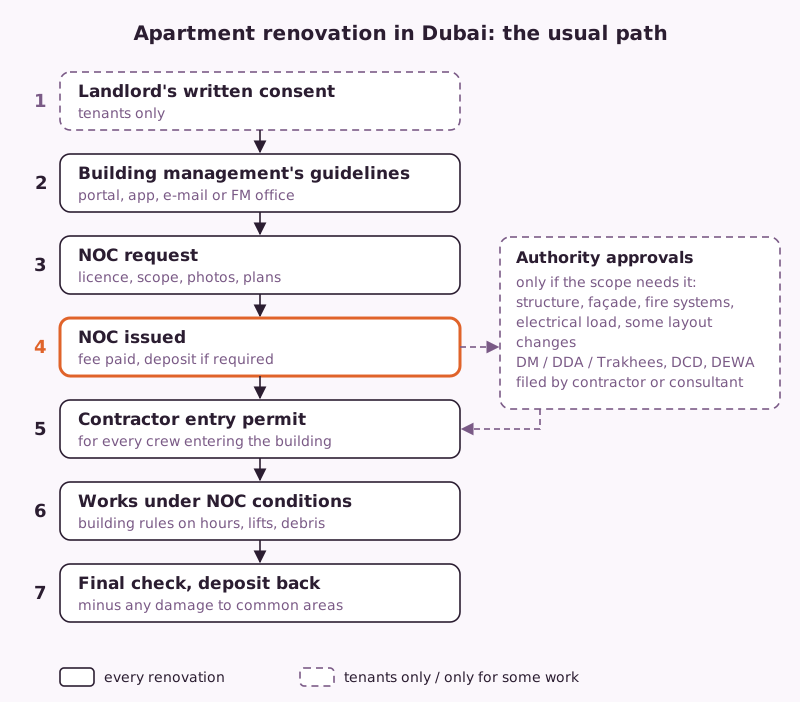
Tenant: get the landlord's consent first. Dubai's tenancy law does not let a tenant make changes without it. Get it in writing, with the scope attached. Then ask management whose name goes on the request. wasl asks for the title deed, so there the owner applies; elsewhere a letter from the landlord may be enough. For decoration work that does not touch the structure, the landlord has to give you the papers the approvals need.
Find out who manages the building. It is the company you or your landlord pay service charges to; reception or security will tell you too. Then find where requests go:
- Emaar Community Management: your community portal (reached from ecm.ae), section "Home Modifications". Emaar's fact sheet says this service does not cover Burj Khalifa; owners there ask their building management.
- Nakheel: an NOC from Nakheel's Urban Planning team, requested on the Nakheel website or in the My Nakheel app.
- DAMAC: the DAMAC Living app, request "NOC for Fit Out/Alterations".
- wasl freehold buildings: e-mail to freeholdnoc@wasl.ae.
- A tower run by a separate management company: its office or FM desk. Ask for their fit-out or modification rules and the request form. If the tower sits inside a developer's master community, also ask whether the master developer's NOC is needed on top.
Download the building's modification guidelines and read them before you plan.
Choose a contractor licensed in Dubai. The contractor's or consultant's trade licence is the first document Emaar asks for, and the same contractor will need a permit to enter the building.
Submit the NOC request. Emaar's checklist: the contractor's Dubai trade licence, a detailed scope of works, current photos of the areas to be changed, and, if relevant, proposed floor plans, sections, details or 3D views. wasl asks for the scope, title deed, passport and Emirates ID, and existing and proposed layouts. A measured plan of the flat helps here: Librae draws it before and after from dimensions you confirm. The first item on Emaar's list, the contractor's licence, is already covered for contractors in the Librae directory, because Librae checks the licence and its validity before it lists anyone.
Answer questions, pay, collect the NOC. The reviewer may ask for more information. Then you pay and download the NOC. Emaar's 2022 fact sheet promised 3 business days from complete documents and charged AED 1,000 for minor or AED 2,000 for major works in total, with AED 500 of it paid up front for review. wasl quotes 2 working days for a minor NOC and 7–21 days for a major one and tells you the fee during review. Nakheel and DAMAC do not publish fees or timelines; you see them in the request. If there is a deposit, the NOC terms state it. Emaar's depends on the works, and the portal shows it. Emaar publishes no figure for flats; its older, undated FAQ, from before the current portal, gave AED 5,000 for villa alterations.
Contractor entry permit. In Emaar communities every contractor needs one, even for work that needs no NOC. The contractor registers on ecmpermits.ae and applies for a home modification permit with the reference number e-mailed after your NOC is approved; approval takes up to one business day. wasl also issues an access permit for the workers once the NOC is out. Other buildings have their own pass system; ask at step 2.
Work under the NOC conditions and building rules. The NOC states what is approved. Anything else needs a new request.
Finish, final check, deposit back. Management confirms the work matches the NOC and the common areas are undamaged, then returns any deposit minus repair costs. How they check varies (wasl asks you to e-mail the completion certificates), so ask at step 2.
Only if management says the scope needs it, an authority approval goes between steps 5 and 6. Emaar's fact sheet says exactly this: DM, DDA or Civil Defence approvals "if required", before the work starts, and Emaar guides you on whether they are.
#What management alone usually approves
Work inside the flat that changes finishes, fixtures and fittings:
- new kitchen and bathroom fit-out on the existing connections;
- new flooring, wall tiles, paint, wallpaper;
- false ceilings, lighting, built-in wardrobes and joinery;
- replacing internal doors in existing openings.
Some of this needs no NOC at all, only the entry permit. Emaar lists internal painting, furniture installation, electrical fixtures and accessories, and regular maintenance as works without an NOC.
Each building also has its own list of what is not allowed in apartments, whatever the authorities say. Emaar's 2022 fact sheet lists:
- structural works and removal of walls;
- removing the original tiles (new tiles may be laid over them). If a previous occupant has already replaced them, Emaar can allow taking up theirs: say so in the application and get a no-objection letter from the neighbours below;
- removing, moving or covering MEP and fire-fighting systems.
If your plan depends on opening up a kitchen or taking out a partition, ask management before you design around it. Emaar and Nakheel also rule out changes to the façade or to how the building looks from outside; Emaar's Downtown Dubai rules name doors, windows and window coverings.
#When authorities are also involved
These cases are less common. In each, management tells you which approval is needed, and the contractor or consultant applies for it.
- Only if you change the structure (load-bearing walls, columns, slabs, beams, new openings in them): approval from the master developer, the Dubai Land Department and the permitting authority, a structural engineer's design, and an authority permit. Emaar, for one, does not allow it in apartments.
- Only if you change the external appearance (glazing, balcony enclosure, external AC units, façade colour): the same three approvals. Emaar and Nakheel do not permit it.
- Only if you move or add sprinklers, smoke detectors or alarm devices, or change escape routes: Civil Defence requirements apply, and the work goes through the building's fire-system contractor.
- Only if you add electrical load or a new distribution board: a DEWA-enrolled contractor applies to DEWA.
- Only if you build full-height partitions or change the layout and the area's authority counts that as fit-out or modification. In Trakhees areas a partition above 1.8 m from the floor needs approval; in DDA areas the contractor may need DDA's fit-out permit.
#Which authority, if any
That depends on where the building is: Dubai Municipality in most of the city, DDA in its own zones, Trakhees in Ports, Customs and Free Zone Corporation areas, or another free-zone authority. There is no single public list by building. Ask management; they deal with it on every request. The technical rules are the same everywhere because the Dubai Building Code 2021 replaced each authority's own design rules.
One fact that helps you talk to a contractor: Dubai Municipality needs no permit for basic maintenance, such as painting, new floors, doors and suspended ceilings, and maintenance of electrical, drainage, AC and fire-fighting systems. A DM-pre-qualified contractor must still do it.
#Building rules during the works
The NOC and the building's rules set the conditions. Ask for them in writing before you sign with a contractor:
- working days and hours, and quiet hours for drilling and demolition;
- lift booking, lift protection and which lift contractors use;
- how debris leaves the building and who pays for skips;
- corridor protection and where materials may be stored;
- who may shut off water or power to your flat, and with how much notice.
Damage to corridors, lifts and other common areas is charged to the owner. In Downtown Dubai, Emaar adds a notice of violation, and the owner answers to other residents for any loss caused by the contractor's defective work or presence.
#What goes wrong
- Starting before the NOC and entry permit are issued. In Emaar communities security lets in only contractors with a digital permit, so the crew is turned away and you pay for lost days.
- Doing works the NOC does not cover. Emaar warns that unapproved modifications can mean loss of the defects warranty, trouble transferring or reselling the flat, and violation notices. Expect the deposit to be held until the work is put right.
- Assuming an internal wall is yours to remove. Emaar lists removal of walls as not permitted in apartments, and a load-bearing wall is a common part of the building.
- Chiselling out old tiles where the rules say "tile over". In Emaar buildings removing the original tiles is on the not-permitted list. Tiles a previous occupant laid are a different case, but only with it stated in the application and the neighbours below agreeing in writing.
- Moving sprinklers or detectors with a new ceiling. This is fire-system work: Civil Defence requirements apply, and Emaar does not allow moving or covering fire-fighting systems in apartments.
- Coring through a slab without a scan. Slabs can contain post-tensioning tendons. In DDA areas cores under 200 mm must avoid them and stay at least 1 m from a column.
- Touching pipes that serve the flat above. Pipes and risers serving other units are common parts, not yours. A leak there becomes a dispute; see the leak guide.
- Tenant renovating without written consent. The law requires the landlord's permission for any change. A verbal "go ahead" will not help you when you move out.
#How to check the work
Before work starts:
- Tenant: the landlord's written consent with the scope attached.
- NOC issued for the actual scope; you have read its conditions.
- Any authority approval the NOC requires is issued.
- The contractor's trade licence covers the work; the entry permit is approved.
- Lift booked; corridor protection agreed.
- Dated photos of the corridor, lift lobby and your flat.
At completion:
- What was built matches the NOC drawings and scope.
- Sprinkler heads, detectors and alarm devices are in place and unobstructed.
- Wet areas were flood-tested before tiling, with photos, if waterproofing was touched.
- Final check by management done; deposit refund requested in writing.
- NOC, any permits, drawings and contractor details are kept with the title deed. A buyer may ask for them.
#When to call a professional
- Structural changes: a structural engineer licensed in Dubai and a consultant to file the approvals. Ask management first whether they are allowed at all.
- Fire systems: the building's fire-system contractor, arranged through management.
- Electrical load, new boards, new circuits: a DEWA-enrolled contractor.
- Authority permits: the contractor or consultant applies. Dubai Municipality and DDA take these from registered contractors and consultants, not from residents.
- Disputes with management over an NOC or with neighbours over common parts: the Rental Disputes Settlement Centre hears disputes under the jointly owned property law.
#What the law says
- Law No. 6 of 2019 (jointly owned property). Owners associations were replaced by management entities: the developer, a RERA-approved management company or a hotel management company (Art. 2, 49). Owners and tenants must follow the building management regulation and the master community declaration (Art. 16). That is where building fit-out rules get their force. Your unit includes floors and finishes, ceilings and the void above, non-load-bearing internal walls, doors and the connections that serve only your flat, unless the site plan says otherwise (Art. 9). Structural walls, columns, slabs, façades, external windows and shared pipes and wiring are common parts (Art. 7). Substantial alterations to the structure or external appearance need the master developer, the Dubai Land Department and the permitting authority (Art. 39(a)); whoever makes them without approval pays to put things right (Art. 39(b), (c)). Disputes go to the Rental Disputes Settlement Centre (Art. 42).
- Law No. 26 of 2007 (landlords and tenants). The tenant needs the landlord's permission and any required licences (Art. 19). For decoration works that do not affect the structure, the landlord must provide the approvals the authorities require (Art. 18).
- Dubai Municipality Administrative Resolution No. 109 of 2022. Basic maintenance needs no permit; structural maintenance and specialised maintenance of main structural elements do (Art. 1–4). Resolution No. 85 of 2019 on decoration permits covers commercial, office and industrial units, not flats.
- Trakhees Circular No. 2 of 2025. Finishes, flooring, movable furniture, dry-wall partitions up to 1.8 m and replacing doors and windows in existing openings need no Trakhees permit; other extensions and minor structural changes need a Modification NOC.
- DDA fit-out permit. Applicant is the contractor; about 2 working days; valid 6 months; structural additions and added floor area go through building modification instead.
- Dubai Building Code 2021 (A.4.1, A.5.1, Table A.1). One design code for DM, DDA, Trakhees and DSOA areas; it and the UAE Fire and Life Safety Code apply to renovation and fit-out of existing units.
Rules and fees change. This guide reflects the documents listed below as read on 31.10.2026; your building's current guidelines and NOC terms take precedence.
This guide explains good practice and cites the documents listed below. It is not a permit, a design approval or an engineering opinion. Work on electrical, gas, fire-safety and structural elements must be carried out by licensed professionals and approved by the relevant authority.
Sources
- Emaar Community Management, Home Modifications fact sheet (2022), archived copy — steps, works needing no NOC, works not permitted in apartments, documents, 3 business days, 2022 fees, authority approvals only if required, entry permit for every contractor; service not for Burj Khalifa
- Emaar Community Management, Downtown Dubai guidelines (archived 16.05.2026) — apply through the community portal, Home Modifications; no changes to the exterior of the unit (doors, windows, window coverings); damage charged to the owner; owner indemnifies others
- Emaar Community Management, contractor permit fact sheet (ecmpermits.ae, read 31.10.2026) — contractor registration, home modification permit with the NOC reference, one business day
- Emaar, older properties FAQ, alterations (undated, e-Services era; read 01.11.2026) — villa alterations, AED 5,000 refundable deposit plus AED 1,000 or 2,000 charge by scope
- Emaar Communities, frequently asked questions (read 31.10.2026) — NOC via community portal; external changes that alter the look of apartments not permitted
- Nakheel, contact us and FAQ (read 31.10.2026) — NOC from Nakheel Urban Planning before any alteration, via website or My Nakheel app; no façade or structural changes
- DAMAC Living app, App Store listing by DAMAC Properties (read 31.10.2026) — service request "NOC for Fit Out/Alterations"
- wasl help centre, NOC for home improvements, fit-out works or modifications (read 31.10.2026) — e-mail freeholdnoc@wasl.ae; documents, minor 2 working days, major 7–21 days, fee advised during review, access permit after NOC, deposit back after completion certificates
- Law No. (6) of 2019 Concerning Ownership of Jointly Owned Real Property in the Emirate of Dubai, Art. 2, 7, 9, 16, 39, 42, 49 — management entity, unit vs common parts, approvals for substantial alterations, liability, disputes
- Law No. (26) of 2007 Regulating the Relationship between Landlords and Tenants in the Emirate of Dubai, Art. 18–19 — tenant needs landlord permission; landlord provides approvals for decoration works
- Dubai Municipality Administrative Resolution No. (109) of 2022 Regulating the Licensing of Maintenance Works, Art. 1–4 — basic maintenance needs no DM permit; structural and specialised maintenance do
- Dubai Municipality Administrative Resolution No. (85) of 2019 Concerning the Licensing of Decoration Works, Art. 1–4 — the decoration permit rule covers commercial, office and industrial units, not flats
- Trakhees (PCFC) Circular No. (2) of 2025 regarding Minor Modification / Decoration works after Completion Certificate, 15.01.2025 — works without a Trakhees permit; partitions above 1.8 m need approval
- Dubai Development Authority, Fit-out Permit service (read 31.10.2026) — applicant is the contractor; about 2 working days; valid 6 months
- Dubai Building Code 2021, Part A, A.4.1 and A.5.1 with Table A.1 — one design code for DM, DDA, Trakhees and DSOA areas; applies to renovation and fit-out of existing units
- DEWA service guide, Getting Electricity Fit-out Connections — electrical fit-out connections go through DEWA-enrolled consultants or contractors