
Permits, contracts and money/UAE › Dubai
Water leak from the apartment above in Dubai: what to do, who pays
Water coming through your ceiling in a Dubai flat? Who to call first, how the source is found, who repairs and pays, what insurance covers and where to complain.
Water coming through your ceiling? Stop the water first and argue about money later. Call building management (the FM desk or security): they can shut off the flat above or the riser and find the source. Switch off power near the leak and photograph everything. Who pays depends on where the water came from. If it is a shower, hose or pipe that serves only the flat above, that flat is normally responsible. If it is a riser, a shared drain or the roof, building management repairs it. If you rent, tell your landlord the same day; the repair is theirs to organise, not yours.
#First hour: stop the water and protect yourself
Power off near the water. If water is near light fittings, sockets, the distribution board or the fan coil unit (the indoor unit of the central AC), switch off those circuits at your board. Not sure which ones? Switch off the main switch. Do not touch wet fittings.
Call building management or security. Ask them to:
- go up to the flat above;
- shut off that flat's water;
- if the source is unclear, shut off the branch from the riser.
In buildings designed to the 2021 Dubai Building Code there is a shut-off valve on each branch from the riser and a quarter-turn valve on the supply to every sanitary fitting, reachable without breaking finishes. Older buildings may be laid out differently, so ask FM where the valves for your stack are.
Neighbour away? Do not force the door. Building management has the owner's contacts; let them arrange access.
Catch the water. Put buckets under the drips and move furniture and electronics away. If the ceiling bulges with water, a small hole lets it drain into a bucket instead of bringing the board down. Do this only with the power off and only in gypsum board.
Burst before the meter. If the leak is in DEWA's network before your meter, call DEWA on 991, day or night. DEWA is responsible up to the meter; everything after the meter is the customer's.
#Document before anything is repaired
Send a short e-mail to building management the same day, and to your landlord if you rent. Put in:
- when the leak started, when you reported it and to whom;
- photos and video of the ceiling, walls, floor and damaged things, with something for scale;
- the FM technician's name and what they found, such as "drain joint under the shower tray, flat 1204";
- a list of damaged belongings with rough purchase dates, and receipts if you have them.
Ask building management for a written incident report that names the source. That one note settles most arguments about who pays.
#Finding the source
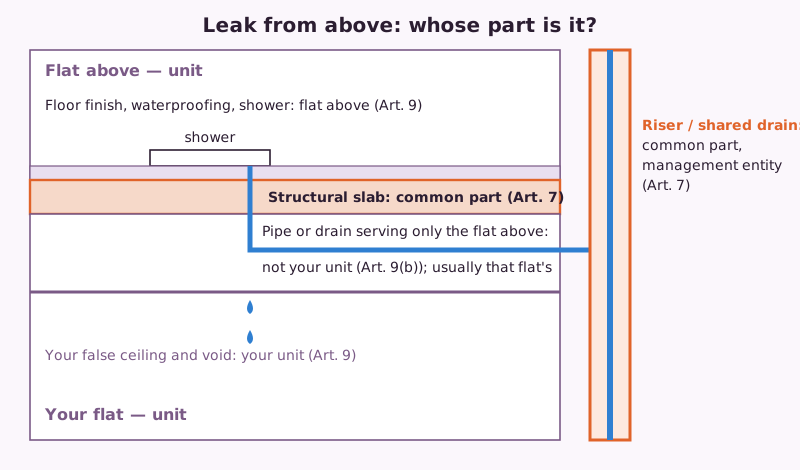
These are the usual culprits above a ceiling in a Dubai flat:
| Source | What you see | Usually whose |
|---|---|---|
| Shower tray, bath or floor waterproofing in the bathroom above | Stain under the bathroom, worse after the neighbour showers | The flat above |
| WC, basin or sink connection, flexible hose, valve | Steady drip, or a drip after one fitting is used | The flat above |
| Washing machine or dishwasher hose | A rush of water during a cycle | The flat above |
| Fan coil condensate tray or drain of the flat above | Drips while the AC runs, near the fan coil | The flat above, if the drain serves only that flat |
| Drain stack, water riser, sprinkler or chilled-water pipe serving several flats | Leak at a shaft or riser, sometimes in several flats | Building management (common part) |
| Roof, façade, window in an external wall | Leak after rain or façade washing, on top floors and over windows | Building management (common part) |
| Your own pipes in your ceiling void | Keeps leaking with the flat above shut off | You |
How to narrow it down:
- Shut-off test. If the leak stops when the upstairs flat's valve is closed, it is a pressurised pipe in that flat. If it carries on, look at drains, risers or your own pipes.
- One fitting at a time. The neighbour runs the shower, then the basin, then the WC, while someone watches your ceiling.
- Open the ceiling. A small inspection hole under the wet patch often shows the source straight away. The ceiling is yours, but agree with FM who opens it and who closes it.
- Leak detection. Moisture meters and thermal cameras show where water travels, not by themselves where it starts. Ask for a report that names the source and the method.
#Who pays
In practice it goes like this:
| What needs fixing | Who arranges it | Who pays in the end |
|---|---|---|
| The source in the flat above | That flat's owner, even if a tenant lives there | That flat's owner |
| A riser, shared drain, roof or façade | Building management | Building management, through service charges or the building insurance |
| Your ceiling, paint and finishes | You, or your landlord if you rent | Whoever caused the leak, or an insurer |
| Sprinklers and detectors in your ceiling | Building management | Same as your ceiling |
| Your furniture and belongings | You | Your contents insurance or whoever caused the leak |
Your flat or the building. Dubai's jointly owned property law splits a building into units and common parts. Your unit includes floors and finishes, the ceiling and the void above it, non-load-bearing walls, fixtures and the connections that serve only your flat. Common parts include the structure, façades, windows in external walls, tanks, and water, drain and power lines that serve more than one unit.
A pipe in your ceiling that serves only the flat above is not part of your flat. Whose it is, the law does not say outright: it can be read as a connection of the flat above or as a common part. Emaar answers by who the pipe serves: a burst pipe is the homeowner's problem unless it serves more than one unit, and then the community manager deals with it. Your building may answer differently, so check its rules and get FM's view in writing.
Building management repairs common parts. It is the developer or the management company running the building. If a common part leaked, fixing it is their job, and the damage to your flat is a matter for the building insurance or a claim against them.
The neighbour above is the person you claim from when the source is in their flat: a fitting, waterproofing, an appliance hose or a pipe serving only that flat. The law forbids using the building in a way that endangers others or the property. If a tenant lives upstairs, start with the owner, who deals with their tenant under the lease.
Unclear or shared, such as a drain blocked by misuse or a leak where a flat's pipe joins the riser: the facts and the building rules decide. Get the source in writing before you negotiate.
#Insurance
- Building insurance. Building management has to insure the building against fire, damage or destruction for any reason, and against liability for damage and injury to residents and others. Owners pay for it through service charges. Ask in writing whether they will report your incident to the insurer and what the excess is.
- Your own policy. If you have contents insurance, read the water-damage section: what is covered, exclusions, the excess and the deadline to report. Report early even if you expect the neighbour to pay.
- The neighbour's policy. If the neighbour's home insurance includes third-party liability, their insurer may handle your claim. Ask for the insurer's name and a claim number in writing.
#Tenants and landlords
If you rent the flat that got wet:
- Tell the landlord or their agent in writing the same day, with photos and the FM report.
- The landlord is responsible for maintenance and for repairing defects that affect your use of the flat, unless the lease says otherwise, and for damage that is not your fault.
- You may not carry out works without the landlord's permission. Let the landlord organise the repair and recover the cost from the upstairs owner or the building.
- Your belongings are yours, not the landlord's. Claim them from your contents insurance or from whoever caused the leak.
- When you move out, you return the flat as you received it, except for normal wear and damage you could not control. Leak damage you did not cause should fall under that. Keep the incident report for the move-out inspection.
If you own the wet flat and rent it out, your tenant will expect you to repair it. Deal with the upstairs owner or building management yourself.
If the leak comes from a rented flat above, contact building management and the upstairs owner. The tenant upstairs may be at fault, but the owner deals with their tenant under the lease.
#Negotiating and escalating
- Write to whoever is responsible, with photos, the FM incident report and a repair quote from a licensed contractor. Give them a reasonable date to reply.
- A common part leaked and management does nothing? Complain to RERA, Dubai's real estate regulator, which takes complaints against management companies. If your building has an owners committee, it can pass the complaint to management and then to RERA if nothing happens within 14 days.
- Formal dispute. Disputes under the jointly owned property law go to the Rental Disputes Settlement Centre, and so do landlord–tenant disputes across Dubai, free zones included, except free zones with their own courts. A claim first goes to the centre's mediation and conciliation stage; urgent and interim applications skip it.
- A claim only for your belongings against a neighbour you have no lease or building dispute with may not fit those categories. Ask a lawyer where to file.
#What goes wrong
- Repairing before documenting. Once the ceiling is closed and painted, it is your word against theirs.
- Taking "it's fixed" on trust. Ask FM to confirm the repair in writing, then watch your ceiling for a few days of normal use upstairs before you redo the finishes.
- Painting over a wet ceiling. Soaked gypsum board and insulation stay wet inside long after the surface looks dry. Closed up, they stain, sag and can grow mould. Let the void dry and replace soaked board.
- Tenant paying a contractor and deducting it from the rent. The tenancy law does not give you that right without the landlord's permission.
- Claiming from the neighbour for a riser leak. If a common part leaked, the neighbour is the wrong party; building management is the right one.
- Missing the insurer's deadline while you wait for the neighbour to pay.
#How to check the work
- Source named in writing by FM or a leak detection report, with the method used.
- Source repaired, confirmed in writing, and no new damp after several days of normal use upstairs.
- Wet gypsum board and insulation replaced, not just painted; the void dry before closing.
- Light fittings and sockets in the wet area checked by a qualified electrician before they are switched back on.
- Fire detectors and sprinkler heads in the repaired ceiling put back and checked through building management.
- Repair invoices and the incident report kept for the insurer, the landlord and any dispute.
#When to call a professional
- Building management (FM) to shut off water, get into the flat above, and deal with risers, drains and anything in a shaft.
- A leak detection company if shutting off and testing fittings one by one has not found the source. Ask for a written report that names it.
- A licensed electrician before switching wet light fittings, sockets or the fan coil back on.
- A licensed fit-out or maintenance contractor for the ceiling and finishes. They are part of your flat, so you or your landlord hire the contractor; sprinklers and detectors go back through building management. Planning other work at the same time? See renovation permits for a Dubai apartment.
- A lawyer if the damage is large, the responsible party refuses to pay, or you want to claim only for belongings from a neighbour you have no other dispute with.
Before the ceiling and finishes are repaired, get the cost in writing, item by item: it is the figure you will put to whoever pays. With the flat drawn in Librae, mark the damaged ceiling and walls: the areas come from the plan, and the first estimate puts each item on its own line, including stripping out the damaged finish, waste removal and 5% VAT.
This guide reflects the laws and official pages listed below as read on 31.10.2026. It is not legal advice; the Arabic text of Dubai legislation prevails over English translations.
#What the laws say
For anyone who needs the exact references. Full titles are in the sources.
- Law No. 6 of 2019 on jointly owned property. Common parts: Art. 7(a). Your unit: Art. 9(a); a pipe serving another unit is not part of yours: Art. 9(b); parts outside unit boundaries that the building needs: Art. 7(a)(8). Building rules bind owners and occupants: Art. 16(a). Management entity repairs common parts: Art. 18(a); owners associations' duties passed to management entities: Art. 49. Owners committee and the 14 days: Art. 24(4). RERA complaints: Art. 33(a)(4). No use that endangers others: Art. 39(d). Building insurance: Art. 41. Disputes to the RDSC: Art. 42.
- Law No. 26 of 2007 on landlords and tenants. Landlord repairs: Art. 16. Damage not caused by the tenant: Art. 17. No works without permission: Art. 19. Returning the flat: Art. 21.
- Decree No. 26 of 2013 on the Rent Disputes Settlement Centre. Jurisdiction and exclusions: Art. 6. Mediation and conciliation: Art. 7 and 10.
- Dubai Building Code 2021, Part H. Isolation valves: H.5.7. Leak detection: H.6.2.9.
This guide explains good practice and cites the documents listed below. It is not a permit, a design approval or an engineering opinion. Work on electrical, gas, fire-safety and structural elements must be carried out by licensed professionals and approved by the relevant authority.
Sources
- Law No. (6) of 2019 Concerning Ownership of Jointly Owned Real Property in the Emirate of Dubai, Art. 7, 9, 16, 18, 24, 33, 39, 41, 42, 49 — common parts vs unit, management entity duties, building insurance, complaints to RERA, RDSC jurisdiction
- Law No. (26) of 2007 Regulating the Relationship between Landlords and Tenants in the Emirate of Dubai, Art. 16, 17, 19, 21 — landlord repairs, tenant not liable for damage not caused by the tenant, no tenant works without permission
- Decree No. (26) of 2013 Concerning the Rent Disputes Settlement Centre in the Emirate of Dubai, Art. 6, 7, 10 — jurisdiction, exclusions, mediation and conciliation directorate
- Rental Disputes Center, About RDC (read 31.10.2026) — jurisdiction includes jointly owned property disputes under Law No. 6 of 2019; conciliation before first instance
- Emaar Communities, frequently asked questions (read 31.10.2026) — developer example — burst pipe is the homeowner's responsibility unless the pipe serves more than one unit
- DEWA, Contact us (technical emergencies 991) — 991 for electricity and water technical notifications, 24/7
- Dubai Media Office, DEWA recommends early detecting of internal leaks (11.07.2024) — DEWA is responsible up to the meter; connections after the meter are the customer's
- Dubai Building Code 2021, Part H, H.5.7 (isolation valves) and H.6.2.9 (leak detection) — accessible quarter-turn isolation valves on every sanitary fitting and branch isolation valves at risers; leak detection where leaks could cause significant damage