
Plumbing and water heating/Global
How to pressure test water pipes: PEX, PPR, multilayer and copper
Test pressures, hold times and pass limits for copper and plastic water pipes, why the gauge drops on plastic, water or air, and what goes in the test record.
A pressure test checks new pipework before it disappears. The plumber fills the pipes with water, pumps the pressure above normal working pressure with a hand pump and leaves it for a set time, watching the gauge and every joint. Copper and steel pass if the pressure does not drop at all. Plastic and multilayer pipe stretches under pressure, so it is tested differently: re-pump first, then allow a small drop that has to slow down. Do it before anything is closed in, and write the result down.
#If a plumber is doing it
In a renovation the plumber who laid the pipes usually tests them; owners rarely do it themselves. Your part is short:
- Agree it before work starts. Put in the quote that the pipes are tested before any wall, screed or ceiling covers them, using the test in the pipe maker's instructions.
- Ask for the numbers in advance: test pressure, hold time and allowed drop. Then you know what the gauge should show.
- Be there at the start and the end, or ask for photos of the gauge with the time showing.
- Look at the joints while the pipes are under pressure. Every one should be dry.
- Get the signed record and keep it with the flat's papers. What goes in it is further down.
In a managed building, also ask facilities management (FM) whether they want to see the test before the ceilings close.
The rest of this guide is the test itself, so you can tell a proper one from a quick look at the gauge.
#Why and when to test
A press fitting nobody pressed, a bad fusion joint on PPR, a nicked pipe: all of these can hold normal pressure and start leaking later, behind the tiles. The test is your last chance to find that for the price of one fitting instead of a bathroom.
Test:
- when the whole section is in and clipped, but before walls, screed, ceilings or insulation cover it;
- again after every repair the test made necessary;
- a large system in sections, with its own record for each one.
The UK rules put it simply: the water system must hold at least 1.5 times the highest pressure it will see in use. The procedures most pipe makers refer to come from the European standard EN 806-4. The Dubai Building Code points to the UK rules and EN 806.
#What you need
- Hand test pump. With a tank, check valve, shut-off and its own hose. It must reach the test pressure with some to spare.
- Pressure gauge. Its range must go above the test pressure, marked in 0.1 bar or finer; that is what the German copper institute recommends. Aquatherm, a PP-R pipe maker, asks for a gauge accurate to 0.5 psi, about 0.03 bar.
- Plugs and caps on every open outlet, rated for the test pressure. For press systems, the maker's own test plugs if it makes them.
- Thermometer, to compare the water and the room.
- Clean water. Filtered drinking water. One German guidance note says to filter out particles of 150 µm and up, and never to use site water.
- A record sheet. What goes on it is further down.
Put the gauge at the lowest point of the section. That is where the pressure is highest, and Aquatherm requires it there so the pipe is not over-pressurised.
#Before you pump
- Disconnect anything not rated for the test pressure or holding a lot of water: the water heater, expansion vessels, pressure reducing valves, mixer cartridges, appliances. The copper institute names pressure vessels specifically.
- Fill slowly from the bottom. Bleed every high point and every outlet until the water runs without air. Air makes the gauge soft and stores energy under pressure. Aquatherm warns that trapped air can make a pipe burst violently.
- Let the temperature settle. The water should be within 10 °C of the room air; that is the rule on Aalberts' test record, based on the German ZVSHK guidance. Water warming in the pipe pushes the pressure up. Water cooling pulls it down, and that looks like a leak.
- Press systems: check at low pressure first. Press fittings made to the German DVGW W 534 standard are designed to leak visibly between 1 and 6.5 bar if they were never pressed. Put mains pressure on them, up to 6 bar, for about 15 minutes, and the forgotten joint shows up before the real test.
#Copper and steel
Metal pipe barely stretches at test pressure. If the pressure keeps dropping, water is getting out somewhere.
| Whose rule | Pressure | How long | Pass |
|---|---|---|---|
| UK rules, system with no plastic pipe | 1.5 × highest working pressure | 1 hour, no re-pumping | Pressure holds, no leak seen |
| EN 806-4 procedure A (Pipelife forms, Uponor spec) | 1.1 × working pressure, at least 11 bar | 10 minutes | No drop |
| German ZVSHK guidance | 11 bar | 15 minutes copper only, 30 minutes mixed (copper institute); 30 minutes on Aalberts' form | No drop, no leak seen |
Procedure A is also used for multilayer pipe. Uponor's UK spec for its multilayer pipe calls for procedure A from EN 806-4, or the 1999 UK rules, at no more than 1.1 times the maximum design pressure and with water no warmer than 25 °C. Pipelife's Austrian forms use procedure A for metal, multilayer and plastic pipe up to DN 50.
#Plastic and multilayer: why the gauge drops
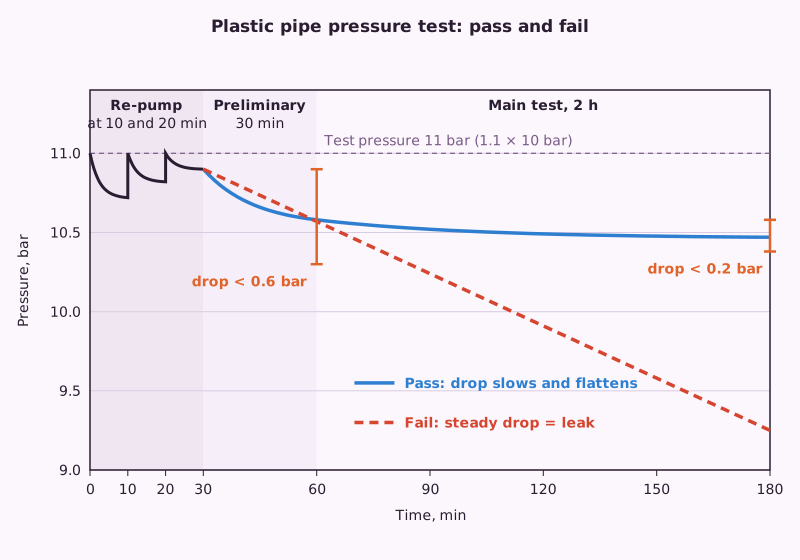
PEX, PPR, polybutylene and the plastic layers in multilayer pipe keep swelling slowly for a while under pressure. This is called creep. The pipe holds a little more water, so the pressure drops even when every joint is perfect. A "10 minutes, no drop" rule would fail a good plastic system, or push the plumber to keep pumping until the needle stays put.
So plastic is tested in two stages. First re-pump, so the pipe does most of its stretching. Then watch how the drop behaves. Creep slows down and stops. A leak does not.
| Whose test | What you do | Pass |
|---|---|---|
| PRINETO record to DIN EN 806-4 | Pump to 1.1 × working pressure (usually 11 bar), top it up at 10 and 20 minutes, stop pumping at 30 minutes | Under 0.6 bar drop over the next 30 minutes, then under 0.2 bar over the following 2 hours; no leak seen |
| UK Test B | Hold 1.5 × working pressure for 30 minutes by pumping, note the reading, then no pumping for 150 minutes | Under 0.6 bar drop after the next 30 minutes, or under 0.8 bar after the next 150 minutes; no leak seen |
| UK Test A, step-down | Hold 1.5 × working pressure for 30 minutes, then drop it to one third of the test pressure | Stays at one third or above for 90 minutes; no leak seen |
| German ZVSHK guidance | 11 bar for 30 minutes, inspect, then drop to half, 5.5 bar | No drop over 120 minutes |
| Aquatherm (PP-R, North America) | Several pressure cycles, then hold 30 minutes and 2 hours at 150 psi (about 10.3 bar) for SDR 11 pipe working at up to 100 psi | No more than 9 psi (about 0.6 bar) lost in 30 minutes and 3 psi (about 0.2 bar) in 2 hours, and no steady decline |
Why the step-down works: once the pressure is let down, the stretched pipe shrinks a little and holds the pressure or even pushes it up. Essex & Suffolk Water, a UK water company, treats a rising reading at this stage as a pass. A leak pulls it down.
Which test to use: the one in your pipe maker's instructions. The warranty depends on it. If the system mixes metal and plastic, test it as plastic. Sources label EN 806-4's procedures B and C differently, so agree the test by its steps and numbers, not by its letter.
#Reading the gauge
| What the needle does | Most likely | What to do |
|---|---|---|
| Stays put (metal), or drops more and more slowly and stops inside the limits (plastic) | Normal | Pass, as long as nothing is wet |
| Falls at the same speed, or goes past the limit | Leak | Check every joint, fix, repeat the whole test |
| Rises | Water warming up, or the mains valve letting by | Check the temperature; isolate the mains properly |
| Big early drop, then steady; pump feels soft | Air in the pipes | Bleed and start again |
| Drops only at night when the room cools | Temperature | Start again with water close to room temperature |
The gauge alone is not proof. PRINETO's record says it plainly: the pressure and its curve do not prove the pipes are tight, so the whole installation must be inspected during the test. A wet press fitting with a "good" gauge is a failed test.
#Water or air?
Water hardly compresses, so if something gives under test pressure, little energy comes out. Air stores energy, more the bigger the volume and pressure, and a joint failing under air can fly apart. That is why every source we checked allows air only at low pressure:
- German ZVSHK guidance, as summarised by the copper institute. Tightness test with air or inert gas at 150 mbar for at least 120 minutes up to 100 litres of pipe, plus 20 minutes for each further 100 litres. Strength test at no more than 3 bar up to DN 50 and 1 bar above that, for at least 10 minutes. Never above 3 bar.
- Pipelife's Austrian form. 0.15 bar for 60 minutes, then 3 bar for 10 minutes.
- Aquatherm. Air only for a first check at no more than 15 psi (about 1 bar). The real tests are done with water.
Air has one advantage: hygiene. Water left in pipes nobody uses goes stale. The copper institute says a filled installation has to be used or flushed at the latest every 7 days, following DIN EN 806. That is why German plumbers often test dry when the move-in date is far off. If you test with water, start using the system soon or flush it.
Use oil-free air or an inert gas such as nitrogen. An ordinary compressor without an oil separator will contaminate drinking water pipes.
Whatever you choose, the pipe maker's rules come first. Some allow air up to a set pressure, some allow only water.
#The test record
Fill it in on the day, on paper or on the pipe maker's form. Photograph the gauge at the start and the end. It should show:
- address, section tested, date, start and finish times;
- pipe material, sizes and fitting system; for press systems, the press tool used;
- highest working pressure, test pressure, which test was used and where it comes from;
- water and room temperature;
- gauge range, scale and calibration date;
- readings at each step; for plastic, at 0, 10, 20, 30, 60 and 180 minutes;
- what the inspection found, any repairs, and the result: pass or fail;
- names and signatures of the plumber and whoever watched.
Essex & Suffolk Water, for example, asks for certified, data-logged results and may send someone to watch. Write into your contract who attends the test and who keeps the record. You will want that record if a leak turns up later; see leaks from the flat upstairs.
#What goes wrong
- Testing after tiling. Then it only tells you where to break.
- Water heater or expansion vessel left on. The heater's safety valve opens before you reach test pressure, and the air in the vessel hides leaks. For how the heater should be connected, see connecting a water heater.
- Air not bled out. The needle wanders, and the stored energy makes it dangerous.
- Cold water in a warm room, or the other way round. The pressure follows the temperature: a good system "fails" and a bad one "passes".
- Plastic tested like metal. "No drop in 10 minutes" fails sound PEX or PPR, or the plumber keeps pumping until it "holds".
- Gauge too coarse. You cannot read a 0.2 bar limit on a dial marked every 0.5 or 1 bar.
- Air at full test pressure. Every source caps air far lower.
- No record. Then a warranty claim or an argument after a leak starts from nothing.
#How to check the work
- The test was done before any pipe was covered; you saw it or have timestamped photos.
- Water heater, expansion vessels, reducing valves and appliances were off or isolated during the test.
- The gauge was at the lowest point and marked in 0.1 bar or finer.
- The test is named and suits the pipe: no drop for metal, re-pump and limits for plastic and multilayer.
- Pressure and times match the pipe maker's instructions or the rules you work under.
- Every joint was looked at during the test and all were dry.
- The record is filled in and signed, with readings and temperatures.
- After a water test the system went into use soon or was flushed, or it was tested with air.
#When to call a professional
- The system serves more than one flat, has risers or pumps, or mixes pipe materials. The test pressure and method should come from the designer.
- The test failed and you cannot see the leak.
- Any test with compressed air or gas.
In Dubai, the building code sets no separate test pressure and no witness rule for household water pipes; it points to EN 806. Its own numbers, 1.5 times design pressure, at least 689 kPa (about 6.9 bar), for at least 15 minutes, are for heating and chilled water pipes. Its witnessed test certificates are for drainage. If you are renovating in a managed building, ask facilities management (FM) whether they want to see the test before the ceilings close. See renovation permits in Dubai.
Write the pressure test into the estimate as its own line, so it is priced from the start and not an extra; in a Librae estimate every item already sits on a line of its own. In the UAE, independent quality control can be added to a renovation ordered through Librae, and the specialist sees the test before walls and ceilings are closed.
#What the codes say
For readers who want to know where the numbers come from. Full titles are in the source list below.
- UK rules (Water Supply (Water Fittings) Regulations (Northern Ireland) 2009, Schedule 2, paragraph 12): at least 1.5 times the highest working pressure; systems without plastic pipe, 1 hour without pumping, para 12(2)(a); plastic pipe, Tests A and B, para 12(2)(b). The same 1.5 times rule is in the 1999 regulations for England and Wales. United Utilities notes that most household fittings are made for a maximum working pressure of 10 bar.
- EN 806-4:2010. We did not read the standard itself; the numbers come from the makers' documents that cite it. Procedure A is clause 6.1.3.2, per Uponor's spec. Sources disagree on the letters B and C.
- German practice: the ZVSHK leaflet and DIN EN 806 as summarised by the Deutsches Kupferinstitut; press fittings to DVGW W 534.
- Dubai Building Code 2021: water services, H.5.4.1; heating and chilled water tests, H.4.13.9.8 and K.10.1.9.7; testing before the concrete pour, H.4.13.6; drainage test certificates, H.6.9.
This guide explains good practice and cites the documents listed below. It is not a permit, a design approval or an engineering opinion. Work on electrical, gas, fire-safety and structural elements must be carried out by licensed professionals and approved by the relevant authority.
Sources
- Water Supply (Water Fittings) Regulations (Northern Ireland) 2009, Schedule 2, paragraph 12 (testing) — 1.5 times test pressure; 1 hour hold for systems without plastics pipe; Test A and Test B for plastics with times and allowed drops.
- Deutsches Kupferinstitut, "Sichere Dichtheitsprüfungen bei Kupferrohr-Installationen" (press information, 1 July 2019) — Summary of DIN EN 806-4 and the ZVSHK leaflet - three hydrostatic procedures A, B, C, copper uses A, air test limits and times, filtered water, hygiene after a wet test, press fitting leak-when-unpressed range.
- Pipelife Austria, pressure test record forms to ÖNORM B 2531 / EN 806 (drinking water procedure A, air test) — Procedure A at 1.1 times operating pressure, at least 11 bar, 10 minutes, no drop; scope metal, multilayer and plastics up to DN 50.
- Uponor MLC & SAC specification (UK, April 2022) — Multilayer pipe tested to BS EN 806-4:2010 clause 6.1.3.2 procedure A; maximum 1.1 times MDP at 25 °C or below.
- IVT PRINETO, pressure test record to DIN EN 806-4 for plastic drinking water installations — Re-pump at 10 and 20 minutes, under 0.6 bar drop in the next 30 minutes, under 0.2 bar in 2 hours; visual inspection required; temperature effects.
- Aalberts IPS, drinking water pressure test record with water (ZVSHK-based) — Temperature difference at most 10 K, unpressed fitting check at up to 6 bar, 11 bar for 30 minutes, plastics then 5.5 bar for 120 minutes.
- Aquatherm Standard Pressure Testing Procedure (Aquatherm North America, revised September 2024) — PP-R heat-fusion systems - test pressures, cyclic test, 30-minute and 2-hour limits, water only, air at most 15 psi, gauge accuracy and position, trapped air hazard.
- Dubai Building Code 2021, Part H, H.4.13.6, H.4.13.9.8, H.5.4.1, H.6.9 and Part K, K.10.1.9.7 — Water services designed to BS EN 806; hydronic (heating and chilled water) test values and pre-pour testing; witnessed certificates for drainage tests.
- Essex & Suffolk Water, Guidance Note 3, Pressure testing of new water supply pipework — Water company asks for certified results and may witness the test; plastic pipes need allowance for expansion; rising pressure after a step-down indicates a pass.
- United Utilities, Hydrostatic pressure testing guidance leaflet — Quotes the 1.5 times rule of the 1999 Water Fittings Regulations; most domestic fittings designed for a maximum working pressure of 10 bar.