
Plumbing and water heating/Global
Expansion vessel for a water heater: size, pre-charge, where it goes
How big an expansion vessel your water heater needs, how to set its air pressure, where to fit it, and why the safety valve can still drip with one fitted.
An expansion vessel gives the water that a storage heater pushes out while heating somewhere to go, so the safety valve stops dripping. It works only if three things are right. It sits on the cold side, between the check valve and the heater. Its air pressure matches the cold supply pressure, or is up to 0.2 bar lower. And it is big enough for your supply pressure. For a 50–100 litre heater in a flat that usually means a small drinking-water vessel of 3 to 12 litres, picked from the heater's or the vessel maker's table.
The order of the valves and the discharge rules are in connecting a water heater. Here it is only the vessel.
#Do you need one
A vessel is optional on most heaters with a standard safety group. What it changes:
- The valve drips only while the heater heats. That is normal. A vessel stops it. Gorenje suggests a 3-litre one when the drip cannot be piped to a drain.
- The valve drips or runs when the heater is off. A vessel will not fix that. Your supply pressure is above what the valve holds, and you need a reducing valve. See what goes on the cold side.
- You have no check valve or reducing valve on the supply. The expanding water can go back into the mains, and there is little for a vessel to do. Amtrol says you need a vessel precisely when one-way devices like these close the system.
#How much water it has to take
Water heated from 10 to 60 °C takes up about 1.7 % more room. Heated to 70 °C, about 2.2 %. Zilmet's sizing formula uses 2.2 % for an ordinary system, so size for 70 °C if your thermostat is turned up.
| Heater | Pushed out, heated to 60 °C | Heated to 70 °C |
|---|---|---|
| 50 litres | 0.8 litres | 1.1 litres |
| 80 litres | 1.3 litres | 1.8 litres |
| 100 litres | 1.7 litres | 2.2 litres |
| 150 litres | 2.5 litres | 3.4 litres |
#How big a vessel
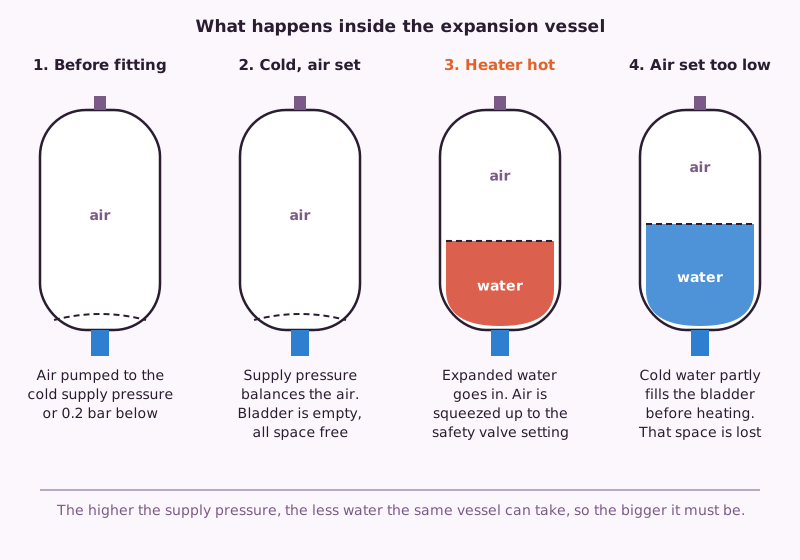
Inside the steel shell is a rubber bladder. Water goes into the bladder, air sits around it. As the heater warms up, water pushes into the bladder and squeezes the air. The air can only be squeezed until the pressure reaches the safety valve setting. So the useful volume depends on where the air starts: the higher your supply pressure, the less a vessel of a given size can take.
Our calculation for a 6 bar safety valve, with the air set to the supply pressure and squeezed all the way to 6 bar:
| Vessel | Takes at 1.5 bar supply | at 3 bar | at 4 bar |
|---|---|---|---|
| 3 litres | 1.9 litres | 1.3 litres | 0.9 litres |
| 5 litres | 3.2 litres | 2.1 litres | 1.4 litres |
| 8 litres | 5.1 litres | 3.4 litres | 2.3 litres |
| 12 litres | 7.7 litres | 5.1 litres | 3.4 litres |
This is the best case. A safety valve can start to weep a little before it reaches its setting, so treat these figures as an upper limit and leave a margin.
Compare that with the makers' tables:
- Gorenje's manual for its 30–120 litre heaters says a 3-litre vessel stops the drip, and does not say at what supply pressure. Gorenje asks for a reducing valve only when the mains is above the heater's 6 bar rating. By our numbers, 3 litres at 3 bar takes 1.3 litres, about what the 80-litre model pushes out heated to 60 °C. So 3 litres does the job on the smaller models or at low supply pressure. On a 100 or 120-litre model at 3 bar or more, it will cut the drip but not stop it.
- Reflex (2026 catalogue, cold water at 10 °C, tank at 60 °C) gives, with a 6 bar safety valve: 8 litres for heaters of 90 to 150 litres at 3 bar pre-charge, and 12 litres for a 100-litre heater at 4 bar. For 150 litres: 8 litres at 3 bar, 18 litres at 4 bar. Its smallest vessel in the table is 8 litres. Reflex leaves a margin: for a 100-litre heater at 4 bar our table says 8 litres would take 2.3 litres, yet Reflex picks 12.
How to choose: use the size in your heater manual if it gives one, for your supply pressure. If it does not, use the vessel maker's table with your measured supply pressure and the safety valve rating from the heater label. A bigger vessel costs more and takes more space, but Altecnic says oversizing rarely causes problems. Too small, and the valve keeps dripping.
#Setting the pre-charge
The air side is pumped up at the factory, and the factory figure is rarely your pressure. Reflex ships its Refix DD potable vessels at 4 bar; Zilmet's Hy-Pro range comes at 1.5–3 bar.
What it should be:
- Reflex: the reducing valve set at least 0.2 bar above the pre-charge. Its 2020 range brochure simply says mains pressure.
- Zilmet: static supply pressure minus 0.2 bar.
- Amtrol: equal to the static supply pressure.
In practice: measure the static pressure at the heater connection with a gauge and no water running (at night is best). Set the vessel to that figure, or up to 0.2 bar lower.
Why it matters. If the air is below your supply pressure, cold water fills part of the bladder before the heater even starts, and that space is lost. Amtrol's guide shows this with a 40 psi tank on a 70 psi supply. If the air is well above your supply, the vessel takes nothing until the tank pressure climbs past it.
How to set it:
- Take the water pressure off. Zilmet says the air can be checked only when the vessel is disconnected or the system is at atmospheric pressure. Close the cold supply to the heater and open a hot tap until it stops.
- Measure at the air valve on the vessel (it looks like a tyre valve) with a tyre gauge.
- Adjust with a tyre pump, or let air out.
- Reopen the supply and check for leaks.
Zilmet asks for a check at least once a year; a big drop means the membrane is near the end of its life. Altecnic also says to check at the annual service.
#Where it goes and what to buy
- On the cold side, between the check valve and the heater. Before the check valve it is useless: the check valve stops the expanding water reaching it. With a one-piece safety group, that means a tee between the group and the heater inlet. Amtrol puts it on the cold supply after the backflow preventer; Gorenje's drawing shows it on the inlet.
- Never on the hot outlet. Amtrol explains why: hot water sits in the vessel and cools, so the next person to open a hot tap gets lukewarm water first.
- Follow the heater manual on the exact spot. Some makers allow nothing between the safety group and the tank. Atlantic is one. Ask the maker where the vessel connects.
- A drinking-water vessel only. Reflex's Refix DD has a butyl bladder and drinking-water approvals (KTW, W270, WRAS, ACS among them), and is made for cold water lines up to 70 °C. Reflex's heating vessels are a separate range for closed heating and cooling systems.
- Not for solar or solid fuel heaters unless the vessel is rated for them. Zilmet says its Hy-Pro is not for heat sources with uncontrolled temperatures.
- Flow-through if you can. Reflex's DD comes with a flow-through fitting so water passes through the vessel instead of sitting in it.
- Support it. Amtrol lets its vessels hang in any vertical position as long as they are supported. Use a wall bracket rather than letting the pipe carry it.
- Keep the air valve reachable. Reflex sells a secured shut-off valve with a drain for this vessel, the Flowjet, so the vessel can be shut off and emptied for a pressure check without draining the heater.
#Why the safety valve still drips
| What you see | Likely cause | Check | Fix |
|---|---|---|---|
| Drips while heating, vessel fitted | Vessel lost its air, or pre-charge wrong | Air pressure with the water side at zero | Re-pump to supply pressure |
| Same, and water comes out of the air valve | Membrane failed | Press the valve pin briefly | Replace the vessel |
| Drips while heating, vessel new | Vessel too small for your pressure | Compare with the maker's table | Bigger vessel |
| Drips or runs when the heater is off | Supply pressure above the valve rating, or the reducing valve no longer holds | Gauge at the heater, at night | Reducing valve or its repair |
| Drips at normal pressure, vessel fine | Dirt on the valve seat, or a worn valve | Work the lever a few times | Replace with the same rating |
| Hot water or steam, steady stream | Overheating | Switch the heater off at its switch | Call a plumber |
Gorenje's valves keep tank pressure within 0.1 MPa (1 bar) of their rating. Never fit a stronger valve and never plug the discharge to stop a drip.
#What goes wrong
- Vessel fitted at the factory pressure. At 4 bar on a 2 bar supply it does almost nothing until the tank pressure climbs past 4 bar.
- Air checked with the system under pressure. The gauge then reads the water pressure, not the air charge.
- A heating vessel on drinking water.
- Vessel on the hot outlet.
- Vessel before the check valve.
- Vessel too small for a high supply pressure.
- A stronger safety valve "because the vessel didn't help".
- No access. A vessel above a ceiling with no hatch never gets checked.
#How to check the work
- The vessel is a drinking-water type, rated for your pressure and temperature.
- It is on the cold side, after the check valve, where the heater manual allows.
- Supply pressure was measured; the pre-charge was set to it or up to 0.2 bar less, with the water side at zero.
- The size matches the heater or vessel maker's table for your pressure.
- It is supported by a bracket, not by the pipe.
- The air valve can be reached.
- The safety valve does not drip through a full heat-up.
#When to call a professional
- Fitting the vessel on a pressurised heater is a plumber's job. So is anything that changes the safety group.
- A safety valve running non-stop, hot water from the discharge, or a bulging tank: switch the heater off and call a plumber.
- In an apartment building, ask the building management before changing the heater set-up. Rules differ; some buildings ask for approval to replace or alter a water heater.
When the vessel goes in as part of a bathroom or kitchen refit, list it with the safety group in the estimate. The plumber on a Librae project looks at the cylinder on site, free of charge, before agreeing that estimate. They can propose changes, but nothing comes off your plan without your approval.
#What the manuals say
- Reflex, BeLux product guide 2026, pp. 24–26: quick selection by heater volume and safety valve setting at 3.0 and 4.0 bar pre-charge, reducing valve at least 0.2 bar above pre-charge; Refix DD 4 bar factory charge, 10 bar, 70 °C, cold water lines only.
- Zilmet Hy-Pro (08/2012): volume = expansion × system volume ÷ (1 − initial ÷ final absolute pressure); pre-charge = static pressure − 0.2 bar; yearly check; air checked only at zero water pressure.
- Amtrol Therm-X-Trol sizing (2019): expanded water × design pressure factor; pre-charge equal to static pressure; cold supply after the backflow preventer.
- Gorenje TGR SM: a 3-litre tank on the inlet stops the drip.
- The figures in our tables come from the density of water at 10, 60 and 70 °C and Boyle's law.
This guide explains good practice and cites the documents listed below. It is not a permit, a design approval or an engineering opinion. Work on electrical, gas, fire-safety and structural elements must be carried out by licensed professionals and approved by the relevant authority.
Sources
- Reflex, Guide de produits BeLux 2026, Refix quick selection tables and Refix DD (pp. 24–26) — Vessel size by heater volume for pre-charge 3.0 or 4.0 bar, reducing valve at least 0.2 bar above pre-charge, safety valve 6–10 bar, cold water 10 °C, tank 60 °C; Refix DD factory pre-charge 4 bar, 10 bar and 70 °C, butyl bladder, drinking-water approvals, cold water lines only, flow-through fitting, Flowjet isolating valve with drain.
- Reflex, Pressure Tanks Product Range 2020 (p. 6) — For hot water expansion, set the pre-charge at mains pressure.
- Zilmet Hy-Pro installation and maintenance guide (08/2012), pp. 2–4 — Vessels for unvented potable systems; not for heat sources with uncontrolled temperatures such as solid fuel or solar; sizing formula with absolute pressures, final pressure = safety valve setting, expansion coefficient 0.02244 for standard systems; pre-charge equal to static pressure minus 0.2 bar; inspect at least once a year; check air only with the vessel detached or the system at atmospheric pressure; factory pre-charge 1.5–3 bar.
- Amtrol, Sizing the Therm-X-Trol (MC10007, 03/2019) — Needed when a check valve, backflow preventer or reducing valve closes the system; pre-charge equal to static supply pressure, set before installation; wrong pre-charge shortens tank life; fit on the cold supply after the backflow preventer, not on the hot outlet; any vertical position if supported.
- Gorenje TGR 30–120 SM storage water heater instructions for use — A 3-litre expansion tank on the inlet avoids dripping from the safety valve (no supply pressure stated); safety valve limits pressure to no more than 0.1 MPa above the rated pressure; reducing valve needed only when mains pressure exceeds the rated pressure; rated pressure 0.6 MPa; actual volumes 30.4 / 47.5 / 76.1 / 96.1 / 116.4 litres.
- Altecnic, Expansion vessels FAQs and Expansion vessels explained (read 1 November 2026) — Potable vessels keep water in a rubber bladder; undersized or failed vessels cause repeated relief valve discharge; oversizing rarely causes problems but costs more; water at the air valve means replacement; check pre-charge at least at annual service.
- NIST Chemistry WebBook, thermophysical properties of water — Density 999.70 kg/m³ at 10 °C, 983.20 kg/m³ at 60 °C and 977.76 kg/m³ at 70 °C; expansion and vessel capacity figures calculated by the editors with Boyle's law.