
Plumbing and water heating/Global · UAE
How to connect a water heater: valves, discharge and first fill
Which valves go on a storage water heater, where the relief water should drain, how to fill and switch it on, and what the Dubai Building Code adds.
A storage water heater on mains pressure is connected to the cold supply through a short row of parts: a shut-off valve, a check valve, a safety valve and a drain cock. If the mains pressure is high, a pressure reducing valve goes in front of them. Water from the safety valve must run to a drain where you can see it. And the one rule for starting up: water first, power last.
In most homes a plumber fits the heater and an electrician wires it. Below is what they should do and what to check before you pay. In many Dubai flats the heater lies on its side above the bathroom's false ceiling. The valves are the same, but you also need a model made for horizontal mounting, a tray under it and a hatch to reach it; see In the UAE.
#Why a heater needs a safety valve
Water grows when it is heated. Between 10 and 60 °C it takes up about 1.7 % more room, so an 80-litre tank has about 1.3 litres too much water on every full heat-up. The check valve stops that water going back into the mains. With no way out, the pressure in the tank climbs until something gives. The safety valve is the way out: it opens at a set pressure and lets the extra water go.
Overheating is handled by the thermostat and a separate thermal cut-out. Gorenje's manual warns that if the thermostat fails, the water can still reach 130 °C even with the cut-out fitted. Atlantic asks for pipes rated for 100 °C and 1 MPa at the heater, or a temperature limiter. So the pipes at the heater must be made for hot water under pressure, not just warm water.
#What goes on the cold side
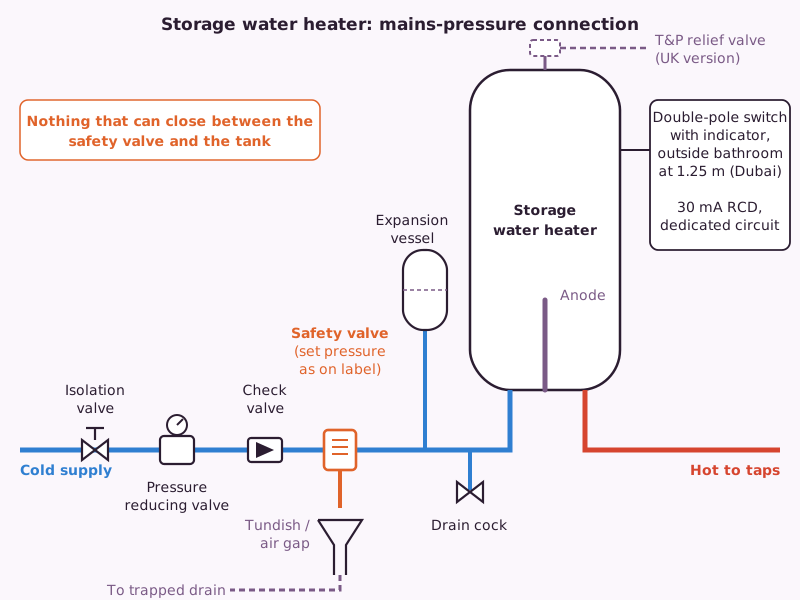
In the direction the water flows, from the pipe to the heater:
- Shut-off valve. Lets you isolate the heater without turning off the whole flat.
- Pressure reducing valve, only if the supply is above what the manual allows. Atlantic's limit is 0.5 MPa (5 bar). It goes on the supply after the meter, not screwed onto the heater.
- Check valve. Stops hot water flowing back into the cold pipe.
- Safety valve. Opens when the tank reaches its set pressure and lets water out. The rating must match the heater label.
- Expansion vessel, optional. It takes the extra water as the tank heats, so the safety valve stops dripping. It must sit after the check valve, or it cannot take anything from the tank. Gorenje's manual lists a 3-litre vessel for its 30–120 litre models; on the larger tanks at normal mains pressure that only cuts the drip. How to size one: expansion vessel for hot water.
- Drain cock. For emptying the tank to clean it or check the anode.
The check valve, safety valve and drain usually come as one unit, called a safety group. Separate valves do the same job if they sit in the same order.
The one rule you cannot break: nothing that can close goes between the safety valve and the tank. No valve, no plug. Atlantic allows nothing at all between its safety group and the tank, so check your heater's manual before you decide where the expansion vessel tee goes.
Which safety valve. Only the one on the label. Gorenje's valves come in 0.6, 0.9 and 1.0 MPa, and tank pressure must not go more than 0.1 MPa above the rating. Atlantic's manual gives 0.7 MPa in some sections and 0.9 MPa in others, so trust the label. A stronger valve "so it stops dripping" is how tanks end up bulging.
#Fitting it, step by step
- Check what will carry it. Gorenje's 80-litre heater weighs 30 kg empty and 110 kg full. Gorenje asks for fixings of at least 8 mm diameter and reinforcement where the wall is weak. Plain plasterboard will not carry it. The same Gorenje range may only hang upright. A heater lying above a ceiling must be a model whose manual allows horizontal mounting, fixed the way that manual shows.
- Leave room for the anode. The magnesium anode comes out through the flange, and Gorenje's drawings allow 80–260 mm for it, depending on tank size. Without that gap the heater has to come down every time.
- Measure the pressure with a gauge at the heater connection, at night when nobody is using water. Compare it with the manual and decide whether you need a reducing valve.
- Build the cold side in the order above. Cold goes into the blue connection.
- Build the hot side. If the manual shows a dielectric union (Atlantic's does), it goes on the hot outlet, the red one.
- Run the discharge. The valve outlet points down into a tundish or trap with a visible air gap between it and the drain. From there the pipe falls all the way, somewhere it cannot freeze. A hose pushed into a sealed waste fitting is not acceptable: you will never see the valve leaking.
- Pressure test the pipes before the walls are closed. See how to pressure test water pipes.
#First fill
The order here matters more than anything else in the job.
- Open a hot tap that is fed by the heater.
- Open the cold shut-off valve. The tank fills and the air comes out through the hot tap.
- When the hot tap runs steadily with no air, the tank is full. Close the tap.
- Lift the safety valve lever. Water should come out of the discharge. If nothing comes out, the valve is stuck or the discharge is blocked.
- Look at every joint. If one drips, drain down, tighten it and refill.
- Only now switch on the power and set the thermostat.
- Watch the discharge during the first heat-up. Dripping while it heats is normal. Water running when it is not heating, or a steady stream, is not.
An element switched on in an empty tank has nowhere to put its heat and is damaged. Both Atlantic and Gorenje warn about this.
After that, Atlantic asks you to work the safety valve lever at least once a month, so it does not seize.
#Electrics
The heater gets its own circuit from the consumer unit, with its own breaker and a 30 mA RCD. It needs a switch that breaks both live and neutral (Atlantic specifies a contact gap of at least 3 mm), and it must be earthed. Cable size and breaker rating follow the heater power and your local wiring rules.
Dubai is stricter and more specific:
- a double-pole switch with an indicator light;
- if the heater is in a bathroom or WC, the switch goes just outside the door;
- the switch is mounted 1.25 m above the finished floor;
- the heater is connected from a flex outlet plate next to it;
- the earth terminal sits beside the live and neutral terminals, under a splash-proof cover.
This is fixed wiring. An electrician does it.
#What goes wrong
- A valve between the safety valve and the tank. Someone closes it "for a minute" and the tank has no protection.
- Discharge plugged or piped into a sealed drain. The dripping stops, and so does the protection.
- A stronger safety valve to stop the drip. The tank now runs above its rating. Fix the cause with a reducing valve or an expansion vessel.
- Reducing valve screwed straight onto the heater instead of the supply after the meter. Atlantic forbids this.
- Power on before filling. A ruined element.
- Heater hung on plain plasterboard or small plugs. 110 kg will come down sooner or later.
- No access. You cannot reach the valves, the drain or the anode without breaking the ceiling or tiles.
- Thermostat below 60 °C to save money. The saving is small; the Legionella risk is not.
- Switch inside the bathroom, or no RCD.
#How to check the work
- The safety valve rating matches the heater label.
- There is no valve between the safety valve and the tank.
- Supply pressure was measured; if it is above the manual's limit, a reducing valve is fitted.
- The discharge is visible and falls all the way; you lifted the lever and water came out.
- The expansion vessel, if fitted, is on the cold side and its air pressure is set as the manual says.
- You can reach the drain cock.
- Nothing drips after filling or after the first full heat-up.
- The heater is properly fixed, with room to pull out the anode.
- Own circuit, the RCD trips when you press its test button, switch outside the bathroom.
- Thermostat at 60 °C or higher.
- The manual, valve rating, installer's name and date are filed with the flat's papers.
#When to call a professional
- Anything on the circuit, RCD or switch: call an electrician.
- The safety valve runs non-stop, the tank bulges, or hot water comes out of the discharge: switch the heater off at its switch and call a plumber.
- A heater with a coil, solar heating, a heat pump or a hot water return loop is a design job, not a heater swap.
- In the UK, an unvented heater with the UK safety kit must be fitted by an installer who can self-certify, otherwise the work has to be notified to building control.
If the heater goes in as part of a renovation, add the tray, its drain and the ceiling hatch as separate lines in the estimate, so they are priced and not skipped. Librae's first estimate is already line by line, with demolition and waste removal as items of their own, so taking out the old heater has a place too. Contractors reach the Librae directory only after their licence has been checked.
#In the UAE
Heaters above the bathroom ceiling. In Dubai flats the heater often lies on its side above the false ceiling of the bathroom. Atlantic requires a tray under the heater with a drain to the sewer in that position. Without one, any leak goes straight into the ceiling board and then to the neighbours below. If it is already leaking on you, see leaks from the flat upstairs.
Access panel. The Dubai Building Code requires valves to be reachable without damaging finishes. In practice that means a ceiling hatch big enough to reach the valves, drain and anode, and to lower the heater out.
Pressure. The Dubai code asks designers to fit reducing valves so that taps get no more than 1.5 bar in buildings and 2 bar in villas. That is a design target, not a guarantee at your heater, so measure at the heater connection.
Discharge. The code wants relief water to run by gravity into a deep-seal trapped tundish or onto a floor gully, with a visible break. A pipe pushed into a sealed waste fitting does not meet it.
Scale and the anode. Atlantic asks for the magnesium anode to be checked every two years and replaced once it is under 10 mm across, and for the tank to be descaled every 2–3 years depending on the water. Gorenje sets the first service at about two years after fitting.
Temperature. Keep stored water at 60 °C or higher, and the code wants 50 °C at the tap within one minute. Water above 50 °C can scald at once, so scald protection comes from thermostatic mixing valves, not a low thermostat. The code recommends no more than 41 °C at showers and basins and 44 °C at baths. Some heaters run their own cycle: Gorenje's heats to 62 °C for 15 minutes if it has not reached 62 °C for 30 days.
Buying the heater. The code says water heaters must be certified and approved by the local authority. Ask the seller for the approval of that exact model.
Villas. New villas must heat their water with solar or a heat pump, with an efficient electric heater usually as backup. That is a system design, not a simple swap.
Before you replace it, ask your building's facilities management (FM) or the landlord if you rent. The heater is often treated as part of the building's water system. Whether you need approval depends on the building; see renovation permits in Dubai.
#What the codes say
For readers who want to know where the numbers come from. Full references are in the source list below.
| Safety group (Europe) | UK unvented heater | Dubai Building Code 2021 | |
|---|---|---|---|
| What it is | One unit on the cold inlet: shut-off, check valve, safety valve, drain, air break (EN 1487:2014, Table 1) | A package from the maker: inlet controls plus a factory-fitted relief valve on the tank (ADG 3.22, 3.39) | Rules for the whole water system; no clause lists a heater's valve kit |
| Pressure | Safety valve; groups cover 0.1–0.7 MPa | Expansion relief valve; a T&P valve also reacts to pressure | Reducing valves; 1.5 bar at outlets (H.5.11), 2 bar in villas (K.10.2.11) |
| Overheating | The group does not control temperature; the thermostat and cut-out do (EN 1487 §1, §3.5) | Two independent devices besides the thermostat, usually a cut-out plus a T or T&P valve (ADG 3.17–3.18) | No heater-level clause; hot water designed to UK Water Fittings Regulations, BS EN 806 and BS 8558 (H.5.10) |
| Discharge | To drain through an air break | Metal pipe to a tundish within 600 mm, then 300 mm drop and a fall of 1:200 or more, ending somewhere safe and visible (ADG 3.50–3.62) | By gravity into a deep-seal trapped tundish or onto a floor gully (H.6.2.3) |
| Electrics | Local rules | Local rules | Own circuit, 30 mA RCD, double-pole switch with indicator outside the bathroom at 1.25 m (G.4.13.7, G.4.18.5, Table G.21; K.9.1.13.6) |
| Who fits it | Per manufacturer and national rules | Competent installer, notifiable unless self-certified (ADG 3.40–3.42) | Heaters certified and approved by the authority (H.5.11) |
Other points from the codes. In the UK, heaters of 15 litres or less with suitable temperature and pressure devices generally do not need the full package (ADG 3.19), and new baths are limited to 48 °C (ADG 3.65). The Dubai code requires a pumped hot water return at 50–55 °C, unless trace heating is used, with balancing valves on all sub-circuits (H.5.10, K.10.2.9); a single apartment heater on short pipes normally has no return loop. Water softening is decided from a water analysis at design stage (H.5.6.2). EN 1717 is the European standard on protecting drinking water from backflow; the air gap at the tundish is what does that job here.
This guide explains good practice and cites the documents listed below. It is not a permit, a design approval or an engineering opinion. Work on electrical, gas, fire-safety and structural elements must be carried out by licensed professionals and approved by the relevant authority.
Sources
- Dubai Building Code 2021, Part G, G.4.13.7 Control of water heaters (p. 441), G.4.18.5 Mounting heights (p. 461), Table G.21 (p. 465) — Double-pole switch with indicator outside the bathroom, flex outlet next to the heater, dedicated final circuit, earth terminal, 30 mA RCCB, switch at 1.25 m.
- Dubai Building Code 2021, Part H, H.5.4.1, H.5.6.2, H.5.7, H.5.8, H.5.10, H.5.11 (pp. 594–605) and H.6.2.3 (p. 608) — Storage at 60 °C or more, 50 °C at outlets within 1 min, mixing valve outlet temperatures, pumped return, PRVs and 1.5 bar outlet pressure, accessible isolation valves, softening, approved heaters, indirect discharge of relief lines.
- Dubai Building Code 2021, Part K (villas), K.9.1.13.6 (p. 782), K.10.2.9–K.10.2.11 (pp. 826–828) — Same electrical rules for villas, 60 °C storage, solar or heat pump for villa hot water, outlet pressure not above 2 bar.
- Approved Document G (England), 2015 edition incorporating 2016 and 2024 amendments, section G3, paragraphs 3.17–3.65 — UK unvented rules, two independent safety devices, T&P valve, tundish and discharge pipe D1/D2 geometry, notification, 48 °C bath limit.
- EN 1487:2014 Building valves — Hydraulic safety groups — Tests and requirements (scope and definitions, public sample) — What a safety group does and does not do; 0.1–0.7 MPa working pressure range; components in upstream order.
- Atlantic Chauffeo / Chauffeo+ electric water heater installation and operating manual, edition February 2021 — Safety group to EN 1487, PRV above 0.5 MPa, filling procedure, monthly valve operation, drip tray in ceilings and lofts, anode check, electrical isolation, pipes rated 100 °C and 1 MPa, scalding above 50 °C.
- Gorenje TGR 30–120 SM storage water heater instructions for use — Safety valve ratings and 0.1 MPa overpressure limit, no shut-off valve before the safety valve, fill before power, 3-litre expansion tank, anode clearance, weights, temperature after thermostat failure, 62 °C cycle.
- NIST Chemistry WebBook, thermophysical properties of water — Density 999.70 kg/m³ at 10 °C and 983.20 kg/m³ at 60 °C, used for the expansion calculation.