
Plumbing and water heating/UAE
Water heater above the bathroom ceiling: tray, access and upkeep
Keeping a water heater above a UAE bathroom ceiling safe. Drip tray and drain, hatch, anode and scale, temperature and Legionella, and replacement.
In many Dubai flats the water heater lies on its side above the bathroom's false ceiling, and you reach it through a hatch. Often there is a second one above the kitchen ceiling; everything below applies to it too. Up there it needs four things: a tray under it with a drain that works, a hatch big enough to reach the valves and the anode, a yearly check of the anode and the scale, and a thermostat at 60 °C or more. In a managed tower the heater is usually yours to look after, and replacing it needs the building's approval first.
Valves, discharge, first fill and electrics are in how to connect a water heater. This guide is about living with a heater above your ceiling.
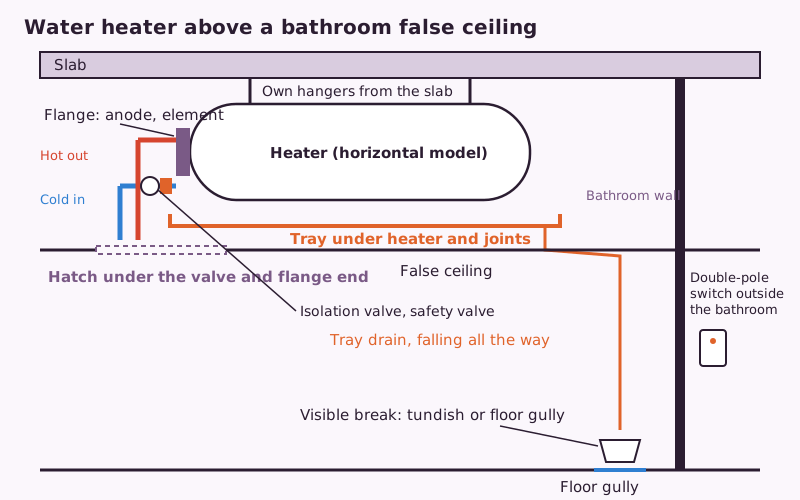
#The tray and its drain
A flat's heater holds 50 to 100 litres. When a tank or joint fails, that water goes into the ceiling board, then the lights, then the flat below.
Atlantic makes a tray under the heater compulsory when it sits in a false ceiling, under a roof or above living space, with a drain to the sewer. A.O. Smith, whose horizontal heaters are sold in the Gulf, asks for the heater to be placed where a leak cannot cause damage. A tray meets both. It works when:
- It is bigger than the heater and sits under all the joints, not just the tank.
- It has its own drain, falling all the way to a floor gully or a tundish where you can see water arrive. The Dubai code asks for this visible break on safety valve discharge, not on trays, but a tray drain run the same way shows you a leak before the ceiling does.
- The drain is clear. Once a year, pour a cup of water into the tray and watch it come out below.
No tray? Fitting one means lifting the heater, so do it at the next service or replacement.
#The hatch
The Dubai code wants valves reachable without breaking finishes. For a heater that means a hatch under the end with the valves and the flange, where the anode and element come out. Atlantic asks for 40 cm of free space at that end to service the element.
Getting the whole heater out is another matter. A.O. Smith's horizontal 80-litre model is 785 mm long and 425 mm across. If your heater will not pass through the hatch, agree now where the ceiling will be cut on replacement day, and keep that strip free of lights. Panel sizes and framing: ceiling access panels.
#Anode and scale
A magnesium anode is a rod that corrodes so the glass-lined steel tank does not. Once it is gone, the tank rusts. Scale builds up on the element and in the tank; Atlantic links a kettle-like rumble to it.
| Task | A.O. Smith | Atlantic | Emaar's guide |
|---|---|---|---|
| Check the anode | Every year; replace above 60 % wear | Every 2 years; replace under 10 mm | — |
| Scale | Check the element every year | Descale the tank every 2–3 years | Flush the tank every year |
| Safety valve lever | Every two months | Every month | Test the relief valve every year |
| General look for leaks and rust | — | Professional check every 2 years | Every 6 months |
Follow your heater's manual. Without it, take the stricter column.
The anode and the element come out through the flange, so the tank has to be drained. A.O. Smith's order: power off, run the hot taps until the water runs cool, close the cold supply, then drain from the flange end into a vessel. Above a ceiling, that is a plumber with a hose to the floor drain, not a bucket on a ladder.
A.O. Smith's tank warranty, five years on residential tanks, depends on the safety valve and anode being kept in working order, and is void if the water is softened too far. Keep the service invoices.
#Temperature and Legionella
Legionella bacteria multiply in water between 20 and 45 °C and infect people who breathe in fine spray, which is exactly what a shower makes. The UK's health and safety regulator says hot water should be stored at 60 °C or more, and should reach 50 °C at the tap within a minute. The Dubai code requires the same.
Emaar's maintenance guide suggests 50 °C on the thermostat. That is 10 °C short of both. Keep the tank at 60 °C and stop scalding at the taps with thermostatic mixing valves; the Dubai code recommends 41 °C at the shower, 38 to 41 °C at the basin and 44 °C at the bath. Water above 50 °C can scald at once, which matters with children in the house.
Some heaters run their own cycle. Gorenje's heats to 62 °C for 15 minutes if the tank has not reached 62 °C in 30 days.
After a holiday or a summer off. Trakhees tells residents to switch heaters off if they will not be used for more than 24 hours and before holidays; Emaar's guide gives the same advice for long summer breaks in its villa communities. Water left in a switched-off tank cools into the range where Legionella grows. When you come back, switch on and let the heater reach 60 °C before anyone showers. Then run each hot tap and the shower for a few minutes, with the shower head pointed down into the drain so it does not spray.
Atlantic also wants the space around the heater ventilated and no hotter than 35 °C.
#Warning signs
| What you notice | Likely cause | What to do |
|---|---|---|
| Steam from the shower, water far too hot | Thermostat set too high or failed | Switch off at once, call a plumber |
| Water in the tray, stain on the ceiling | Joint, valve or tank leak | Switch off, close the cold valve, check the tray |
| Rumbling or kettle noise while heating | Scale | Book a descale |
| Safety valve drips when the heater is not heating | Supply pressure too high | See expansion vessel and connecting a heater |
Atlantic's own fault table says a leak from the tank itself means corrosion and a new heater.
Trakhees issued its rules in 2012 after a heater exploded in a Palm Jumeirah flat: the thermostat did not meet the standard and there was no thermal cut-out behind it. An overheating heater is not a nuisance. Switch it off.
#Replacing it
- Approval. In a managed tower, ask the community manager or FM. Emaar's rules for Downtown towers require prior written approval for replacing a water heater. A tenant asks the landlord.
- Choose a certified model. The Dubai code says heaters must be certified and approved by the authority. In the UAE that is a MoIAT conformity certificate (ECAS) listing the model, the standards and the energy star rating. Ask the seller for it; it can be checked through UAE Pass.
- Same position. A heater lying above a ceiling must be a model its maker allows to be mounted horizontally, hung from the slab on its own fixings, not from the ceiling grid.
- New safety valve and connections, a tray with a working drain, and the electrics checked. The details are in how to connect a water heater.
- Fill before power, check every joint above the ceiling, and look again after the first full heat-up.
Where Trakhees is the authority, Palm Jumeirah among them, its circular also asks for the thermostat and the pressure relief valve to be inspected and replaced every two years, whatever their condition.
Replacing the heater during a renovation is the moment to add the tray, the drain and a proper hatch. Draw them in the Librae project with the bathroom ceiling, and the ceiling area and the hatch are in the quantities before the old ceiling comes down. If the flat is in the UAE and the renovation is ordered through Librae, add independent quality control as well: the tray drain and connections get checked while the ceiling is still open.
#What goes wrong
- No tray, or a tray with a blocked or missing drain. The leak goes through the ceiling.
- A hatch under the wrong end or too small for the flange. Every service starts with cutting the ceiling.
- Thermostat turned down to 50 °C or lower to avoid scalding.
- Anode never checked until the tank leaks.
- Discharge and tray drains piped into a sealed fitting. You never see the valve leaking.
- Lights and ducts built across the strip the heater has to come down through.
- A replacement fitted without the building's approval.
#How to check the work
- There is a tray under the heater and the joints, with its own drain; a cup of water poured in comes out below.
- The safety valve discharges somewhere you can see.
- The hatch opens under the valve end and you can reach the isolation valve with one hand.
- You know how the heater would come out, and that strip has no lights in it.
- The thermostat is at 60 °C or more; mixing valves protect the taps.
- You have the manual, the certificate and the date the anode was last checked.
- The double-pole switch with its light is outside the bathroom.
#When to call a professional
- Plumber: anode, descaling, valves, tray and drain, leaks, replacement.
- Electrician: switch, circuit, RCD, thermostat wiring.
- FM or the community manager: approval for a replacement, and any leak that reaches another flat. If the water is coming from above, see leaks from the flat upstairs.
- Landlord, if you rent.
#What the codes say
- Dubai Building Code 2021: Legionella control strategy (H.5.6.1); accessible valves (H.5.7); 60 °C storage, 50 °C in 1 minute, mixing valves and Table H.7 (H.5.10); heaters certified and approved (H.5.11); indirect discharge to a tundish or gully (H.6.2.3); heater electrics (G.4.13.7).
- Trakhees Circular EHS/IO/04/12 and Safety Alert IO/02/12 (2012): approved heaters, two-yearly thermostat and relief valve replacement, switch-off rules.
- Emaar verticals rules 2026 §7.11: owner maintains the heater, approval for replacement. Law No. 6 of 2019, Art. 9: equipment serving the unit is part of it.
This guide explains good practice and cites the documents listed below. It is not a permit, a design approval or an engineering opinion. Work on electrical, gas, fire-safety and structural elements must be carried out by licensed professionals and approved by the relevant authority.
Sources
- Dubai Building Code 2021, Part H, H.5.6.1 (PDF p. 601), H.5.7 (p. 602), H.5.10 and Table H.7 (p. 604), H.5.11 (p. 605), H.6.2.3 (p. 608); Part G, G.4.13.7 (p. 441) — Legionella strategy, accessible valves, 60 °C storage and 50 °C at outlets in 1 minute, mixing valve temperatures, approved heaters, indirect discharge to a tundish or gully, heater electrics.
- Atlantic Chauffeo / Chauffeo+ electric water heater installation and operating manual, February 2021 — Tray compulsory in a suspended ceiling or above living space, drained to the sewer; 40 cm free for servicing the element; ventilated space up to 35 °C; 65 °C factory setting; anode every 2 years, replace under 10 mm; descaling every 2–3 years; troubleshooting for noise, leaks and steam.
- A.O. Smith MEV/MEH 50–100 EC instruction manual (Middle East), rev. 2019 — Place where a leak cannot cause damage and accessible; safety valve every two months; element and anode yearly, anode replaced above 60 % wear; drain-down steps; 75 °C thermostat, 87 °C cut-out, 8 bar; warranty conditions.
- MoIAT ECAS certificate of conformity no. 26-01-178780/E26-01-186727/NB0010, A O Smith Water FZE (2026) — Horizontal MEH heaters registered to UAE.S 5010-4:2014, IEC 60335-1 and IEC 60335-2-21; MEH 80 EC 785 mm long, 425 mm diameter; verifiable through UAE Pass Self-Care.
- Trakhees (PCFC) Circular EHS/IO/04/12 and Safety Alert IO/02/12, 2 August 2012 — Approved heaters; thermostat and relief valve inspected and replaced every two years; switch off when unused over 24 hours; steam from the shower means switch off; the alert describes a heater explosion in a Palm Jumeirah flat.
- HSE (UK), Legionnaires' disease, what it is and things to consider — Growth at 20–45 °C, infection by inhaled droplets, storage at 60 °C, 50 °C within a minute, weekly flushing of little-used outlets, quarterly showerhead descaling.
- Emaar Community Management, Rules and Regulations for Vertical Communities (Downtown Dubai), January 2026, §7.11 — Owner maintains the water heater; prior written approval for replacement or upgrades.
- Emaar Community Management, Property Maintenance guide (2025) — Water heater table — flush yearly, test the relief valve yearly, 50 °C setting, leaks and corrosion every 6 months (buildings); switch off for long summer breaks (villa communities only).
- Law No. (6) of 2019 Concerning Ownership of Jointly Owned Real Property in Dubai, Article 9 — Equipment serving only the unit is part of the unit.