
Cooling and air/UAE
Chiller, VRF or split: what cools UAE homes and how to tell yours
District cooling, a building chiller, VRF, ducted split or wall split. How to tell which one your flat or villa has, who runs it, how you pay and what you may change.
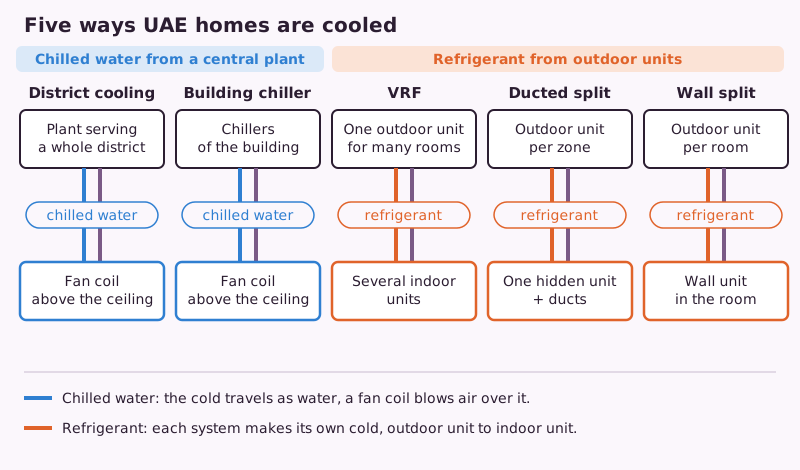
Homes in the UAE are cooled in one of two ways. Either chilled water from a central plant runs to a fan coil in your flat, or refrigerant runs from outdoor units to indoor units that are yours alone. The first is district cooling or the building's own chiller plant. The second is VRF, a ducted split or a wall split. Which one you have decides who you call, how you pay and what you may change. Many Dubai towers are on chilled water. Villas usually have their own splits or VRF, though some communities are on district cooling.
#How to tell what you have
A few minutes and no tools:
- Look at the bills. A monthly cooling bill with a capacity charge and ton-hours means district cooling. It may come from the provider, such as Empower, Emicool, Tabreed or Emaar District Cooling, or from a billing agent working for it. The Dubai Building Code names these four providers and says the list is not complete.
- No cooling bill, but a "chiller" or "AC" line in the service charge usually means the building makes its own chilled water. Ask FM.
- Only a DEWA bill and nothing for cooling usually means a refrigerant system of your own, and its electricity is in that DEWA bill.
- Look outside. An outdoor unit on your balcony, on the roof above your villa or in its yard means a refrigerant system. In a flat, an empty balcony proves nothing: some buildings put each flat's outdoor unit on the roof, and a hidden ducted split looks much like a fan coil from below. The bills settle it.
- Count indoor units per outdoor unit. One outdoor unit to one wall unit is a wall split. One small outdoor unit to two or more wall units is a multi-split. One outdoor unit and a hidden ceiling unit with ducts to several rooms is a ducted split. One large outdoor unit feeding many indoor units, each with its own controller, is usually VRF.
- Ask. FM, the landlord or the developer's handover file will name the system. In a villa, the outdoor unit's rating plate gives the make and model.
#The five systems
| District cooling | Building chiller | VRF | Ducted split | Wall split | |
|---|---|---|---|---|---|
| Where the cold is made | Plant serving many buildings | Chillers on or in your building | Outdoor unit | Outdoor unit | Outdoor unit |
| How it reaches the room | Chilled water to a fan coil | Chilled water to a fan coil | Refrigerant to indoor units | Refrigerant to one hidden unit, then ducts | Refrigerant to a wall unit |
| Your bills | Provider bill plus DEWA for the fan | Service charge or meter, plus DEWA | DEWA | DEWA | DEWA |
| Who looks after the plant | Provider, then FM | FM | You | You | You |
District cooling. A plant with chillers, cooling towers and sometimes chilled-water storage tanks serves a whole district through pipes under the streets. In Dubai, providers need a permit from the regulator (RSB). How it works and what the bill means are covered in district cooling in Dubai.
Building chiller. The same idea on a smaller scale: chillers on the roof or in a plant room serve one building or one project. In your flat it looks exactly like district cooling: a fan coil above the ceiling. Under the Dubai code, a building cooled from a central plant must have a chilled-water meter for each flat, so you may still get a bill for your own use.
VRF (Daikin calls it VRV). One outdoor unit sends refrigerant, not water, to several indoor units, and adjusts the flow for each zone. It turns up in villas and in some buildings. Indoor units can be ducted, cassette or wall-mounted.
Ducted split. One indoor unit hidden in the ceiling, one outdoor unit, and ducts to grilles in several rooms. The return grille holds the filter. Motorised dampers can split it into zones.
Wall split. One indoor unit on the wall, one outdoor unit outside, for one room. The Dubai code wants every room AC unit on its own circuit from the distribution board, with a double-pole switch next to it.
The two water systems use the same fan coil in the flat, so everything in our fan coil guide applies to both.
#In an apartment
The usual situation in a tower: a fan coil above a false ceiling, a thermostat on the wall, no outdoor unit of your own. In buildings designed to the 2021 Dubai code the fan coil sits over a wet area, a bathroom or kitchen, so leaks do less damage; in older towers it can be anywhere above the ceiling.
What that means for you:
- The plant is not yours. The building's cooling system is a common part under Dubai's jointly owned property law, run by FM and paid for through the service charge. With district cooling, the provider looks after everything up to the meter.
- The fan coil is yours. Equipment serving only your flat is part of your unit, unless the site plan says otherwise. Emicool's agreement puts everything after the meter on the customer.
- Problems go to FM first, not to the provider. Emicool tells its customers the same.
- If you rent, the landlord is responsible for repairs that affect your use of the flat, unless the contract says otherwise.
Can I add a split unit? On district cooling, not without the provider and the building. Emicool's standard agreement, which owners and tenants sign, says the customer must not use any air-conditioning devices in the premises besides its service. For a breach the customer pays to remove them, pays a fine of AED 3,000 a month and the declared-load fees for that time, and Emicool may report it to the Land Department, the owners' association and the master developer. Other providers have their own terms, so read yours. A new outdoor unit also touches the facade, which is a common part. In practice you start with the building's management or the developer. Dubai's jointly owned property law adds that substantial changes to the external appearance need the master developer, the Dubai Land Department and the authority. If a room is too warm, have FM check that fan coil first.
Some buildings have no chilled water at all: each flat has its own wall splits or a ducted split, with the outdoor units on balconies or on the roof. Then the units are yours, their electricity is on your DEWA bill, and you call your own AC company, though the building still controls where outdoor units go.
#In a villa
Villas usually have their own refrigerant systems: ducted splits, sometimes VRF, sometimes wall splits in added rooms. Everything is yours: the outdoor units, the indoor units, the ducts and the electricity. Some villa communities are on district cooling instead, and the Dubai code makes those follow the same district cooling rules as towers.
What the Dubai code asks for in new villas:
- Comfort range of 22.5–25.5 °C and 30–60 % humidity for 95 % of the year.
- Efficiency. Household ACs must meet the UAE energy label standard (UAE.S 5010-1), chillers the ASHRAE 90.1 efficiency tables.
- Controls. Every system needs its own programmable controller with a timer and temperature control, and room sensors on an interior wall away from grilles, doors, windows, sun and lamps.
In practice villa owners keep an annual maintenance contract with an AC company, cleans or checks filters between visits, and keeps the outdoor units free of sand, plants and storage. Replacing a system is a design job: a load calculation for each room, not "same size as the old one".
#What goes wrong
- Assuming "chiller" means the building pays. Read the tenancy contract or the sale documents to see who pays which cooling charge.
- Adding a split to a district-cooled flat to fix one warm room. Under Emicool's terms that means a monthly fine and removal at your cost, and the real fault in the fan coil is still there.
- Calling the provider for a warm room. Go to FM first.
- Villa outdoor units boxed in by storage, planting or a new pergola. They need free air.
- Replacing villa units like-for-like without checking the load after an extension or a converted room.
#How to check before you buy or rent
- You know the system: district cooling, building chiller, VRF, ducted split or wall split.
- For chilled water: the provider's name, who pays capacity and consumption, and whether there is a meter for the flat.
- The contract says who pays cooling charges and who maintains the AC.
- Every room cools to about 24 °C, and the fan coil or indoor unit has access for service.
- For a villa: age and make of the outdoor units, the last service report, and whether an AC maintenance contract runs.
- No water marks under fan coils or indoor units.
#When to call a professional
- FM: anything on chilled water inside the flat, and any question about the building's plant.
- The cooling provider: bills, meters and the account on district cooling. See district cooling in Dubai.
- An AC maintenance company: service and faults on your own splits or VRF.
- An MEP engineer: before replacing or adding systems in a villa, and before any change to fan coils, ducts or outdoor units in a flat. The building and the community will want approved drawings; see renovation permits in Dubai.
Even a renovation that keeps the existing system needs a plan showing indoor units, grilles and hatches. Drawn in Librae, in 2D with a 3D view, it is a starting point for the drawings the building asks for, and the contractor checks it in the flat on a free visit before agreeing it.
#What the codes say
- Executive Council Resolution No. 6 of 2021 (Dubai): what counts as a district cooling plant and network, and who may provide the service, Art. 1.
- Dubai Building Code 2021: district cooling providers, Ref. G.9; room AC circuits and switches, G.4.13.8; fan coils in wet areas, H.4.3; efficiency standards, H.4.8.1; chilled water meters per dwelling, H.4.14.4; villas on district cooling, K.9.6; villa comfort range, efficiency label and controllers, K.10.1.4, K.10.1.5.1, K.10.1.10.1.
- Law No. 6 of 2019: common parts, Art. 7; parts of the unit, Art. 9; substantial alterations to the structure or external appearance, Art. 39. Law No. 26 of 2007: landlord maintenance, Art. 16.
- Emicool standard Chilled Water Cooling Services Agreement, as published on its Customers page: maintenance split at the meter, no other air-conditioning devices.
This guide explains good practice and cites the documents listed below. It is not a permit, a design approval or an engineering opinion. Work on electrical, gas, fire-safety and structural elements must be carried out by licensed professionals and approved by the relevant authority.
Sources
- Executive Council Resolution No. (6) of 2021 Regulating the Provision of District Cooling Services in the Emirate of Dubai, Art. 1 — Definitions of district cooling plant (chillers, thermal storage, cooling towers, pumping stations), network serving one or more buildings, service providers authorised by the RSB.
- Dubai Building Code 2021, Parts G, H and K — District cooling providers (Ref. G.9, PDF p. 416); one circuit and a double-pole switch for each room AC unit (G.4.13.8, p. 441); fan coils in wet areas (H.4.3, p. 565); efficiency tables for split, multi-split units and chillers (H.4.8.1, p. 569); chilled water meter per dwelling with a central plant or district cooling (H.4.14.4, p. 586); district cooling in villa communities (K.9.6); villa comfort range, AC efficiency label and programmable controllers (K.10.1.4, K.10.1.5.1, K.10.1.10.1, pp. 817, 822).
- Emicool, Customers page, Customer Rights and Obligations, and FAQ (read 1 November 2026) — Provider maintains up to the meter, customer after it; no other air-conditioning devices, AED 3,000 per month fine plus declared load fees; district cooling delivers chilled water; cooling problems go to FM first.
- Law No. (6) of 2019 on jointly owned real property in Dubai, Art. 7, 9 and 39 — Facades and building cooling systems are common parts (Art. 7(a)(1), (a)(4)); equipment serving only the unit is part of it (Art. 9(a)(4)); substantial changes to the structure or external appearance need the master developer, DLD and competent authority (Art. 39(a)).
- Daikin, Variable refrigerant volume (VRV) systems — VRV distributes refrigerant rather than water from the outdoor unit to multiple indoor units and adjusts refrigerant flow for each zone.
- Daikin Middle East and Africa, concealed ceiling units; Daikin Australia, key components of a ducted system — Ducted system = indoor unit hidden in the ceiling, outdoor unit and flexible ducting to vents; return air grilles with a filter; motorised dampers for zoning (daikin.com.au FAQ).
- Law No. (26) of 2007 regulating landlords and tenants in Dubai, Art. 16 — Landlord responsible for maintenance and repairs affecting the tenant's use, unless agreed otherwise.