
Bathrooms and wet areas/Global · UAE
Bathroom electrics: zones, IP ratings and 30 mA RCDs
Where lights, fans, towel rails, mirrors and shaver sockets may go in a bathroom, which IP rating to buy, what RCD protection is needed, and Dubai's stricter rules.
Bathroom electrics are planned by zones around the bath or shower. Zone 1 takes only fixed, wired-in equipment, and everything in zones 1 and 2 must be splash-proof, at least IPX4. Every circuit serving the room goes through a 30 mA RCD, and ordinary sockets stay well away from the water. Dubai goes further: no sockets in the bathroom apart from a shaver unit, and light switches outside the door.
The zones and numbers come from the British wiring regulations, BS 7671, which the Dubai Building Code is based on. Countries on the IEC rules use similar zones; check your local code.
#The zones
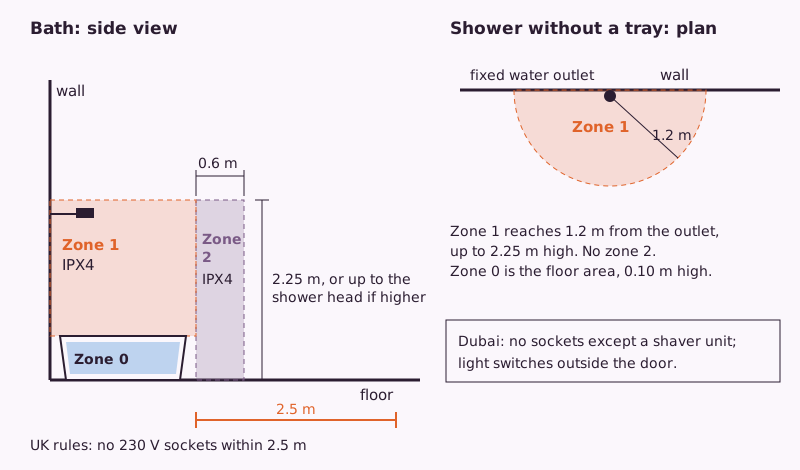
- Zone 0 is the inside of the bath or shower tray, the part that holds water. In a shower without a tray, it is the floor area of zone 1, 0.10 m high.
- Zone 1 is the space above the bath or tray, up to 2.25 m from the floor, or up to a fixed shower head if it sits higher. The space under the bath is zone 1 too if you can get into it without a tool; a bath panel held by screws keeps it outside the zones.
- Zone 2 is a 0.6 m band beside zone 1, to the same height.
- Shower without a tray. There is no zone 2. Zone 1 reaches 1.2 m sideways from the centre of the fixed water outlet on the wall or ceiling, and up to 2.25 m, or to the shower head if it is higher. In a small bathroom that circle takes in a lot of the room. Planning the shower floor itself: walk-in shower without a tray.
Outside the zones is still the bathroom. General equipment can go there if its circuit has a 30 mA RCD.
#What may go in each zone
| Zone | Allowed | Minimum rating |
|---|---|---|
| 0 | Only fixed equipment made for zone 0, fed at extra-low voltage: up to 12 V AC or 30 V DC, with the safety transformer outside the zones | IPX7 |
| 1 | Fixed, permanently connected: electric showers and pumps, whirlpool units, extractor fans, towel rails, water heaters, light fittings; and extra-low-voltage equipment up to 25 V AC or 60 V DC with the source outside the zones | IPX4 |
| 2 | Anything rated IPX4; shaver supply units where shower spray is unlikely to reach; switches and sockets of extra-low-voltage circuits only | IPX4 |
| Outside | Other equipment, switches and accessories | Circuit on 30 mA RCD |
What the IP numbers mean. The first digit is protection from solid objects, the second from water. X means the first digit was not tested. IPX4 takes splashing from any direction; IPX7 takes a short dip under water.
When you buy fittings:
- Downlights over the bath or in the shower. IPX4 at least, for the whole fitting as installed, not just the front glass.
- Extractor fan. In zone 1 or 2, a fixed fan rated IPX4. Its isolator switch goes outside the zones.
- Towel rail. Fixed and wired in, not plugged in. In zones 1 and 2, IPX4.
- Mirror with lights. Ideally outside zones 1 and 2; inside them, IPX4.
- Shaver unit. A shaver supply unit with its own isolating transformer, to BS EN 61558-2-5. It is not splash-proof, so put it where the shower cannot reach.
#30 mA RCD on every bathroom circuit
The British rules want a 30 mA RCD on every low-voltage circuit that serves the bathroom: lights, fan, towel rail, water heater and any shaver unit. Circuits that only pass through zones 1 or 2 on their way elsewhere need one too.
An RCD trips when current leaks to earth, for example through a wet hand on a faulty fitting. An ordinary breaker does nothing in that case. What sits on your board is in electrics in a UAE flat; how the RCD is tested is in electrical testing after a renovation.
#Supplementary bonding
Supplementary bonding is a green-and-yellow cable joining the metal parts in a bathroom, such as metal pipes and the earth terminals of fittings, so they cannot sit at different voltages during a fault.
The British rules let the electrician leave it out if all three of these hold:
- every final circuit in the bathroom disconnects automatically in a fault within the required time;
- every final circuit in the bathroom has a 30 mA RCD;
- every metal part that could bring in a different potential, such as metal water pipes, is already connected to the building's main bonding.
If any one is missing, for example in an older flat where a bathroom circuit has no RCD, the bonding goes in. Any change to an existing bathroom must meet the bathroom rules in full, so sort this out during the refit.
#What goes wrong
- IP20 downlights over the shower. Cheap living-room downlights are not splash-proof. Water gets in and trips the RCD, or worse.
- Zone 1 forgotten in a walk-in shower. Without a tray, zone 1 reaches 1.2 m from the shower head. A fan or light "outside the shower" may still be inside it.
- A plug-in heater or hair dryer on an extension lead. Zone 1 takes only fixed, wired-in equipment, and a trailing lead brings a socket in by the back door.
- A shaver unit in the spray. It is not splash-proof.
- Bathroom lights on a 100 mA RCD. Dubai's code allows 100 mA on general lighting, but the British rules it is based on want 30 mA on every bathroom circuit.
- Bonding cut during the refit. The old cable goes when the pipes are changed, and nobody checks that the three conditions now hold.
#How to check the work
- Every fitting in zones 1 and 2 is marked IPX4 or higher; anything in zone 0 is marked IPX7 and runs at extra-low voltage.
- In a walk-in shower, everything within 1.2 m of the shower head is treated as zone 1.
- The bathroom circuits are behind a 30 mA RCD; press the test button and the bathroom goes dark.
- Towel rail and fan are wired in, not plugged in.
- Sockets: none in a Dubai bathroom; under the British rules none within 2.5 m of zone 1.
- The shaver unit is out of the shower's reach.
- Bonding is in place, or the electrician confirms in writing that the three conditions for omitting it are met.
- The test results list the bathroom circuits with their RCD trip times.
#When to call a professional
All fixed wiring in a bathroom is a job for a qualified electrician; in Dubai, for a contractor enrolled with DEWA. Call one if the RCD trips when someone showers, a fitting mists up inside, or you feel a tingle from a tap or towel rail. Until then, switch the bathroom circuit off at the board.
Put the lights, any shaver socket and the switches outside the door on the bathroom plan before the electrician prices the job. Electricians in the Librae directory are listed only after Librae has checked their licence. If you are in the UAE and order the renovation through Librae, independent quality control looks at the first-fix wiring while the walls are still open.
#In the UAE
The Dubai Building Code takes its electrical rules from BS 7671, so the zones, IP ratings and 30 mA RCD apply. It adds its own bathroom rules, the same as DEWA's:
- No sockets in bathrooms. The only outlet allowed is a shaver socket with a safety isolating transformer. A hair dryer socket goes outside.
- No switches in bathrooms. Light switches and the water heater switch go outside, next to the door, at 1.25 m. The water heater switch is a double-pole switch with a neon indicator.
- Shaver sockets and mirror lights count as extra-low-voltage equipment with a safety isolating transformer. The shaver socket goes at 1.25 m.
- RCD ratings. The code's table gives 30 mA for the water heater and 10 mA for jacuzzi pumps and underwater lights. For general lighting it allows 30 or 100 mA; in the bathroom, ask for 30 mA.
- Fan coil above the bathroom ceiling. The code's table suggests 100 mA for fan coils. If yours sits above the bathroom's false ceiling, ask the electrician which RCD protects it and whether they treat it as a bathroom circuit; if they do, BS 7671 wants 30 mA. A water heater above the ceiling is on 30 mA under both rulebooks.
- Bonding. All metalwork, including metal water pipes, is bonded to the main earthing terminal with a main bonding conductor of at least 6 mm².
Who may do the work and what approvals you need: electrics in a UAE flat. The water heater's wiring: connecting a water heater. If you are redoing the shower floor, finish the waterproofing and flood test before any fittings go in.
#What the codes say
The zones, IP ratings, socket distance, RCD rule and bonding conditions are from BS 7671:2018+A2:2022, Section 701 (Regulations 701.411.3.3 for the RCD, 701.415.2 for supplementary bonding, 701.512.3 for sockets), as summarised in SELECT's pocket guide. Since 15 October 2026 the current edition is BS 7671:2018+A4:2026; the NICEIC summary of Amendment 4 and other published overviews do not list Section 701 among the changes, but we have not seen the full A4 text, so the figures are labelled as A2:2022. The older 17th edition put the socket limit at 3 m; it is 2.5 m in the 18th. In Dubai, Part G of the Dubai Building Code 2021 covers bathroom switches and sockets in G.4.18.4, shaver sockets in G.4.13.2 and G.4.13.9, water heater controls in G.4.13.7, mounting heights in G.4.18.5, RCD ratings in Table G.21 and bonding in G.4.19.5. DEWA's Regulations for Electrical Installations, 2017 edition, say the same in sections 4.6 and 7.4.
This guide explains good practice and cites the documents listed below. It is not a permit, a design approval or an engineering opinion. Work on electrical, gas, fire-safety and structural elements must be carried out by licensed professionals and approved by the relevant authority.
Sources
- SELECT, Electrical installations in locations containing a bath or shower, pocket guide TS 19-001 (based on BS 7671:2018+A2:2022, Section 701) — Zone dimensions, permitted equipment and IP ratings per zone, socket distance, 30 mA RCD, conditions for omitting supplementary bonding.
- IET Wiring Matters via Voltimum, Section 701 Locations containing a bath or shower (G. Cronshaw) — Regulation numbers 701.411.3.3, 701.415.2, 701.512.3; shaver supply units only where direct spray is unlikely.
- NICEIC, Understanding BS 7671:2018+Amendment 4:2026 — Amendment 4 published 15 April 2026; previous edition withdrawn 15 October 2026; list of changed sections.
- Dubai Building Code 2021, Part G, G.4.1, G.4.13.2, G.4.13.7, G.4.13.9 (pp. 418, 438, 441) — Code based on BS 7671; shaver sockets in bathrooms to BS EN 61558; water heater switch outside the bathroom; mirror lights and shaver sockets with a safety isolating transformer.
- Dubai Building Code 2021, Part G, G.4.18.4, G.4.18.5, G.4.19.4 Table G.21, G.4.19.5 (pp. 460–466) — No switches or sockets in bathrooms; switch and shaver socket height 1.25 m; recommended RCD ratings; equipotential bonding of metalwork.
- DEWA, Regulations for Electrical Installations, 2017 Edition, sections 4.6.2, 4.6.7, 7.4.1 — The same bathroom rules as the Dubai Building Code: shaver sockets, extra-low-voltage mirror lights, no switches or sockets in bathrooms.