
Plumbing and water heating/Global · UAE
Sewer smell in an apartment: how to find the source
Find the source of a drain smell, starting with the usual cause, a dry trap. Then suction, seals, hoses, AC drains and the stack, and who fixes what in UAE towers.
In most flats a sewer smell comes from a trap that has lost its water: a floor drain, shower or guest WC that nobody uses, or every basin after a long holiday. Pour water into every drain and wait a day. If the smell comes back, listen for gurgling, then check the seals around the WC and drains, the washing machine hose and the AC drain. If several rooms smell, or the neighbours do too, the fault is usually in the building's stack or vents. In a UAE tower that is a job for facilities management (FM).
#How a trap keeps the smell out
Every basin, shower, bath, sink, WC and floor drain has a trap: a bend in the pipe that stays full of water. That water plug stops drain air coming back up. England's guidance gives basins, sinks, washing machines and dishwashers a 75 mm seal, and baths, showers and WCs 50 mm. Whatever happens in the drains, at least 25 mm of water must stay in the trap. The Dubai Building Code asks for at least 75 mm in every floor drain.
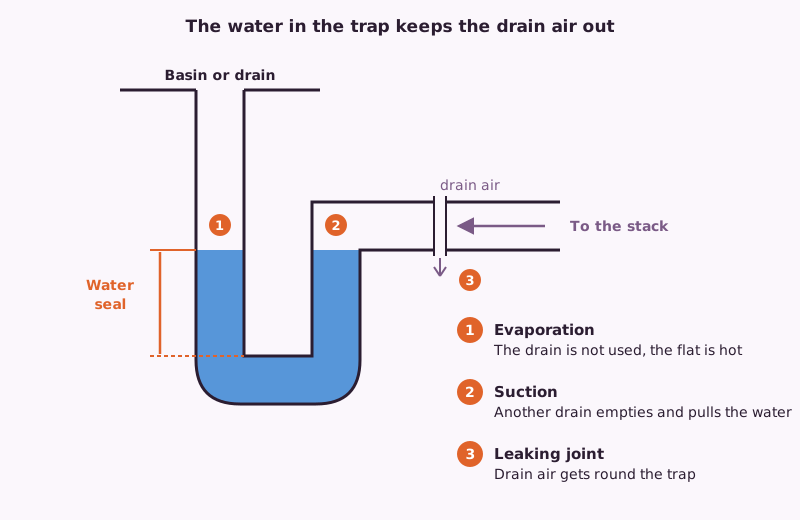
So the smell gets in three ways: the water dries up, suction pulls it out, or drain air slips round the trap through a bad joint.
#Find the source, most likely first
Before you start, note where the smell is strongest and when it appears: all the time, after someone flushes, when the AC starts, after a holiday. Then go down this list.
If the smell started right after building work, start at the end: check what the contractor left open (last step) and the WC and drain seals, then come back to the top.
- Dry traps. Run every tap, shower and bath for a few seconds, flush every WC, and pour a jug of water into every floor drain, including the kitchen, laundry and balcony ones. Do not forget the guest bathroom and the bidet. Wait a day. If the smell is gone, a trap had dried out. The Dubai code tries to prevent this by connecting floor drains to a basin waste or an AC drain, but if the basin is never used, both dry out together.
- Suction (siphoning). Fill the basin, then let the bath out or flush the WC and listen. Gurgling from the basin, or a trap that is half empty afterwards, means another discharge is sucking its water out. England's guidance says branch pipes longer or steeper than its limits need a vent pipe or an air admittance valve, a one-way valve that lets air in. A plumber can fit one on your branch. If every flat on the stack gurgles, the stack's venting is the problem.
- Dirty traps and overflows. Slime and hair in a shower drain or the overflow channel of a basin smell like drains but are not. Lift the grate, pull out the hair, clean the trap and flush the overflow with hot water.
- Seals. Smell at the base of the WC, worse after a flush, points to the pan connector. Smell around a shower drain points to the joint between the drain body and the tray or waterproofing. Check slip nuts on basin and sink traps by hand. A smoke pencil at the gaps of a pipe boxing, with the extract fan on, shows whether air is coming out of it.
- Washing machine and dishwasher. Their waste needs a trap too: England's guidance gives a 75 mm seal. A hose pushed into an open pipe with no trap below it, or into a standpipe that has dried out, lets drain air straight in. Check how the hose is connected, not just the machine.
- Air conditioning drain. If the smell comes from a ceiling grille when the AC starts, the condensate trap of the fan coil may be dry, or the condensate pipe may have been plumbed straight into a waste pipe. The Dubai code sends AC condensate into a trapped tundish or a floor gully with an air gap, never straight into a waste pipe. This is a job for FM or your AC maintenance contractor; see AC drain problems.
- The stack and its vents. Smell in several rooms, in the corridor or in the neighbours' flats, a blocked roof vent or a stuck air admittance valve: these belong to the building. In a tower, report it to FM.
- Leftovers from renovation. An old waste pipe left open behind a new kitchen unit or under a raised floor, a trap left out, a floor drain tiled over. If the smell started after works, ask the contractor what they disconnected. A smoke machine test finds open pipes behind finishes.
| Smell | Most likely | First check |
|---|---|---|
| After a holiday, everywhere | Dry traps | Run water in every drain |
| In a room nobody uses | Dry floor drain or shower | Pour water in, wait a day |
| When the bath empties or the WC flushes | Suction from another drain | Listen for gurgling at the basin |
| At the base of the WC | Pan connector seal | Smell at the base right after a flush |
| From the shower drain only | Slime in the trap | Clean the grate and trap |
| Behind the washing machine | Hose with no trap or a dry standpipe | How the hose enters the pipe |
| From a ceiling grille when the AC starts | Dry condensate trap | FM or AC contractor |
| Several rooms, neighbours too | Stack or roof vent | Report to FM |
#What goes wrong
- Covering a floor drain with tape or silicone. In many UAE bathrooms the basin or AC drain runs into it. Seal it and a leak has nowhere to go.
- Air fresheners instead of a fix. The smell comes back, and drain gas keeps coming in.
- A washing machine hose sealed airtight into the pipe. No trap and no air gap.
- A trap removed because it kept blocking, with a straight pipe in its place.
- An air admittance valve boxed in with no access. England's guidance and the Dubai code both want them reachable for maintenance.
- Ignoring gurgling. Every time someone empties the bath, the trap loses water.
#How to check the work
- Every drain has water in its trap, including unused ones.
- No gurgling at any basin when the bath empties or the WC flushes.
- The smell has not come back after a few days of normal use.
- The washing machine and dishwasher drain through a trap.
- No open pipe ends behind units, panels or in the ceiling.
- Any air admittance valve can be reached without breaking finishes.
- Floor drains are open, clean and wet.
#When to call a professional
- A plumber for pan connectors, shower drain joints, missing traps, washing machine connections, and a vent or air admittance valve on your branch.
- FM for anything in the shared stack, the roof vents, the shafts and the corridor, and when neighbours smell it too.
- FM or your AC maintenance contractor for the fan coil's condensate trap. Who that is depends on the building (see below).
- A contractor with a smoke machine, arranged through FM in a tower, when the simple checks found nothing. See smoke tests.
If the cause turns out to be a bad pan connector or a missing trap left by an earlier refit, the fix usually means opening tiles. Plan it in Librae as part of the bathroom works: the area of tiles to lift and relay comes from the plan, and the job goes to a contractor whose licence Librae has checked.
#In the UAE
Who fixes what. In a tower, the pipes, traps and fittings inside your unit are usually yours to maintain. Emaar's rules for Downtown Dubai towers put the unit's plumbing and drainage on the owner and recommend inspections at least twice a year. Dubai Holding Community Management's rules make common-area plumbing the community's responsibility. The stack, the roof vents and the shafts are common parts, so smells coming from them go to FM. A tenant reports to the landlord or FM. If water is coming through your ceiling as well, see leaks from the flat upstairs.
Floor drains everywhere. The Dubai code puts a floor drain in every room with wet fittings, including kitchens. To stop them drying out, it wants them fed by a basin or an AC drain, or fitted with an automatic trap primer. A flat left empty through the summer, with the AC off, is where you meet a dry trap.
AC drains. Fan coils drain condensate into the sanitary system through a trap. When the trap dries, the smell comes out of the AC grille. Inside the flat the fan coil is often the owner's to maintain: Emaar's Downtown tower rules make the owner responsible for the unit's AC, and Dubai Holding Community Management requires owners to keep a contract for quarterly servicing of fan coil units with an approved supplier. Ask FM which applies to your building.
Changing the plumbing. Moving a WC or a shower drain, or adding fixtures, usually needs the building's or developer's approval first. Emaar's tower rules require prior written approval for new fixtures or rerouted pipes.
#What the codes say
- Approved Document H (England) 2015: traps at every discharge point (1.3); 25 mm minimum seal in use (1.3); Table 1 seal depths 75 mm and 50 mm (1.4); venting of long or steep branches and air admittance valves (1.19–1.20, 1.33); ventilated stacks to protect trap seals (1.29).
- Dubai Building Code 2021: foul air kept out and seals maintained (H.6.2.1–H.6.2.2); AC condensate via trapped tundish or floor gully (H.6.2.3); floor drains in wet areas with a 75 mm seal, fed against evaporation or primed (H.6.2.4; K.10.3.2.3 for villas); air admittance valves accessible (H.6.2.5).
- Emaar Downtown vertical community rules (2026), 7.8 and 7.9; DHCM community rules (October 2026), 7.1 (7.1.3 for fan coil servicing).
This guide explains good practice and cites the documents listed below. It is not a permit, a design approval or an engineering opinion. Work on electrical, gas, fire-safety and structural elements must be carried out by licensed professionals and approved by the relevant authority.
Sources
- Approved Document H (England), 2015 edition, H1 paragraphs 1.3–1.5, Table 1, 1.19–1.20, 1.29, 1.33 — Every discharge point needs a trap; seals keep at least 25 mm under working conditions; minimum seal depths 75 mm (basin, bidet, sink, washing machine, dishwasher) and 50 mm (bath, shower, WC); branch pipes longer or steeper than Table 2 need venting or an air admittance valve; stacks ventilated so traps keep their seals; air admittance valves accessible, not in dusty air.
- Dubai Building Code 2021, Part H, H.6.2.1–H.6.2.5 (pp. 606–610), and Part K, K.10.3.2.3 (p. 830) — Drains must keep foul air out and trap seals maintained in use; AC condensate drains indirectly via a deep-seal trapped tundish or floor gully; floor drains in all wet areas, seal at least 75 mm, fed by a fitting or AC condensate to stop evaporation, otherwise an automatic trap primer; air admittance valves accessible for maintenance.
- Emaar Community Management, Community Rules and Regulations for Vertical Communities, Downtown Dubai (January 2026), 7.8 Plumbing and Drainage, 7.9 Air Conditioning Maintenance — Owner maintains the unit's plumbing and drainage at own cost; prior written approval for significant plumbing changes such as new fixtures or rerouting; inspection at least twice a year recommended; owner maintains the unit's AC system.
- Dubai Holding Community Management, Community Rules and Regulations (1 October 2026, v3), 7.1 and the residents' responsibilities table — Owners keep plumbing in their property in repair; owners keep a contract for quarterly servicing of AC ducts and fan coil units with an approved supplier (7.1.3); plumbing in common areas is the community's responsibility; residents arrange repairs inside their property.