
Bathrooms and wet areas/Global · UAE
Mould in the bathroom and behind furniture: causes and removal
Why mould grows on bathroom ceilings, round AC grilles and behind wardrobes, how to clean it safely, and how to stop it returning in an air-conditioned home.
Mould grows on any surface that stays damp, and household dust gives it all the food it needs. So the fix has two parts: clean off what is there, and stop the surface getting wet. In a bathroom the water is shower steam that does not leave fast enough. Behind furniture and around AC grilles it is usually condensation: room air meets a surface colder than its dew point. In an air-conditioned UAE flat those cold surfaces are the AC grilles, ducts and chilled-water pipes, plus anything that humid outside air reaches.
#Why a surface gets damp
Air holds water vapour. Cool it far enough and the vapour turns to water. That temperature is the dew point, and the more humid the room, the higher it is:
| Room air | Dew point | Surface reaches 75 % humidity at |
|---|---|---|
| 24 °C, 50 % (Dubai design) | about 13 °C | about 17 °C |
| 24 °C, 60 % | about 16 °C | about 20 °C |
| 24 °C, 70 % | about 18 °C | about 23 °C |
A surface does not have to drip. The WHO's review found that mould generally does not grow below about 75–80 % humidity at the surface. So a wall or ceiling only a few degrees colder than the room is already at risk, and the more humid the room, the smaller the margin.
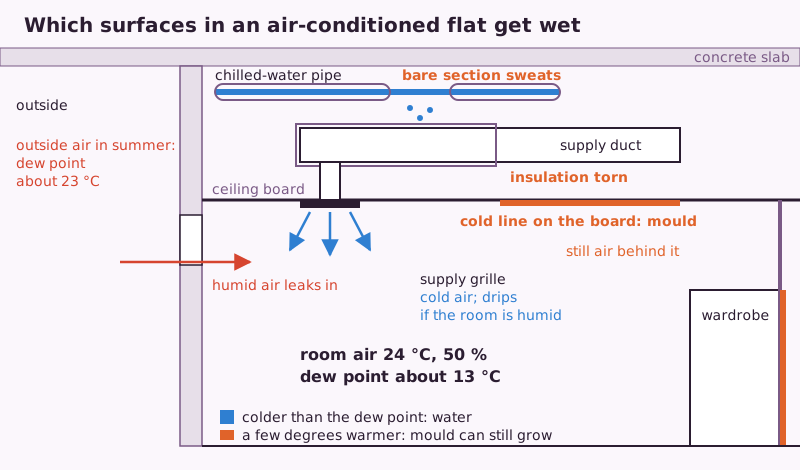
In a European winter the cold surface is the outside wall. Furniture against it keeps the warm room air off the wall, so the wall behind it gets colder still. That is the classic mould behind a wardrobe, and UK guidance tells you to leave a gap between furniture and outside walls.
In an air-conditioned flat it runs the other way. The cold parts are inside: the supply grilles, the ducts and chilled-water pipes above the ceiling, and the board around them. The WHO names cold water pipes and cool parts of air-conditioning as typical spots where surfaces drop below the dew point. It also describes the hot-climate case: humid outside air leaks in through gaps and condenses on surfaces the AC has cooled.
Outside air in a Dubai summer is very humid. The Dubai code sizes air conditioning for 46 °C outside with a wet-bulb temperature of 29 °C. That air has a dew point of about 23 °C, almost room temperature. Let it in and it condenses on anything the AC has cooled below that.
#Where to look, and what it usually means
| Where the mould is | Usual cause | What to do |
|---|---|---|
| Bathroom ceiling and top corners | Steam does not leave fast enough | Check the extract: bathroom ventilation |
| Silicone round the bath, shower or basin | Silicone stays wet; mould grows into it | Cut out and replace the silicone |
| Round a supply grille or diffuser | Humid room air meets cold air; grille loose | Doors shut; FM or AC company checks the grille |
| A line or patch on the ceiling away from grilles | Duct or chilled-water pipe above with torn insulation, or a slow leak | FM or AC company: see AC leaking water |
| Behind a wardrobe or bed on a wall next to a bathroom or kitchen | Water in the wall: a leak or failed waterproofing | Find the leak before cleaning |
| Behind furniture on an outside wall (UAE) | Humid outside air through gaps; still air behind the furniture | Seal gaps round windows and pipes; move the furniture out a little |
| Inside cupboards, on clothes, shoes and leather | Humidity rose, often while the AC was off for weeks | Dry the room with the AC; air the cupboards |
Two checks tell you a lot. First, buy a cheap hygrometer and watch the humidity for a few days. If the room sits above 60 %, the air is the problem. Second, if the patch is on a wall that shares plumbing or a shower, or the ceiling under a bathroom, look for a leak first; see leaks from the flat upstairs.
#How to clean it
How much is DIY. The US EPA puts the limit for doing it yourself at about 10 square feet, roughly 1 m². UK government guidance says much the same: occupants can deal with condensation and very small patches, larger areas need professionals. For more than that, or if anyone at home has asthma or a weak immune system, get it done professionally.
Protect yourself. The EPA suggests an N-95 mask, gloves, and goggles without vent holes. Do not touch mould with bare hands.
Hard surfaces (tiles, glass, painted walls in good condition, metal grilles):
- Scrub with detergent and water. UK guidance prefers a mould and mildew product to bleach; the EPA does not recommend bleach as routine.
- Never mix bleach with other cleaners. The fumes are toxic.
- Dry the surface completely.
- Fix the cause the same week, or it comes back.
Porous materials (plasterboard, ceiling tiles, carpet, silicone, unsealed wood): the EPA says they may have to be thrown away. Mould grows into them, and a spray only cleans the face. In practice, mouldy silicone is cut out and redone, and plasterboard that is stained through, soft or keeps coming back is replaced.
Wet after a leak: dry it within 24–48 hours, before mould starts, the EPA says. Do not close up or paint a wet ceiling.
Never paint over mould. The EPA says plainly: do not paint or caulk mouldy surfaces. Clean, dry, find the cause, then paint.
#How to stop it coming back
- Keep humidity down. The EPA's target is below 60 %, ideally 30–50 %. Dubai flats are designed for 24 °C and 50 %.
- Keep doors and windows shut while the AC runs. The WHO notes that most moisture gets into a building with incoming air, and in a UAE summer that air is very humid.
- Run the bathroom extract during the shower and after it until the mirror clears. How much air it should move and who owns it: bathroom ventilation.
- Do not switch the AC off for weeks in summer. With the AC off, indoor humidity follows the outside air. Ask FM what your building recommends while you are away.
- Get the insulation fixed. The Dubai code requires chilled-water pipes and supply ducts to be insulated precisely so they do not sweat. A brown line on the ceiling along a duct often means that insulation has failed or something above is leaking.
- Let air reach the walls. Pull wardrobes and beds a little off the wall, especially outside walls and walls with a shower behind them, and do not pack cupboards solid.
- Clean more often. The EPA's advice for bathroom mould is simple: more ventilation and more frequent cleaning. Dust is what mould feeds on.
Anti-mould paint has a film tested to resist fungal growth. Jotun's data sheet for Fenomastic Hygiene, a paint sold in the UAE, cites the BS 3900 Part G6 test. It helps on a bathroom ceiling that gets damp for half an hour a day. It does nothing about a surface that is wet all the time. More on paint in painting walls.
#What goes wrong
- Painting over it. It comes back through the new paint within weeks.
- Bleach on plasterboard. The face goes white, the board stays mouldy inside.
- Cleaning without finding the water. The patch returns in the same place.
- A stronger fan in a bathroom with the door sealed. No air can come in, so little goes out. See bathroom ventilation.
- Cutting duct or pipe insulation to fit lights in a new ceiling. The bare section sweats onto the new board.
- AC off all summer in an empty flat. You come back to mould in the cupboards.
- Closing a ceiling that is still wet after a leak.
#How to check the work
- You know the cause: steam, a cold surface, a leak or humid air.
- Indoor humidity, measured over a few days, is below 60 %.
- Mouldy silicone and board were replaced, not painted.
- Ducts and chilled-water pipes above the ceiling have continuous insulation with no bare sections (look through the access panel).
- The bathroom extract pulls a tissue against the grille, and the mirror clears after a shower.
- Furniture stands a little off walls where mould was.
- Two to four weeks on, the cleaned area is still clean.
#When to call a professional
- FM: mould near AC grilles, along ceilings, around ducts or pipes, or from a leak above; anything on the building's extract or risers.
- Landlord, if you rent: report it in writing with photos before you clean.
- AC company: your own fan coil or ducts, insulation repairs, a grille that leaks cold air.
- Mould remediation contractor: more than about 1 m², mould inside ceilings or walls, or after a flood.
- Doctor: if someone at home has breathing problems that get worse indoors.
If the fix means new ceiling board, insulation repairs and a fan, treat it as a small renovation rather than a cleaning job. Plan it in Librae: the first estimate lists each item, from taking down the damaged board to waste removal, and the contractor sees the damage on a free inspection visit before agreeing it.
#In the UAE
- Responsibility. WHO puts it simply: building owners are responsible for construction and maintenance, occupants for how they use water, ventilation and appliances. In a tower, insulation on shared pipes, the risers and the building's extract are FM's; how you use the AC, the bathroom fan and the balcony door is yours.
- During a renovation this is the time to fix causes: replace stained ceiling board with moisture-resistant board in the bathroom (see plasterboard types), repair duct and pipe insulation before the new ceiling goes up (see order of works), and fit your own extract fan where the bathroom has only a passive grille. Put the fan in the renovation application.
- Coastal flats. The WHO notes that dampness is much worse in coastal areas than the national average, so a balcony door left open or a leaky window seal shows up faster as mould near the grilles.
#What the codes say
- WHO guidelines for indoor air quality: dampness and mould (2009): no acceptable level, prevent and remediate (executive summary); cold surfaces including cool AC parts (executive summary); humid outside air condensing on AC-cooled surfaces, too little dehumidification (pp. 36–37); no mould growth below about 75–80 % surface humidity (p. 38).
- Dubai Building Code 2021: design 46 °C dry bulb and 29 °C wet bulb outside, 24 °C ± 1.5 °C and 50 % ± 5 % inside (Tables H.1–H.2); chilled-water pipes and supply ducts insulated against condensation (H.4.8.4, K.10.1.5.4); pressurisation to limit condensation and mould (H.4.10.1); envelope must not promote surface condensation or mould (E.7.4).
- US EPA: humidity below 60 %, drying within 24–48 hours, about 10 sq ft as the DIY limit, bleach not a routine method.
- US National Weather Service: dew-point formulas used for the table and for Dubai's outside design air.
This guide explains good practice and cites the documents listed below. It is not a permit, a design approval or an engineering opinion. Work on electrical, gas, fire-safety and structural elements must be carried out by licensed professionals and approved by the relevant authority.
Sources
- WHO guidelines for indoor air quality — dampness and mould (WHO Regional Office for Europe, 2009), executive summary pp. xiii–xv, chapter 3 pp. 36–38 — Health effects, no acceptable level, water as the trigger and dust as food, cold surfaces including cool parts of AC units, worse dampness in coastal areas, humid outside air condensing on AC-cooled surfaces, no mould below about 75–80 % surface humidity, who is responsible for what.
- US EPA, A Brief Guide to Mold, Moisture and Your Home — Bleach not recommended as routine practice, detergent and water, drying within 24–48 hours, no painting over mould, porous materials replaced, about 10 sq ft as the limit for doing it yourself, N-95, gloves and goggles, humidity below 60 % and ideally 30–50 %.
- UK Government, Understanding and addressing the health risks of damp and mould in the home (updated 1 April 2026) — Mould and mildew products in preference to bleach, very small areas by occupants and larger ones by professionals, gap between furniture and external walls.
- Dubai Building Code 2021, Part H, Tables H.1–H.2 (PDF p. 567), H.4.8.4 and H.4.10.1 (p. 570); Part E, E.7.4 (p. 317); Part K, K.10.1.5.4 (p. 818) — Design conditions 46 °C dry bulb and 29 °C wet bulb outside, 24 °C and 50 % inside; chilled-water pipes and supply ducts insulated against condensation; envelope must not promote surface condensation or mould.
- US National Weather Service, Wet-bulb temperature and dewpoint from air temperature and relative humidity — Formula used for the dew points and surface humidities in the table.
- US National Weather Service, Relative humidity and dewpoint temperature from temperature and wet-bulb temperature — Formula used for the dew point of Dubai's design outside air (46 °C, wet bulb 29 °C, sea-level pressure), about 23 °C.
- Jotun, Fenomastic Hygiene Emulsion Matt, Technical Data Sheet (issue 06.06.2023) — Example of what "anti-mould" means on a data sheet sold in the UAE, resistance to fungal growth tested to BS 3900 Part G6. Not a recommendation.