
Tiles and wall finishes/Global
Flexible stone and MCM soft tile: what you are buying, how to fit it
Real stone veneer sheets, MCM "flexible travertine" and plastic imitations compared, plus surfaces, adhesives, corners and curves, showers and outdoor use.
"Flexible stone" is sold under one name but means three different things. The first is a thin sheet of real stone: 0.1–1.4 mm of split stone on a resin and glass-fibre backing. The second is MCM tile, also sold as soft tile or flexible travertine: modified clay or mineral powder, with no stone in it. The third is a plastic panel made to look like stone. All three are light and bend to some degree, but they stick differently and belong in different places. So first find out which one you have, then follow that maker's instructions to the letter.
#What you are buying
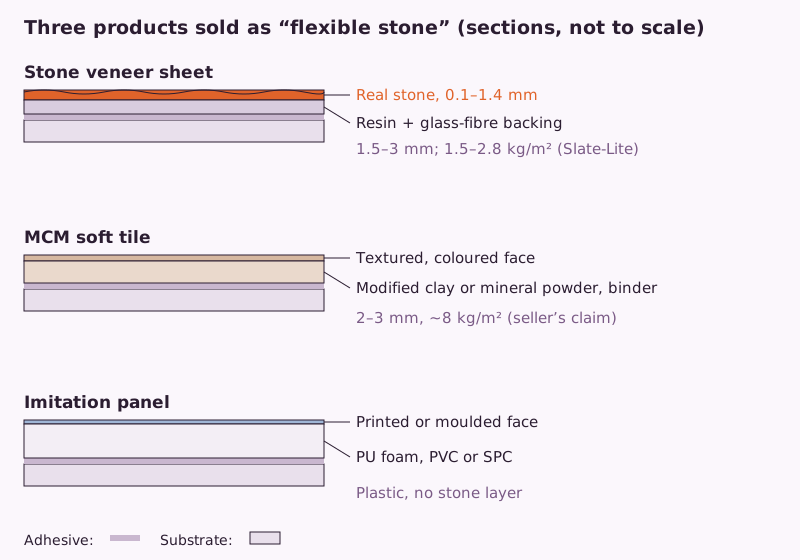
| Stone veneer | MCM tile | Imitation | |
|---|---|---|---|
| Also sold as | Flexible stone, bendable stone, thin stone sheet | Flexible travertine, soft stone, soft porcelain, flexible ceramic, MCM | Faux stone panel, PU stone, printed wall panel |
| Made of | A layer of slate, quartzite, sandstone, marble or limestone split from a block, on polyester or acrylic resin with glass fibre | Modified clay or mineral powder, as the makers describe it | Polyurethane foam, PVC or SPC |
| Face | Real stone, every sheet a little different | Moulded and coloured to look like stone | Printed or moulded plastic |
Ask the seller which one it is and for the maker's data sheet. A real stone veneer names the stone and the backing. MCM makers describe the material only in general terms, and not always consistently: one seller's page calls it both "modified inorganic powder" and "modified clay material". None of the MCM makers we checked publishes a full data sheet or test reports.
#Where it works, and where it does not
- Works well: feature walls, curved walls and columns, bulkheads, ceilings, doors and furniture. These are the places where tile would be too heavy or cannot follow the shape.
- Only if the maker allows it: showers and other wet walls, with the adhesive and sealer it names and a membrane behind; outdoor walls.
- Floors: no, or light home use at most. TXTR-LITE rules floors out, VersaLite allows light residential floors only, Slate-Lite keeps its limestone off them.
- Facades: only after a fire-safety check, because the fire classes these makers publish are for floors or for a fire-retardant version.
- Ceilings and anything overhead: possible, but give it to an installer who has fitted that exact product before.
#What to agree with the installer
Before work starts, settle these in writing:
- The exact product, with its data sheet and fitting guide: stone veneer, MCM or imitation, the product name, one batch for the whole job.
- The surface it goes on, and who prepares it.
- The adhesive the guide names for that surface and room, and a test piece on the real wall first.
- Joints and edges: butted or grouted, which grout, and which trim at cut edges and sharp corners.
- Curves: a test bend at the planned radius.
- Sealing: which sealer, and whether before or after fitting.
- In a shower: the membrane and its flood test come before the finish.
#Weight, bending and where it may go
| Stone veneer | MCM tile | For comparison | |
|---|---|---|---|
| Thickness | 1.5–2.0 mm (Slate-Lite); 2.0–3.0 mm (VersaLite) | 2.0–3.0 mm (Caron Stone, seller's claim) | Stone or porcelain tile: several mm to over 10 mm |
| Weight | 1.5–2.8 kg/m² (Slate-Lite) | About 8 kg/m² (Caron Stone, seller's claim) | 10 mm travertine about 25 kg/m²; 6 mm sintered stone 14.4 kg/m² |
| Sheet size | 1220 × 610 mm standard, up to 2600 × 1200 mm (Slate-Lite) | 1100 × 2300 mm (Caron Stone) | — |
| Bend radius | About 5 cm (Slate-Lite); about 20 cm, tighter with heat (VersaLite); 46 cm along the long side only (TXTR-LITE) | 200–300 mm, one seller's claim with no test behind it | Does not bend |
| Fire | Slate-Lite has a European floor class and a fire-retardant version | "Class A" or "fireproof" claims with no published reports | — |
| Sunlight | Slate-Lite is UV tested; TXTR-LITE says its stone face resists sun | Outdoor use claimed, no test data found | — |
| Floors | Light home floors only (VersaLite); no floors (TXTR-LITE); no limestone on floors (Slate-Lite) | Mainly walls | Floors |
Weight is the main reason to buy these products. A curved column, a ceiling, a door or a piece of furniture can take a stone face that a 25 kg/m² tile could not. The price is a thin wearing layer, a resin backing, and a bond that depends on the exact product and adhesive.
#The surface underneath
- Clean, dry, sound and flat. Every guide starts here. A thin sheet shows every bump, and Slate-Lite's split stone face already varies by up to 2 mm on its own.
- What it goes on. Veneer makers list plasterboard, cement board, plaster, wood-based boards and metal. For choosing the board, see drywall board types.
- Primer only if the adhesive maker asks for it. Some guides also ask you to clean or prime the back of the sheet for certain adhesives.
- Wet areas. The finish is not waterproofing. In a shower the membrane goes on first, as described in bathroom waterproofing. Then check with the adhesive maker that the adhesive sticks to that membrane.
- Temperature. Slate-Lite recommends working between 10 and 35 °C. In hot weather, work with the air conditioning on and keep the sheets out of the sun.
#Adhesive
Pick the adhesive from the product's own guide, then test it with a sample piece on the real wall.
| Product | Adhesives the maker names | Not to use |
|---|---|---|
| Slate-Lite | MS/hybrid polymer, polyurethane, epoxy and two-part adhesives; for factory lamination onto boards, one-part PU with a balancing sheet of at least 150 g/m² on the back of the board | — |
| VersaLite | One that suits the surface and the room; epoxy in wet areas | Contact adhesive |
| TXTR-LITE | Thick or foaming laminate adhesives, construction adhesives, thin-set where it can dry; epoxy is best in showers and bathrooms | Contact adhesive (the uneven back does not bond fully) |
| Specified Solutions | Heavy-duty polyurethane construction adhesive, solvent-free FRP adhesive, acrylic tile adhesive | — |
| MCM tile | Depends on the maker; Peiko describes a notched-trowel bed of 2–3 mm with more than 80 % contact, Caron Stone names C2 cement-based tile adhesive or epoxy | — |
Two rules from the veneer guides. VersaLite and Specified Solutions warn that adhesives which cure by drying or by moisture in the air may not cure properly between two surfaces that do not breathe, such as a sheet on a waterproofing membrane or on metal. And roll every sheet with a hand roller from the middle outwards to push the air out, but not so hard that you squeeze the adhesive out of the hollows.
#Layout, cutting and joints
- Lay it out dry. Stone veneer changes colour from sheet to sheet and batch to batch. Lay the whole wall out on the floor and mix the sheets so the colour runs evenly. Order everything from one batch.
- Decide on joints. Butt the sheets for an almost unbroken surface, or leave a grout joint for a tiled look. Outdoors, Specified Solutions recommends a joint between sheets.
- Cut. Veneer cuts with ordinary tools. Slate-Lite says normal DIY tools, TXTR-LITE metal shears, VersaLite also a wet saw or a carbide blade. For large jobs Slate-Lite and VersaLite recommend a diamond blade.
- Grout. Veneer makers name epoxy, ready-mixed acrylic or sanded grout. Peiko names its own joint filler or silicone for its MCM.
- Hide the edges. The backing shows at a cut edge. Cover it with a trim, or on a rounded corner simply wrap the sheet round it.
#Corners and curves
- Bend a test piece first. All three veneer makers ask for it, because the radius depends on the stone and the thickness.
- Bend it the right way. TXTR-LITE bends along its 4 ft length but not across its 2 ft width.
- Heat lets some products bend tighter; VersaLite mentions it. Use the maker's method and temperature.
- Outside corners on a column or a rounded wall can be wrapped in one piece if the radius allows. A sharp 90° corner needs a corner trim.
- Hold curves until they grab. A bent sheet wants to spring back. Keep it pressed with battens or tape that leaves nothing on the stone until the adhesive takes.
#Sealing and care
- Seal stone veneer. VersaLite must be sealed and recommends sealing before fitting, to keep adhesive and grout off the face. Slate-Lite uses a water-based impregnator indoors and a two-part PU sealer for busy areas and outdoors.
- Reseal. Specified Solutions advises resealing outdoor and wet-area work after 7 years.
- Clean with neutral cleaners. Acids eat into marble, limestone and travertine.
- Repair by replacing a sheet. A thin veneer cannot be ground or polished like solid stone.
#Showers and outdoors
- Showers: only where the maker allows. Use the adhesive it names, usually epoxy, its joints and its sealer, and keep the membrane behind. Slate-Lite keeps limestone out of wet areas.
- Outdoors: Slate-Lite, VersaLite and Specified Solutions allow it. Leave room for heat movement in the adhesive and joints, seal the face, and do not cover a wall that needs to dry out. Check the fire class before putting any of these on a facade. Many places restrict combustible cladding, and the only European classes these makers publish are for floors or for a fire-retardant version.
#Against real stone and porcelain
| Stone veneer | MCM tile | Stone tile, 10 mm | Porcelain tile | |
|---|---|---|---|---|
| Real stone face | Yes | No | Yes | No |
| Weight | 1.5–2.8 kg/m² (Slate-Lite) | About 8 kg/m² (seller's claim) | About 25 kg/m² for travertine | About 19 kg/m² at 9 mm (60 × 60 cm) |
| Curves | Yes, within the stated radius | Claimed | No | No |
| Floors | Light use only, or not at all | Mainly walls | Yes | Yes |
| Showers | With the right adhesive, sealing and a membrane | Depends on the maker | With a membrane | With a membrane |
| Published data | Data sheets with test references | Product-page claims | Stone test data | A product standard |
#What goes wrong
- Buying MCM as real stone. It may look right, but it is another material, and most of its properties are unpublished.
- Contact adhesive on an uneven stone back: hollow spots, then sheets that lift.
- An adhesive that cures by drying or air moisture, between two surfaces that do not breathe, such as a sheet on a membrane or metal. It never fully cures.
- No test bend, then a cracked stone face on a column.
- Limestone veneer on a floor or in a shower, or any veneer on a floor beyond what the maker allows.
- Unsealed stone in a kitchen or bathroom: oil, soap and water stain it.
- Mixed batches on one wall, with a visible change in colour.
- Treating it as waterproofing. The membrane goes behind the finish.
#How to check the work
- The data sheet and fitting guide for the exact product are on site, and you know which of the three it is.
- The adhesive matches the guide for that surface and room, and a test piece went up first.
- Sheets are fully stuck: tapping finds no hollow spots, and the edges do not lift.
- Curves are within the stated radius, with no cracks in the stone.
- Joints and edges are finished as planned, with no backing showing at cuts.
- The stone is sealed with the sealer the maker names, and the date is written down.
- In a shower, there is a membrane behind it and a record of its flood test.
- One batch across the wall, and the colour variation looks even.
#When to call a professional
For a shower, a facade, a ceiling, or anything above head height where a falling sheet could hurt someone, use an installer who has already worked with that exact product. A facade also needs a fire-safety check by a qualified designer against local rules. A feature wall indoors is a fair job for a careful owner following the guide, as long as a test piece goes up first.
Agree the sheet layout on the plan before ordering: joints and cuts decide how many sheets you buy. Librae computes the wall areas from the plan, and the installer visits for free to check the walls and the plan on site, then agrees the estimate before any sheets are ordered.
#What the codes say
For readers who want to know where the numbers come from.
- Slate-Lite fire class is given under the European system EN 13501-1: Cfl-s1, which is a floor class, not a wall class. Under the German DIN 4102 it is B1. The fire-retardant version is C-s3,d0. No wall class is published for standard veneer.
- Sunlight. Slate-Lite is tested to DIN EN ISO 11507 (UV-B).
- Stone weight for comparison is worked out from a travertine density of 2.47 g/cm³, measured to EN 1936.
- Porcelain tile is made to the product standard EN 14411.
- MCM. In China this kind of tile falls under the industry standard JG/T 311-2011. We found no test reports from makers under it or under fire rules.
This guide explains good practice and cites the documents listed below. It is not a permit, a design approval or an engineering opinion. Work on electrical, gas, fire-safety and structural elements must be carried out by licensed professionals and approved by the relevant authority.
Sources
- Slate-Lite datasheet, English (R&D GmbH, Germany) and Slate-Lite Translucent datasheet — Construction (0.1–1.4 mm stone on polyester and glass fibre), 1.5–2.0 mm, 1.5–2.8 kg/m², sizes, fire class Cfl-s1 and FR version C-s3,d0, UV test, adhesives, limestone warning, sealing, tools, 10–35 °C.
- Slate-Lite datasheet 2021 (exhibitor literature, International Builders' Show) — Bend radius approx. 5 cm, large formats up to 2600 × 1200 mm.
- Richter Revo VersaLite Stone Veneer product and installation sheets — 2.0–3.0 mm, indoor and outdoor, light residential floors only, epoxy adhesive in wet environments, no contact adhesive, sealing, bend radius and heat.
- TXTR-LITE stone veneer specification sheet — 18 in bend radius along the long side only, not for floors or countertops, epoxy in showers, metal shears, no contact adhesive.
- Specified Solutions, Installation Guidelines — Stone Veneer Surfaces — Interior, exterior and wet-area use, recommended adhesive types, dry fitting, hand roller, grout types, joints outdoors, resealing.
- Hubei Peiko, MCM flexible tile product page — MCM composition claim (modified mineral powder), notched trowel, 2–3 mm adhesive bed, more than 80 % coverage, joint fillers.
- Caron Stone, MCM flexible soft stone veneer, travertine texture (seller's product page) — Seller's claims without test references — 1100 × 2300 mm, 2.0–3.0 mm, about 8 kg/m², radius 200–300 mm, "Class A", C2 cement-based or epoxy adhesive.
- JG/T 311-2011 Flexible tile for building decoration (China), standard abstract — Chinese industry standard (in force since 1 August 2011) for flexible facing tile made mainly of polymers and inorganic aggregate, mainly as the finish of external wall insulation systems.
- Silver Tumbled Travertine technical data (Mandarin Stone) — Travertine apparent density 2.47 g/cm³ (EN 1936), so 10 mm weighs about 25 kg/m².
- Neolith sintered stone technical data sheet — Sintered stone 6 mm = 14.4 kg/m², 12 mm = 28.8 kg/m².
- Agrob Buchtal, series Like, porcelain stoneware tile 430652 (60 × 60 cm, 9 mm), article data — Porcelain tile weight for comparison, about 19 kg/m² at 9 mm.