
Floors/Global · UAE
Large-format porcelain floor tiles: base, adhesive, clips and joints
How 60×120 and 120×120 porcelain goes down on a floor without hollows or lips — base flatness, adhesive class, back-buttering, levelling clips and joints.
Large porcelain tiles, 60×120 or 120×120 cm, go down like small ones, with no margin for error. Make the base flat first, use a class 2 deformable adhesive, and get full contact: adhesive combed on the floor and buttered on the back. Clips cannot fix a wavy base. Joints are at least 3 mm, with a movement joint at the walls and thresholds.
#UK or US numbers?
UK and US practice give different numbers for the same things. Rule of thumb: if your contract names a rulebook, use its numbers. If it names none, aim for the stricter figure in each row below and write the rulebook into the contract before tiling starts.
| UK (BS 5385-3, Tile Association) | US (TCNA, ANSI A108) | |
|---|---|---|
| Base flatness, tile edge 375 mm or more | Flat before tiling; no figure published | 3 mm over 3 m, 1.5 mm over 600 mm |
| Base flatness, smaller tiles | — | 6 mm over 3 m |
| Adhesive contact on floors | 100%, no voids; large tiles as near 100% as possible | 80% dry areas, 95% wet and exterior |
| Brick pattern | Large tiles may not suit it at all | Offset at most a third when a side is over 15 in (about 380 mm) |
| Floor joints | At least 3 mm | Brick pattern, side over 15 in: average at least 3 mm rectified, 4.5 mm calibrated, plus the tile's edge bow |
| Movement joints | Perimeter and thresholds; every 8–10 m indoors, 3–5 m outdoors; at least 6 mm wide | — |
#Old tiles: off or over?
Decide this first: it sets the floor height.
- Taking them off gives the lowest floor and shows you the screed. It is noisy and needs the building's permission.
- Tiling over is quicker and quieter. Mapei sells its deformable adhesive for laying on existing ceramic and marble. Tap every old tile and fix hollow or loose ones first. Degrease and clean. The floor rises by the new tile plus the bed, so check door bottoms, thresholds and where it meets other rooms.
In Emaar apartments the choice is made for you: the original developer tiles may not be removed, and new tiles go over them. You still need a Home Modifications NOC through the Emaar community portal, and the contractor needs an Emaar entry permit. Tiles a previous occupant laid may come out if you state it in the modification application and the neighbours below consent.
#The base: flat before anything else
A long tile bridges small dips: it rocks, sounds hollow and stands proud of its neighbour. The Tile Association also reminds you that a tile's own allowed bow grows with its size.
Use the US figures from the table, measured from the high points. The tiler lays a 2–3 m straightedge in several directions and measures the gaps. High spots are ground down; low areas are filled with levelling compound before tiling. Filling dips with thick adhesive gives an uneven bed, hollow spots and slow drying.
A new cement screed needs at least 3 weeks of curing before tiling, says Mapei.
#Adhesive
The EN 12004 code on the bag tells you what you are buying:
- C cement, D paste, R resin; 1 normal, 2 improved (stronger bond).
- F fast-setting, T reduced slip, E extended open time; S1 deformable, S2 highly deformable.
For large tiles the Tile Association asks for class 2, plus F, T, E, S1 or S2 as the job needs. On a floor that means C2 with at least S1; Mapei Keraflex Maxi, for instance, is labelled C2TE S1. Paste adhesives (class D) are not for porcelain or floors.
Mapei's limits for that adhesive: 5–35 °C, open time over 30 minutes in normal conditions, tiles adjustable for about an hour, bed up to 15 mm.
#Full contact: comb, butter, press
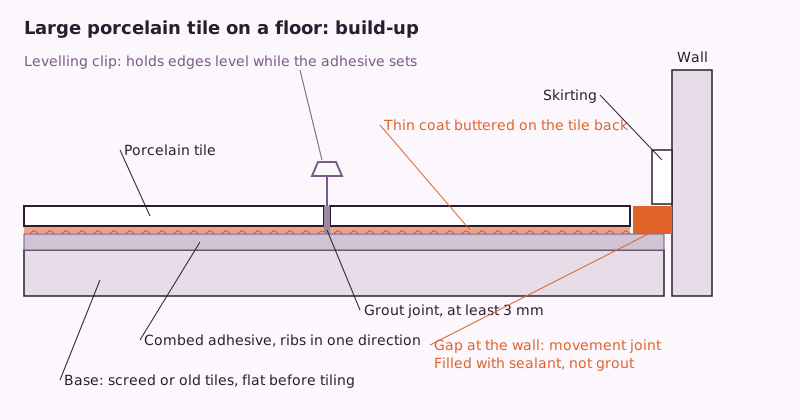
- Scratch coat. Press a thin layer into the base with the flat edge of the trowel, as Mapei asks, then comb on top.
- Comb in one direction. Straight ribs let the air out; swirls trap it. The Tile Association's large-format trowel has 20 mm round notches, 13 mm deep. US practice combs along the short side of the tile.
- Butter the back. A thin coat fills the texture of the back. The Tile Association asks for it on large tiles; Mapei on tiles over 300×300 mm, floors under heavy loads, outdoors and in pools.
- Press and slide. Bed the tile and slide it a little across the ribs so they merge into one layer.
- Lift one and look. Among the first tiles of the day, lift one. Stripes of bare tile on the back mean a different notch or technique.
Never "dot and dab". Five blobs under a large tile give a floor that sounds hollow and cracks under a chair leg.
#Levelling clips
Clips go under the tile edges, and a wedge or cap pulls neighbouring edges to one height while the adhesive sets. Rubi, which makes them, spaces them about 150–200 mm apart along the edges.
Rubi itself says clips are no substitute for surface preparation and are not designed to take the bow out of a tile. The Tile Association notes there is no British Standard on clips.
Remove them once the adhesive has cured, usually after 24–48 hours per Rubi. Knock them off along the joint, not across it, or the tile edge chips.
#Joints and layout
- Width. At least 3 mm. Rectified tiles still vary slightly, and a 2 mm joint shows every difference. Grout choice and the full width rules are in tile grout.
- Brick pattern. Long tiles bow a little along their length. Offset by half, the high middle of one sits next to the low end of the next. Keep to a third or less, or choose another layout.
- Setting out. Start from the centre line of the main room or the line people see first, so cuts fall under furniture and in corners. Draw the room in Librae with this tile as the floor finish, and the 2D plan and the 3D view show where the cuts fall before a single tile is bought.
#Movement joints
Floors need them:
- Round the room, including door thresholds. The gap sits under the skirting and is filled with sealant, not grout.
- Over joints in the structure, carried through the tile and bed.
- Across large areas, at the spacing in the table.
- Where the base changes, for example from old tiles to new screed.
With underfloor heating, the Tile Association splits floors into bays of up to 40 m² with no side over 8 m.
#Handling and cure
9 mm porcelain weighs about 18 kg per square metre, so one 120×120 tile is about 26 kg. Carry and cut it with care; the 2024 edition of BS 5385-3 added a section on safe handling.
With Mapei's deformable adhesive the floor takes light foot traffic and grouting after 24 hours, and full use after 14 days.
#What goes wrong
- No back-buttering, swirled ribs. Voids under the corners; tiles ring hollow and crack.
- Adhesive with a skin. In heat the open time drops to minutes, and tiles pressed into a skin do not bond.
- Tiles tight to the wall. No room to move; tiles lift or crack in a line.
- Walking on it too soon. Tiles shift before the adhesive sets.
#How to check the work
Tapping, straightedge and lippage checks with their tolerances are in checking finished tiling. Specific to large tiles:
- The adhesive bag shows C2 with S1 or S2.
- You saw a lifted tile with a full back.
- No tile rocks, and joints are even and at least 3 mm.
- The gap at walls and thresholds is sealed, not grouted.
#When to call a professional
- The base is off by more than a few millimetres over 2 m: levelling compound or a screed, laid by someone who does it often.
- Tiles of 120×240 cm and larger, or porcelain 5.5 mm thick or less: hire a tiler who has laid them, and follow the tile maker's instructions.
- A floor already laid sounds hollow over large areas.
#Hot climates and the UAE
- Heat and sun. Mapei says sun, heat and drying wind can cut the open time from over 30 minutes to a few minutes, and asks for sun-heated surfaces to be cooled with water first. Tile with the AC on and curtains closed, mix small batches and check for a skin before each tile. If one forms, comb the adhesive afresh: water sprinkled on it leaves a film that stops the bond, Mapei warns. Mapei also asks for new tiling to be kept out of strong sun for 5–7 days.
- Removing old tiles. Emaar apartments are covered above. In other buildings, ask the community or FM whether removal is allowed and at what hours: breaking out tiles is the noisiest part of a renovation. Emaar's 2026 rules for Downtown towers allow power-tool noise only from 09:00 to 13:00 and 15:00 to 17:00.
- Control during the works. In the UAE, a renovation ordered through Librae can include independent quality control: a specialist checks the base on site before tiling and each stage after it.
#What the codes say
For readers who want to know where the numbers come from.
- UK practice is BS 5385-3, the code of practice for floor tiling, revised in May 2024. The figures here come from the Tile Association's 2020 guide (written against the previous edition) and its 2024–2025 notes on the new edition, which add external movement joints.
- Adhesive classes: EN 12004 (and ISO 13007-1); deformability S1 and S2 is tested to EN 12002.
- US practice: base flatness from TCNA guidance, coverage from the ANSI A108 standards, joints and brick-pattern offset from ANSI A108.02 clauses 4.3.8.1 and 4.3.8.2, tile warpage from ANSI A137.1, all as quoted by Laticrete and the Ceramic Tile Education Foundation. Laticrete quotes an older wording with an 18-inch (450 mm) threshold; the Foundation's 2025 note quotes 15 inches.
This guide explains good practice and cites the documents listed below. It is not a permit, a design approval or an engineering opinion. Work on electrical, gas, fire-safety and structural elements must be carried out by licensed professionals and approved by the relevant authority.
Sources
- The Tile Association, Tiling Guide (2020), sections 4, 5, 8, 9, 10, 11, 13 — Adhesive classes; large-format trowel; solid bed and 100% coverage on floors; floating and buttering; ribs in one direction; no British Standard on levelling clips; brick bond caution; movement joints at perimeter, thresholds and 8–10 m, at least 6 mm; joints at least 3 mm; heated floors in bays up to 40 m².
- The Tile Association, updates to BS 5385 Part 3 (2 August 2024) — BS 5385-3:2024 published 30 May 2024; external movement joints at 3–5 m; new section on safe handling.
- Tilezine (TTA), External floor tiling incorporating movement joints (30 January 2025) — Floor tile joints never less than 3 mm; normal working temperatures 5–25 °C.
- Mapei Keraflex Maxi, technical data sheet (UK) — Class C2TE S1; bed up to 15 mm; laying on existing ceramic and marble floors; back-buttering; open time over 30 min, shorter in sun and heat; 5–35 °C; grout floors after 24 h; light traffic 24 h; full use 14 days; screeds cured at least 3 weeks.
- Laticrete TDS 164, Lippage – Causes and Prevention — TCNA base flatness (3 mm in 3 m, 1.5 mm in 600 mm for tiles with an edge of 375 mm or more); ANSI A108.02 joints and 33% offset in brick patterns; ANSI A137.1 warpage.
- Ceramic Tile Education Foundation, How to select the right trowel notch (updated 11 October 2022) — ANSI A108 coverage 80% in dry areas, 95% in wet and exterior areas; lift a tile to check; trowel ridges along the short side.
- Ceramic Tile Education Foundation, Offsets, grout joints and customer expectations (6 May 2025) — ANSI A108.02 4.3.8.1 and 4.3.8.2 as currently quoted — tiles with a side over 15 in; offset at most 33%; average joint 1/8 in rectified, 3/16 in calibrated.
- Rubi, Mastering levelling clips (10 February 2025) — Clips are no substitute for surface preparation and do not remove tile bow; spacing; removal after the adhesive cures, along the joint.
- BAL on changes to BS 5385-1 (26 July 2018) — 9 mm porcelain weighs about 18 kg/m².
- Emaar Community Management, Home Modifications fact sheet (2022) — Apartments may not remove existing tiles; new tiles may be laid over them; refurbishments need a NOC; contractors need an entry permit.
- Emaar Community Management, Formal Rules and Regulations, Verticals, Downtown Dubai (January 2026), section 4.1 — Power-tool noise in apartments only 09:00–13:00 and 15:00–17:00.