
Plumbing and water heating/Global · UAE
PPR pipes: fusion welding, fibre pipe and expansion
How PPR water pipes are welded, heating times by size, which pipe to use for hot water, and when a hot run needs room to expand. Notes for UAE homes.
PPR (polypropylene) water pipe is joined by heat, not glue or threads. The plumber heats the pipe end and the fitting socket on a tool at 250–270 °C for a set number of seconds, pushes them together straight, holds them still and lets them cool. Done right, the joint becomes one piece of plastic. Done wrong, it can hold for months and then leak inside the wall.
You usually see the new pipes for a day or two before the tiles go on. Below: what a good joint needs, which pipe goes on hot water, and when a hot run needs room to move.
#Which pipe goes where
PPR pipes come in pressure classes. The thicker the wall, the higher the class. Ekoplastik's manual is a typical example:
| Pipe | Used for | What to know |
|---|---|---|
| Plain PPR, PN10 | Cold water | Not for hot |
| Plain PPR, PN16 | Hot water | 8 bar at 60 °C |
| Plain PPR, PN20 | Hot water, heating | 10 bar at 60 °C, 8 bar at 70 °C |
| Fibre reinforced | Hot water | About 3× less expansion, welded like plain pipe |
| Aluminium stabilised | Hot water | About 3× less expansion, foil must be shaved off before welding |
Those pressures are rated for 50 years of service. Every pipe in the table is fine for cold water at 10 bar.
Two rules make life easier. Use reinforced pipe or PN20 for every hot line. And buy pipe and fittings from one maker: heating times and depths come from its table, and its warranty may depend on it. Ekoplastik, for one, guarantees only installations built entirely from its own parts.
#Welding a joint, step by step
This is socket fusion with a hand tool, the way pipes from 20 to 40 mm are joined in a flat. From 50 mm, Ekoplastik recommends a jig or a machine to keep the parts in line.
- Heat the tool. Fit the heater bushes for the pipe size and set 250–270 °C. Ekoplastik asks for a contact thermometer check, not just the indicator light. Wipe the bushes with a cotton rag.
- Cut square. Use pipe shears or a cutter, not a hacksaw. The pipe must stay round. A squashed end will not seat evenly.
- Chamfer the outer edge at 30–45°, especially on pipes over 40 mm. It stops the melt being pushed into a ridge.
- Shave aluminium pipe. On aluminium stabilised pipe, remove the outer plastic and the foil over the whole socket length with the maker's shaver. Fibre pipe needs no shaving.
- Mark the depth on the pipe. Ekoplastik says to stop about 1 mm short of the bottom of the socket, so the melt does not narrow the bore.
- Clean the pipe end and the socket. NIBCO's sheet asks for isopropyl alcohol of 70 % or more.
- Heat. Push the fitting onto the heater first, because its wall is thicker, then the pipe. Start counting when both are fully on. No twisting while heating; Ekoplastik allows a turn of up to 10° only to slide them on.
- Join. Pull both off and push the pipe into the fitting in one straight move, up to the mark. Do not twist. You have a few seconds to correct the line, then hold it still for 20–30 seconds.
- Let it cool for the time in the table before you put any load on it.
Times from aquatherm, which follow the German welding guideline DVS 2207-11. Ekoplastik's table gives the same heating times.
| Pipe, mm | Heating, s | Heating below +5 °C, s | Time to join, s | Cooling, min | Weld depth, mm |
|---|---|---|---|---|---|
| 20 | 5 | 8 | 4 | 2 | 14.5 |
| 25 | 7 | 11 | 4 | 2 | 16.0 |
| 32 | 8 | 12 | 6 | 4 | 18.0 |
| 40 | 12 | 18 | 6 | 4 | 20.5 |
| 50 | 18 | 27 | 6 | 4 | 23.5 |
| 63 | 24 | 36 | 8 | 6 | 27.5 |
Heat matters in both directions. Ekoplastik does not weld below +5 °C at all. On a very hot site, above 38 °C, NIBCO's sheet allows a slightly shorter heating time but never less than 80 % of the table value.
What a good joint looks like. NIBCO's sheet describes two beads of melt, one from the pipe and one from the fitting, visible and joined all the way round. The pipe and the fitting sit in one line. Missing bead on one side, a step, or a kink at the joint all mean redo.
Before water goes in. Ekoplastik says wait at least one hour after the last weld. Then pressure test the pipes before anything is closed up.
#Expansion: when the pipe needs room
Plastic grows when it gets hot, much more than copper. To work out by how much, multiply the pipe length by the temperature rise and by a coefficient. Ekoplastik designs with 0.12 mm per metre per degree for plain PPR and 0.05 for its reinforced pipes. Other makers publish other figures, so use the one for your pipe.
Ekoplastik's own example: a 10 m plain PPR run, laid at 20 °C, carrying water at 60 °C, gets 48 mm longer. The same run in reinforced pipe grows about 20 mm. aquatherm says its fibre pipe expands at least 75 % less than plain PP.
What that means in a home:
- Short runs in wall chases, the usual bathroom and kitchen branches in a flat, change direction every metre or two. The bends take up the movement. This is the common case and needs nothing special beyond the right pipe.
- Pipes in the floor build-up or above a false ceiling. Ekoplastik puts pipes inside floor and ceiling structures in flexible polyethylene sleeves, so the pipe can move and is protected.
- Long straight hot runs, such as risers or garage and roof runs in villas, need planning. Fixed clamps hold the pipe at chosen points. Between them the pipe must be free to slide, and each change of direction needs a free arm long enough to bend.
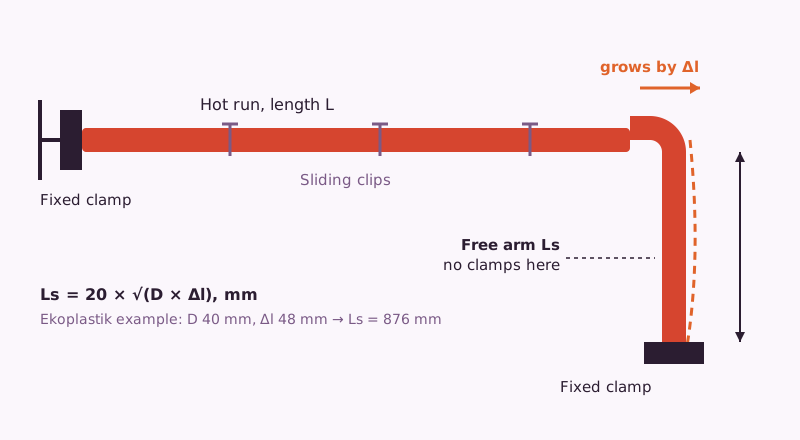
Ekoplastik sizes the free arm as 20 × √(pipe diameter × growth), all in millimetres. For a 40 mm pipe that grows 48 mm, that is 876 mm of pipe with no clamp on it. Where there is no room for an arm, an expansion U-bend or a compensator does the same job. Reinforced pipe can also be clamped rigidly inside a wall channel, with strong clamps, so the pipe takes the force instead of moving; Ekoplastik allows that for its reinforced pipes, not for plain PPR.
Take clip spacing from the maker's table. Clips go closer on hot lines, because warm pipe needs more support.
#Threads, bends and other metal parts
- Never cut a thread into PPR. Connections to taps, valves and meters use threaded fittings with metal inserts, sealed with PTFE tape or a thread sealant.
- No brazing next to a plastic joint. The heat travels along the metal into the fitting.
- No open flame or heat gun to bend pipe. Ekoplastik allows cold bending of 16–32 mm pipe at +15 °C or warmer, to a radius of at least eight times the diameter. Tight turns get an elbow.
#What goes wrong
- Twisting the pipe in the socket to line it up. It smears the melt and weakens the joint.
- Heating too long. The melt is pushed into the bore as a ring and narrows the pipe.
- Heating too short or joining too slowly. The surfaces have cooled before they meet: a cold weld that may hold the test and fail later.
- Pushing the pipe to the bottom of the socket. The ring of melt inside chokes the flow.
- Aluminium pipe not shaved, or shaved short. Water reaches the foil, or the weld forms on the outer skin only.
- Dirty or wet ends, a worn heater bush, or a heater below temperature.
- PN10 pipe on the hot side.
- Long hot runs clamped tight at both ends with no arm. The pipe bows between clips or pulls on the fittings.
- Mixing brands with different heating tables.
#How to check the work
Ask to see the pipework before the walls are closed:
- Hot lines are reinforced pipe or PN20, never PN10; the print on the pipe says so.
- One brand of pipe and fittings throughout.
- Every joint shows a full, even bead around it; no kinks, steps or scorched plastic.
- Pipes in the floor run in sleeves; long hot runs have free arms at bends.
- Threaded connections are metal-insert fittings, not threads cut in plastic.
- The pressure test was done after the welds cooled and is written down: pressure, time, drop, date. See pressure testing.
- Photos of all runs, with measurements from a wall corner, before tiling.
#When to call a professional
- Re-piping a bathroom or kitchen is plumber's work. A fusion joint gives no second chance once the tiles are on.
- Risers, pumps, a hot water return loop or anything on the building's side of your isolation valve belongs to the building's facilities management (FM) or a contractor they approve.
- A leak behind finished tiles: shut the water and call a plumber with leak detection gear before opening the wall.
Ask for the pipe route on the plan before the chases are cut. Once the route is on the Librae plan, the plumber can propose a different one but cannot redraw yours; a reroute happens only when you approve it. In the UAE, the joints and the pressure test can be checked before tiling by independent quality control, added to a renovation ordered through Librae.
#In the UAE
What you will find. PPR is the usual pipe in UAE homes. You will also meet CPVC, copper and PEX. In many towers the bathroom and kitchen branches run above the false ceiling and drop to the fixtures in wall chases, so the ceiling often has to open too. Where new PPR meets an old pipe of another kind, the joint is a threaded transition fitting, not a weld or glue.
Approvals for the pipe. The Dubai Building Code requires water pipework and fittings approved by WRAS or WRc, and hot and cold pipes insulated to BS 5422. Ask the supplier for the approval of the exact pipe and fittings.
Permission to reroute. Emaar's 2026 rules for its Downtown towers need written approval for significant plumbing changes, including rerouting pipes. Other communities set their own rules. Ask FM before the plumber starts, and see developer NOCs.
Hot water. The Dubai Building Code requires stored hot water to be kept at 60 °C or more, so hot lines get the hot-rated pipe from the table above. How the heater itself is connected: water heater installation.
Heat and sun. On a summer site above 38 °C, follow the hot-weather note in your maker's table instead of guessing. Keep pipe out of direct sun on site; UV discolours and damages PPR. Pipes on villa roofs and outside walls need covering or insulation.
#What the codes say
- DVS 2207-11 is the German guideline for heated tool welding of PP pipes. aquatherm states its heating times follow it; the guideline itself is a paid document and was not opened for this guide.
- EN ISO 15874 and DIN 8077/8078 are the pipe standards Ekoplastik names for its PPR products. Service classes (class 1 = 60 °C, class 2 = 70 °C, 50 years) come from ISO 10508.
- Dubai Building Code 2021: storage at 60 °C or more (H.5.10); WRAS or WRc approval of pipework and fittings, insulation to BS 5422, about 1.5 m/s pipe velocity and 1.5 bar at outlets (H.5.11).
This guide explains good practice and cites the documents listed below. It is not a permit, a design approval or an engineering opinion. Work on electrical, gas, fire-safety and structural elements must be carried out by licensed professionals and approved by the relevant authority.
Sources
- Wavin Ekoplastik, Ekoplastik System Installation Manual, 2014 edition, sections 3, 4, 8, 10.1–10.8, 11, 13, Tables 1–2 — Pipe classes and pressures at 60 and 70 °C, expansion coefficients and formulas with worked example, routing in floors and chases, threads, bending, fusion procedure at 250–270 °C, heating and cooling times, one hour before filling, UV protection.
- aquatherm GmbH, Welding parameters, aquatherm green (heated tool socket welding per DVS 2207-11) — Heating times by size, longer times below +5 °C, processing time, cooling time and welding depth for 20–125 mm.
- aquatherm GmbH, Frequently asked questions — Fibre composite pipe expands at least 75 % less than plain PP; UV discolours the pipe; up to six months unprotected outdoor storage.
- NIBCO / Webstone, PP-R Socket Fusion Instructions, form PPRSF-0417 (2017), based on the aquatherm Installer Manual, 3rd edition (2014) — Iron about 500 °F, cleaning with 70 % isopropyl alcohol, at least 80 % of table time above 100 °F, 5–15 s alignment window, no twisting, both beads joined.
- Dubai Building Code 2021, Part H, H.5.10 (p. 604) and H.5.11 Water services system installation requirements (p. 605) — Hot water stored at 60 °C or more; pipework and fittings approved by WRAS or WRc; insulation to BS 5422.
- Emaar Community Management, Formal Rules and Regulations, Verticals, Downtown Dubai (January 2026), section 7.8 — Written approval needed for significant plumbing alterations, including rerouting pipes.